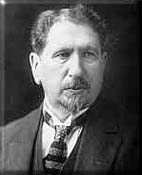
Nahum Sokolow was born in Wyszogrod, Russian
Poland in 1859 and received a traditional Jewish education. In
secular subjects he was an autodidact specializing in languages and
literature. He spoke German, French, Spanish and Italian as well as
English, Yiddish, Hebrew, Polish and Russian. By profession he was a
journalist writing for the Warsaw periodical HaTzefira. In
time he became the owner and editor of the periodical. He wrote a
number of books, one on Hebrew geography, another on anti-Semitism.
In 1901 he wrote a tract in which he attempted to convince religious
Jews that despite the secular leadership of the Zionist
movement, there was no ideological reason for them to oppose the
cause. Sokolow later translated Herzl's Altneuland into Hebrew giving it the title Tel-Aviv. In
1918 he wrote one of the earliest accounts of the history of Zionism
controversially beginning his study in the mid-seventeenth century.
Sokolow was not a member of the Hovevei
Zion movement even though his HaTzefira was Zionist in
orientation. Indeed when Herzl's "The Jewish State" was
published, Sokolow dismissed the Eretz-Israel option as an illusion.
However, Sokolow went through a metamorphosis and rallied to the
Zionist organization in particular after David
Wolffsohn, Herzl's successor called on him to become the
Secretary General of the World Zionist Organization. Sokolow held
this position from 1907-1909 but differences over the political
nature of Wolffsohn's Zionism led to a rift between the two men. In 1911, under a new
administration, Sokolow became responsible for the political
portfolio and tried to win support for the Zionist idea in particular
in the United States and in Britain. Just before the outbreak of the
First World War he had visited various Arab leaders but with the
outbreak of hostilities he moved to England where he worked closely
with Chaim Weizmann.
Sokolow became a key figure in the negotiations
for the Balfour Declaration when he met with French officials and won a pro-Zionist statement
from them in May 1917. He was received by Cardinal Gasparri, the
Papal Secretary of State, who assured Sokolow that Zionism need not
fear the Vatican. These missions elevated his status in the movement
as evidenced by the fact that at the Paris Peace Conference in 1919
he headed the Zionist delegation. In 1921, Sokolow was elected
Chairperson of the Zionist Executive during which time he traveled
extensively, putting the case of the movement before various
dignitaries including Mussolini. In 1931 following Weizmann's departure from the Presidency of the World Zionist Organization,
Sokolow assumed his mantle although he continued the policies of his
predecessor. When in 1935 Weizmann returned to the Presidency, Sokolow was elected honorary President
and assumed responsibilities in the newly formed Cultural Department.
He died in 1936. His remains were reinterred at Mt. Herzl, Jerusalem
in 1956.