Thomas Friedman
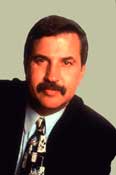
(1953 - )
Thomas Friedman was born in Minneapolis on July 20,
1953. After finishing high school in Minneapolis, he attended Brandeis
University, where he graduated Summa Cum Laude in 1975 with a degree
in Mediterranean Studies. During his undergraduate years, he spent semesters
abroad at the Hebrew University of Jerusalem and the American University
in Cairo. After completing his B.A., Mr. Friedman attended St. Antony's
College, Oxford University, on a Marshall Scholarship. In 1978, he received
a Masters degree in Modern Middle East Studies from Oxford and immediately
thereafter joined the London Bureau of United Press International (UPI).
Mr. Friedman spent a year in London doing general assignment
reporting before being dispatched to Beirut as a UPI correspondent.
He lived in Beirut from June 1979 to May 1981, when he was hired by
the New York Times and brought back to New York. From May 1981
to April 1982, Mr. Friedman worked as a general assignment financial
reporter for the New York Times, based in New York. He specialized
in OPEC and oil-related news. In April 1982, he was assigned by the New York Times to be its Beirut Bureau Chief, a post he took
up six weeks before the Israeli
invasion.
In June 1984, Mr. Friedman was transferred to Jerusalem,
where he served as the Times' Israel Bureau Chief until February
1988, when he was awarded a Guggenheim Foundation Fellowship to write
a book about his reflections on the Middle East. In June 1989, he published From
Beirut to Jerusalem, which was on the New York Times bestseller list for nearly 12 months and won the 1989 National Book
Award for non-fiction and the 1989 Overseas Press Club Award for the
Best Book on Foreign Policy. From
Beirut to Jerusalem has been published in more than 20 languages,
including Japanese and Chinese, and is now used as a basic textbook
on the Middle East in many high schools and universities.
In January 1989, Mr. Friedman accepted a new assignment
in Washington as the Time's Chief Diplomatic Correspondent. For
the next four years he traveled some 500,000 miles covering Secretary
of State James A. Baker 3d and the end of the cold war. In November
1992, Mr. Friedman shifted to domestic politics and was appointed Chief
White House correspondent. He covered the transition and first year
of the Clinton Administration.
In January 1994, Mr. Friedman shifted again, this time to economics
and became the Times' international economics correspondent,
covering the nexus between foreign policy and trade policy.
In January 1995, Mr. Friedman became the New York
Times Foreign Affairs Columnist. In 1998, Mr. Friedman wrote the
text to accompany Micha Bar-Am’s photographs for the book, Israel:
A Photobiography, published by Simon and Schuster. His book, The
Lexus and the Olive Tree: Understanding Globalization, issued by
Farrar Straus and Giroux in 1999, won the Overseas Press Club Award
for best nonfiction book on foreign policy in 2000. Longitudes and
Attitudes: Exploring the World After September 11, his most recent
book, was published by FSG in 2002.
For his coverage of the Middle East, Mr. Friedman was
awarded the 1983 Pulitzer Prize for international reporting (from Lebanon)
and the 1988 Pulitzer Prize for international reporting (from Israel).
He was awarded the 2002 Pulitzer Prize for Distinguished Commentary
for “his clarity of vision…in commenting on the worldwide
impact of the terrorist threat.”
Mr. Friedman lives in Bethesda, Md., with his wife,
Ann, and their two daughters. He is a member of the Board of Trustees
of Brandeis University and a member of the Advisory Board of the Marshall
Scholarship Commission. Mr. Friedman served as a Visiting Professor
at Harvard in 2000 and has been awarded honorary degrees from Brandeis,
Macalester, Haverford and Hebrew Union College.
Sources: Thomas Friedman and the New
York Times |