Leon Trotsky
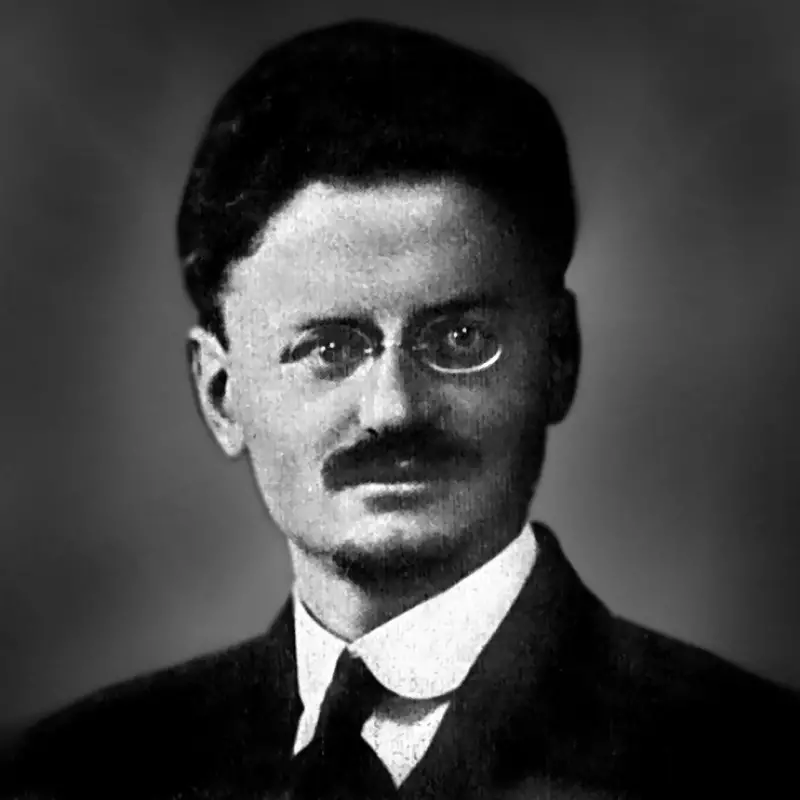
(1879 - 1940)
Leon Davidovich Trotsky (November 7, 1879 – August
21, 1940), born Lev Davidovich Bronstein, was a Bolshevik revolutionary
and Marxist theorist. An influential politician in the early days of
the Soviet Union, Trotsky
served as the People's Commissar for Foreign Affairs and the People's
Commissar of War and was the founder and commander of the Red Army.
He was also a founding member of the Politburo, the central policymaking
and governing body of the Communist Party of the Soviet
Union. Following a power struggle with Joseph
Stalin in the 1920s, Trotsky was expelled from the Communist Party
and deported from the Soviet Union.
Ramon Mercader assassinated Trotsky in Mexico in 1940. Trotsky's ideas
form the basis of the Communist theory of Trotskyism, which remains
a major school of Marxist thought theoretically opposed to Stalinism
and Maoism.
Childhood and Family (1879-1896)
Trotsky was born in Yanovka, Kherson Province, Ukraine on November 7, 1879. He was the fifth child of a wealthy but illiterate
Jewish farmer, David Leontyevich Bronstein and Anna Bronstein (d.
1910). Trotsky was born Lev Davidovich Bronstein, named after an uncle
who would, later that month, attempt to blow up the imperial railway
carriage. Although the family was ethnically Jewish, it was not religious,
and the languages spoken at home were Russian and Ukrainian instead
of Yiddish.
When Trotsky was nine, his father sent him to school
in Odessa. He was enrolled in a historically German school, which
became increasingly Russified during his years in Odessa due to the
government's policy of russification. While a good student, even in
his youth Trotsky was rebellious, organizing a protest against an
unpopular teacher in the second grade.
Revolutionary Activity & Exile (1896-1902)
Trotsky became involved in revolutionary activities
in 1896 after moving to Nikolayev. At first a narodnik, or
revolutionary populist, he was introduced to Marxism later that year
and gradually shifted towards Marxism. Instead of pursuing a mathematics
degree, Bronstein helped organize the South Russian Workers' Union
in Nikolayev in early 1897. Using the name 'Lvov' [2], he wrote and
printed leaflets and proclamations, distributed revolutionary pamphlets
and popularized socialist ideas among industrial workers and revolutionary
students.
In January 1898, over 200 members of the Union, including Trotsky,
were arrested. Trotsky spent the next two years in prison awaiting
trial. Two months after his arrest and imprisonment, the 1st Congress
of the newly formed Russian Social Democratic Labor Party (RSDLP)
was held. From that point on, Trotsky affiliated himself with that
party. While in prison, he married a fellow Marxist, Aleksandra Sokolovskaya,
and studied philosophy. In 1900 he was sentenced to four years in
exile in Siberia, where his first two daughters, Nina Nevelson and
Zinaida Volkova, were born.
It was in Siberia that Trotsky became aware of disagreements within
the party, which had been decimated by arrests in the last two years
of the 19th century. Some social democrats known as "economists"
were arguing that the party should concentrate on helping industrial
workers improve their lot in life. Others argued that overthrowing
the monarchy was more important and that a well organized and disciplined
revolutionary party was essential. The latter opinion was led by the
London-based newspaper Iskra, which was founded in 1900.
Bronstein quickly sided with the Iskra position.
First Emigration & Second Marriage
(1902-1903)
Trotsky escaped from Siberia in the summer of 1902,
having stolen a passport in the name of Leon Trotsky (a former
jailer in Odessa), which became his primary revolutionary pseudonym.
Once abroad, he moved to London to join Georgy Plekhanov, Vladimir
Lenin, Julius Martov and other editors of Iskra. Under the
penname Pero ("feather" or "pen" in Russian)
Trotsky soon became one of the paper's leading authors.
Unbeknownst to Trotsky, the six editors of Iskra were evenly
split between the "old guard" led by Plekhanov and the "new
guard" led by Lenin and Martov. Not only were Plekhanov's supporters
older (in their 40s and 50s), but they had also spent the previous
20 years in European exile together. Members of the new guard were
in their early 30s and had only recently come from Russia. Lenin,
who was trying to establish a permanent majority against Plekhanov
within Iskra, expected Trotsky, then 23, to side with the
new guard and wrote in March 1903 [3]:
I suggest to all the members of the editorial board that they
co-opt 'Pero' as a member of the board on the same basis as other
members. [...] We very much need a seventh member, both as a convenience
in voting (six being an even number), and as an addition to our forces.
'Pero' has been contributing to every issue for several months now;
he works in general most energetically for the Iskra; he gives lectures
(in which he has been very successful). In the section of articles
and notes on the events of the day, he will not only be very useful,
but absolutely necessary. Unquestionably a man of rare abilities,
he has conviction and energy, and he will go much farther.
Due to Plekhanov's opposition, Trotsky did not become a full member
of the editorial board, but from that point on he participated in
its meetings in an advisory capacity, which earned him Plekhanov's
enmity.
In late 1902, Trotsky met Natalia Sedova, who soon became his companion
and, from 1903 until his death, wife. They had two children together,
Leon Sedov (b. 1906) and Sergei Sedov (b. 1908). As Trotsky later
explained [4], after the 1917 revolution, “In order not
to oblige my sons to change their name, I, for "citizenship"
requirements, took on the name of my wife.” However, the
name change remained a technicality and he never used the name "Sedov"
either privately or publicly. Natalia Sedova sometimes signed her
name "Sedova-Trotskaya". Trotsky and his first wife, Aleksandra
Sokolovskaya, maintained a friendly relationship until Sokolovskaya
disappeared in 1935 during the Great Purges.
Split with Lenin (1903-1904)
After a period of secret police repression and internal
confusion that followed the first party Congress in 1898, Iskra succeeded in convening the party's 2nd congress in London in August
1903, with Trotsky and other Iskra editors in attendance.
The Congress proceeded as planned, with Iskra supporters
handily defeating the few "economist" delegates at the Congress.
Then the Congress discussed the position of the Jewish Bund, which
had co-founded the RSDLP in 1898, but wanted to remain autonomous
within the Party. In the heat of the debate, Trotsky made a controversial
statement to the effect that he and eleven other non-Bund Jewish delegates
who had signed an anti-Bund statement “ while working in
the Russian party, regarded and still do regard themselves also as
representatives of the Jewish proletariat.” As Trotsky
explained two months later, his statement was just a tactical maneuver
made on Lenin's request. [5]
Shortly thereafter, pro-Iskra delegates
unexpectedly split in two factions. Lenin and his supporters (known
as "Bolsheviks") argued for a smaller but highly organized
party. Martov and his supporters (known as "Mensheviks")
argued for a larger and less disciplined party. In a surprise development,
Trotsky and most of the Iskra editors supported Martov and
the Mensheviks while Plekhanov supported Lenin and the Bolsheviks.
The two factions were in a state of flux in 1903-1904
with many members changing sides. Plekhanov soon parted ways with
the Bolsheviks. Trotsky left the Mensheviks in September 1904 over
their insistence on an alliance with Russian liberals and their opposition
to a reconciliation with Lenin and the Bolsheviks. From that point
until 1917 he remained a self-described “non-factional social
democrat.”
Trotsky spent much of his time between 1904 and 1917
trying to reconcile different groups within the party, which resulted
in many clashes with Lenin and other prominent party members. Trotsky
later conceded he had been wrong in opposing Lenin on the issue of
the party. During these years Trotsky began developing his theory
of permanent revolution, which led to a close working relationship
with Alexander Parvus in 1904-1907.
The 1905 Revolution & Trial (1905-1906)
After the events of Bloody Sunday (1905), Trotsky
secretly returned to Russia in February 1905. At first he wrote leaflets
for an underground printing press in Kiev, but soon moved to the capital,
Saint Petersburg. There he worked with both Bolsheviks, like Central
Committee member Leonid Krasin, as well as the local Menshevik committee,
which he pushed in a more radical direction. A secret police agent,
however, betrayed the latter, in May. Trotsky had to flee to rural
Finland where he worked on fleshing out his theory of permanent revolution
until October, when a nationwide strike made it possible for him to
return to St. Petersburg.
After returning to the capital, Trotsky and Parvus
took over the newspaper Russian Gazette and increased its
circulation to 500,000. Trotsky also co-founded Nachalo ("The
Beginning") with Parvus and the Mensheviks, which proved to be
very successful.
Immediately prior to Trotsky's return to the capital,
the Mensheviks had independently come up with the same idea that Trotsky
had -- an elected non-party revolutionary organization representing
the capital's workers, the first Soviet ("Council") of Workers.
By the time of Trotsky's arrival, the St. Petersburg Soviet was already
functioning with Khrustalyov-Nosar (Georgy Nosar, alias Pyotr Khrustalyov),
a compromise figure, at its head and proved to be very popular with
the workers in spite of the Bolsheviks' original opposition. Trotsky
joined the Soviet under the name "Yanovsky" (after the village
he was born in, Yanovka) and was elected vice-Chairman. He did much
of the actual work at the Soviet and, after Khrustalev-Nosar's arrest
on November 26, was elected its Chairman. On December 2, the Soviet
issued a proclamation which included the following statement about
the Tsarist government and its foreign debts [6]:
The autocracy never enjoyed the confidence of
the people and was never granted any authority by the people. We have
therefore decided not to allow the repayment of such loans as have
been made by the Czarist government when openly engaged in a war with
the entire people.
The following day, December 3, the Soviet was surrounded
by troops loyal to the government and the deputies were arrested.
Trotsky and other Soviet leaders were put on trial in 1906 on charges
of supporting an armed rebellion. At the trial, Trotsky delivered
some of the best speeches of his life and solidified his reputation
as an effective public speaker, which he confirmed in 1917-1920. He
was convicted and sentenced to exile for life.
Second Emigration (1907-1914)
In January 1907, Trotsky escaped en route to exile
and once again made his way to London, where he attended the 5th Congress
of the RSDLP. In October 1907, he moved to Vienna where he frequently
participated in the activities of the Austrian Social Democratic Party
and, occasionally, of the German Social Democratic Party, for the
next seven years.
It was in Vienna that Trotsky became close to Adolph
Joffe, his friend for the next 20 years, who introduced Trotsky to
psychoanalysis [7]. In October 1908 he started a bi-weekly Russian
language Social Democratic paper aimed at Russian workers called Pravda ("The Truth"), which he co-edited with Joffe, Matvey Skobelev
and Victor Kopp and which was smuggled into Russia. The paper avoided
factional politics and proved popular with Russian industrial workers.
When various Bolshevik and Menshevik factions tried to re-unite at
the January 1910 RSDLP Central Committee meeting in Paris over Lenin's
objections, Trotsky's Pravda was made a party-financed 'central
organ'. Lev Kamenev, Trotsky's brother-in-law, was added to the editorial
board from the Bolsheviks, but the unification attempts failed in
August 1910 when Kamenev resigned from the board amid mutual recriminations.
Trotsky continued publishing Pravda for another two years
until it finally folded in April 1912.
When the Bolsheviks started a new workers-oriented
newspaper in St. Petersburg on April 22, 1912, they called it Pravda as well. In what appeared to be a minor development at the time, in
April 1913 Trotsky was so upset by what he saw as a usurpation of
'his' newspaper's name that he wrote a letter to Nikolay Chkheidze,
a Menshevik leader, bitterly denouncing Lenin and the Bolsheviks.
Trotsky was able to suppress the contents of the letter in 1921 to
avoid embarrassment, but once he started losing power in the early
1920s, the letter was made public by his opponents within the Communist
Party in 1924 and was used to paint him as Lenin's enemy.
This was a period of heightened tension within the
RSDLP and led to numerous frictions between Trotsky, the Bolsheviks
and the Mensheviks. The most serious disagreement that Trotsky and
the Mensheviks had with Lenin at the time was over the issue of "expropriations"
[8], i.e. armed robberies of banks and other companies by Bolshevik
groups to procure money for the Party, which had been banned by the
5th Congress, but continued by the Bolsheviks.
In January 1912, the majority of the Bolshevik faction
led by Lenin and a few Mensheviks held a conference in Prague and
expelled their opponents from the party. In response, Trotsky organized
a "unification" conference of social democratic factions
in Vienna in August 1912 (a.k.a. "The August Bloc") and
tried to re-unite the party. The attempt was generally unsuccessful.
While in Vienna, Trotsky continuously published articles
in radical Russian and Ukrainian newspapers like Kievskaya Mysl under a variety of pseudonyms, often "Antid Oto". In September
1912 Kievskaya Mysl sent him to the Balkans as its war correspondent,
where he covered the two Balkan Wars for the next year and became
a close friend of Christian Rakovsky, later a leading Soviet politician
and Trotsky's ally in the Soviet Communist Party.
With the outbreak of World War I, Trotsky was forced
to flee Vienna for neutral Switzerland to avoid arrest as a Russian
émigré on August 3, 1914.
World War I (1914-1917)
The outbreak of WWI caused a sudden realignment within
the RSDLP and other European social democratic parties over the issues
of war, revolution, pacifism and internationalism. Within the RSDLP,
Lenin, Trotsky and Martov advocated various internationalist anti-war
positions, while Plekhanov and other social democrats (both Bolsheviks
and Mensheviks) supported the Russian government to some extent.
While in Switzerland, Trotsky briefly worked within
the Swiss Socialist Party, prompting it to adopt an internationalist
resolution, and wrote a book against the war, The War and the
International. The thrust of the book was against the pro-war
position taken by the European social democratic parties, primarily
the German party.
Trotsky moved to France on November 19, 1914, as
a war correspondent for the Kievskaya Mysl. In January 1915
he began editing (at first with Martov, who soon resigned as the paper
moved to the Left) Nashe Slovo ["Our Word"], an
internationalist socialist newspaper, in Paris. He adopted the slogan
of "peace without indemnities or annexations, peace without conquerors
or conquered", which didn't go quite as far as Lenin, who advocated
Russia's defeat in the war and demanded a complete break with the
Second International.
Trotsky attended the Zimmerwald Conference of anti-war
socialists in September 1915 and advocated a middle course between
those who, like Martov, would stay within the Second International
at any cost and those who would, like Lenin, break with the Second
International and form a Third International. The conference adopted
the middle line proposed by Trotsky. At first opposed to it, in the
end Lenin voted [9] for Trotsky's resolution to avoid a split among
anti-war socialists.
In September 1916, Trotsky was deported from France
to Spain for his anti-war activities. Spanish authorities wouldn't
let him stay and he was deported to the United States on December
25, 1916. He arrived in New York City on January 13, 1917. In New
York, he wrote articles for the local Russian language socialist newspaper Novy Mir and the Yiddish language daily Der Forverts (The
Forward) in translation and made speeches to Russian émigrés.
February Revolution (1917)
Trotsky was living in New York City when the February
Revolution of 1917 overthrew Tsar Nicholas II. He left New York on
March 27, but British naval officials in Halifax, Nova Scotia intercepted
his ship and he spent a month detained at Amherst, Nova Scotia. After
initial hesitation by the Russian foreign minister Pavel Milyukov,
he was forced to demand that Trotsky be released and the British government
freed Trotsky on April 29. He finally made his way back to Russia
on May 4 of that year.
Upon his return, Trotsky was in substantive agreement
with the Bolshevik position, but he didn't join them right away. At
the time, Russian social democrats were split in at least 6 groups
and the Bolsheviks were waiting for the next party Congress to determine
which factions they would merge with. Trotsky temporarily joined the
Mezhraiontsy, a regional social democratic organization in St. Petersburg,
and became one of its leaders. At the First Congress of Soviets in
June, he was elected member of the first All-Russian Central Executive
Committee from the Mezhraiontsy faction.
Trotsky was arrested on August 7, 1917 after an unsuccessful
pro-Bolshevik uprising in Petrograd, but was released 40 days later
in the aftermath of the failed counter-revolutionary uprising by Lavr
Kornilov. After the Bolsheviks gained a majority in the Petrograd
Soviet, Trotsky was elected Chairman on October 8. He sided with Lenin
against Grigory Zinoviev and Lev Kamenev when the Bolshevik Central
Committee discussed staging an armed uprising and he led the efforts
to overthrow the Provisional Government headed by Aleksandr Kerensky.
Stalin in Pravda gave the following summary of Trotsky’s
Role in 1917 on November 6, 1918. (Although this passage was quoted
in Stalin's book "The October Revolution" issued in 1934,
it was expunged in Stalin's Works released in 1949.)
"All practical work in connection with the
organization of the uprising was done under the immediate direction
of Comrade Trotsky, the President of the Petrograd Soviet. It can
be stated with certainty that the Party is indebted primarily and
principally to Comrade Trotsky for the rapid going over of the garrison
to the side of the Soviet and the efficient manner in which the work
of the Military Revolutionary Committee was organized."
After the success of the uprising on November 7-8,
Trotsky led the efforts to repel a counter-attack by Cossaks under
General Pyotr Krasnov and other troops still loyal to the overthrown
Provisional Government at Gatchina. Allied with Lenin, he successfully
defeated attempts by other Bolshevik Central Committee members (Zinoviev,
Kamenev, Alexei Rykov, etc) to share power with other socialist parties.
By the end of 1917, Trotsky was unquestionably the
second man in the Bolshevik Party after Lenin, overshadowing the ambitious
Zinoviev, who had been Lenin's top lieutenant over the previous decade,
but whose star appeared to be fading. This turnaround planted the
seeds of the two Bolshevik leaders' mutual enmity, which lasted until
1926 and, in the end, did much to destroy them both.
Commissar for Foreign Affairs & Brest-Litovsk (1917-1918)
After the Bolsheviks came to power, Trotsky became
the People's Commissar for Foreign Affairs and published the secret
treaties previously signed by the Triple Entente and the United States
that detailed plans for post-war reallocation of colonies and redrawing
state borders.
Trotsky was the head of the Soviet delegation during
the peace negotiations in Brest-Litovsk between December 22, 1917
and February 10, 1918. At that time the Soviet government was split
on the issue. Left Communists, led by Nikolai Bukharin, continued
to believe that there could be no peace between a Soviet republic
and a capitalist country and that only a revolutionary war leading
to a pan-European Soviet republic would bring a durable peace. They
cited the successes of the newly formed (January 15, 1918) voluntary
Red Army against Polish forces of Gen. Józef Dowbor-Muśnicki
in Belarus, White forces in the Don region and newly independent Ukrainian
forces as proof that the Red Army could successfully repel German
forces, especially if propaganda and asymmetrical warfare were used.
Left Communists didn't mind holding talks with the Germans as a means
of exposing German imperial ambitions (territorial gains, reparations,
etc) in hopes of accelerating the hoped for Soviet revolution in the
West, but they were dead set against signing any peace treaty. In
case of a German ultimatum, they advocated proclaiming a revolutionary
war against Germany in order to inspire Russian and European workers
to fight for socialism. Left Socialist Revolutionaries, who were then
the Bolsheviks’ junior partners in a coalition government, shared
their opinion.
Lenin, who had earlier hoped for a speedy Soviet
revolution in Germany and other parts of Europe, quickly decided that
the imperial government of Germany was still firmly in control and
that, absent a strong Russian military, an armed conflict with Germany
would lead to a collapse of the Soviet government in Russia. He agreed
with the Left Communists that ultimately a pan-European Soviet revolution
would solve all problems, but until then the Bolsheviks needed to
be able to survive and stay in power. Lenin didn't mind prolonging
the negotiating process for maximum propaganda effect, but, from January
1918 on, he advocated signing a separate peace treaty if faced with
a German ultimatum.
Trotsky's position during this period was in between
these two Bolshevik factions. Like Lenin, he admitted that the old
Russian military, inherited from the monarchy and the Provisional
Government and in advanced stages of decomposition, was unable to
fight [10]:
That we could no longer fight was perfectly clear
to me and that the newly formed Red Guard and Red Army detachments
were too small and poorly trained to resist the Germans.
On the other hand, he agreed with the Left Communists
that signing a separate peace treaty with an imperialist power would
be a terrible moral and material blow to the Soviet government, negating
all of its military and political successes in late 1917-early 1918,
resurrecting the notion that the Bolsheviks were secretly allied with
the German government, and causing an upsurge of internal resistance.
In case of a German ultimatum, Trotsky argued, the best policy was
to refuse to accept it, which had a good chance of being the last
drop that would lead to an uprising within Germany or, at the very
least, inspire German soldiers to refuse to obey their officers since
any German offensive would be a naked grab for territories. As Trotsky
wrote in 1925 [11]:
We began peace negotiations in the hope of arousing
the workmen's party of Germany and Austria-Hungary as well as of the
Entente countries. For this reason we were obliged to delay the negotiations
as long as possible to give the European workman time to understand
the main fact of the Soviet revolution itself and particularly its
peace policy.
But there was the other question: Can
the Germans still fight? Are they in a position to begin an attack
on the revolution that will explain the cessation of the war? How
can we find out the state of mind of the German soldiers, how to fathom
it?
Throughout January and February of 1918, Lenin's
position was supported by 7 members of the Bolshevik Central Committee
and Bukharin's by 4. Trotsky had 4 votes (his own, Felix Dzerzhinsky's,
Nikolai Krestinsky's and Adolph Joffe's) and, since he held the balance
of power, he was able to pursue his policy in Brest-Litovsk. When
he could no longer delay the negotiations, he withdrew from the talks
on (February 10, 1918), refusing to sign on Germany's harsh terms.
After a brief hiatus, the Central Powers notified the Soviet government
that they would no longer observe the truce after February 17. At
this point Lenin again argued that the Soviet government had done
all it could to explain its position to Western workers and that it
was time to accept the terms. Trotsky refused to support Lenin since
he was waiting to see whether German workers would rebel or whether
German soldiers would refuse to follow orders.
The German side resumed military operations on February
18. Within a day, it became clear that the German army was capable
of conducting offensive operations and that Red Army detachments,
which were relatively small, poorly organized and poorly led, were
no match for it. At this point, in the evening of February 18, 1918,
Trotsky and his supporters in the Bolshevik Central Committee abstained.
Lenin's proposal was accepted 7-4 and the Soviet government sent a
telegram to the German side accepting the final Brest-Litovsk peace
terms.
The German side didn't respond for three days, continuing
its offensive and encountering little resistance. When the response
did arrive on February 21, the proposed terms were so harsh that even
Lenin briefly thought that the Soviet government had no other choice
but to fight. In the end, however, the Bolshevik Central Committee
once again voted 7-4 on February 23, 1918, which paved the way to
the signing of Treaty of Brest-Litovsk on March 3 and its ratification
on March 15, 1918. Since he was so closely associated with the policy
previously followed by the Soviet delegation at Brest-Litovsk, Trotsky
submitted his resignation from his position as Commissar for Foreign
Affairs in order to remove a potential obstacle to the new policy.
Head of the Red Army (Spring
1918)
The failure of the recently formed Red Army to resist
the German offensive in February 1918 put its weaknesses on display:
insufficient numbers, lack of knowledgeable officers, almost complete
absence of coordination and subordination. Celebrated and feared Baltic
Fleet sailors, one of the bastions of the new regime led by Pavel
Dybenko, ignominiously fled from the German army at Narva. The notion
that the Soviet state could have an effective voluntary or militia
type military was seriously undermined.
Trotsky was one of the first Bolshevik leaders to
recognize the problem and he pushed for the formation of a military
council of former Russian generals that would function as an advisory
body. Lenin and the Bolshevik Central Committee agreed to create the
Supreme Military Council, with former chief of the imperial General
Staff Mikhail Bonch-Bruevich at its head, on March 4. However, the
entire Bolshevik leadership of the Red Army, including People's Commissar
(defense minister) Nikolai Podvoisky and commander-in-chief Nikolai
Krylenko, protested vigorously and eventually resigned. They believed
that the Red Army should consist only of dedicated revolutionaries,
rely on propaganda as well as on force, and have elected officers.
They viewed former imperial officers and generals as potential traitors
who should be kept out of the new military, much less put in charge
of it. Their views continued to be popular with many Bolsheviks throughout
most of the Russian Civil War and their supporters, including Podvoisky,
who became one of Trotsky's deputies, were a constant thorn in Trotsky's
side. The discontent with Trotsky's policies of strict discipline,
conscription and reliance on carefully supervised non-Communist military
experts eventually led to the Military Opposition, which was active
within the Communist Party in late 1918-1919.
On March 13, 1918 Trotsky's resignation as Commissar
for Foreign Affairs was officially accepted and he was appointed People's
Commissar of Army and Navy Affairs in place of Podvoisky and chairman
of the Supreme Military Council. The post of the commander-in-chief
was abolished and from that point on, Trotsky was in full control
of the Red Army, responsible only to the Communist Party leadership,
their Left Socialist Revolutionary allies having left the government
over Brest-Litovsk. With the help of his faithful deputy Ephraim Sklyansky,
Trotsky spent the rest of the Civil War transforming the Red Army
from a ragtag network of small and fiercely independent detachments
into a large and disciplined military machine.
The Civil War (1918-1920)
Trotsky's managerial skills and his approach to building
the Soviet military were soon put to a test. When the Czechoslovak
Legions, then en route from European Russia to Vladivostok, rose against
the Soviet government in May-June 1918, the Bolsheviks were suddenly
faced with the loss of most of the country's territory, an increasingly
well organized resistance by Russian anti-Communist forces (usually
referred to as the White Army after their best known component) and
widespread defection by the military experts that Trotsky relied on.
Trotsky and the Soviet government responded with
a full-fledged mobilization, which increased the size of the Red Army
from less than 300,000 in May 1918 to one million in October 1918,
and an introduction of political commissars into the Red Army. The
latter were responsible for ensuring the loyalty of military experts
(who were mostly former officers in the imperial army) and co-signing
their orders.
Facing military defeats in mid-1918, Trotsky introduced
increasingly severe penalties for desertion, insubordination, and
retreat. He organized the formation of the infamous "blocking
units", special squads stationed behind the front-line troops,
whose role it was to summarily gun down all soldiers suspected of
desertion and unauthorized retreat.[12] As he later wrote in his autobiography
[13]:
An army cannot be built without reprisals. Masses
of men cannot be led to death unless the army command has the death
penalty in its arsenal. So long as those malicious tailless apes that
are so proud of their technical achievements — the animals that
we call men — will build armies and wage wars, the command will
always be obliged to place the soldiers between the possible death
in the front and the inevitable one in the rear.
These reprisals included the death penalty for deserters
and "traitors", as well as using former officers' families
as hostages against possible defections[14]:
[...] commissars are obligated to keep track
of [former] officers' families and appoint them to positions of responsibility
when it is possible the seize their families in case of treason.
[...]I ordered you to establish the family status
of former officers among command personnel and to inform each of them
by signed receipt that treachery or treason will cause the arrest
of their families and that, therefore, they are each taking upon themselves
responsibility for their families. That order is still in force. Since
then there have been a number of cases of treason by former officers,
yet not in a single case, as far as I know, has the family of the
traitor been arrested, as the registration of former officers has
evidently not been carried out at all. Such a negligent approach to
so important a matter is totally impermissible.[15]
Trotsky also threatened to execute unit commanders
and commissars whose units either deserted or retreated without permission.
(Trotsky later argued that these threats were either taken out of
context or were used to scare his subordinates into action and were
not necessarily meant to be carried out.) Since Red Army commissars
were often prominent Bolsheviks, it sometimes led to clashes between
them and Trotsky.
Though he and Trotsky were later to become mortal
enemies, Stalin was influenced by Trotsky's use of disciplinary measures,
and expanded the use of blocking units well into World War II.[16]
In addition to the use of terror, Trotsky believed
that state-sponsored propagation of revolutionary ideals could improve
an army's performance. As he wrote in his memoirs [17]:
And yet armies are not built on fear. The Czar's
army fell to pieces not because of any lack of reprisals. [...] The
strongest cement in the new army was the ideas of the October revolution,
and the train supplied the front with this cement.
The train referred to in the quote above was Trotsky's
personal armored train that he used during the Civil War to visit
the most critical sections of the front. While there, he not only
planned and supervised military operations, but also used his considerable
oratorical talents to inspire Red Army soldiers and even deserters,
often with considerable success. Trotsky made at least 36 trips to
"hot spots" in 1918-1920 and his train became one of the
symbols of the Red Army.
Trotsky continued to insist that former officers
should be used as military experts within the Red Army and, in the
summer of 1918, was able to convince Lenin and the Bolshevik leadership
not only to continue the policy in the face of mass defections, but
also to give these experts more direct operational control of the
military. In this he differed sharply from Stalin who was, from May
through October 1918, the top commissar in the South of Russia. Stalin
and his future defense minister, Kliment Voroshilov, went so far as
to refuse to accept former general Andrei Snesarev who had been sent
to them by Trotsky. Stalin's stubborn opposition to Trotsky's military
policies led to an acute personal conflict, which continued, in various
forms, for the next 10 years, until Trotsky's expulsion from the Soviet
Union.
In September 1918, the Soviet government, facing
continuous military difficulties, declared what amounted to martial
law and reorganized the Red Army. The Supreme Military Council was
abolished and the position of the commander-in-chief was restored,
filled by the commander of the Red Latvian Rifleman Ioakim Vatsetis
(aka Jukums Vācietis), who had formerly led the Eastern Front
against the Czechoslovak Legions. Vatsetis was put in charge of day-to-day
operations of the Red Army while Trotsky was appointed Chairman of
the newly formed Revolutionary Military Council of the Republic and
retained overall control of the military. Trotsky and Vatsetis had
clashed earlier in 1918 while Vatsetis and Trotsky's adviser Mikhail
Bonch-Bruevich were also on unfriendly terms. Nevertheless, Trotsky
eventually established a working relationship with the often prickly
Vatsetis.
The reorganization caused yet another conflict between
Trotsky and Stalin in late September - early October 1918 when the
latter refused to accept former imperial general Pavel Sytin, who
had been appointed by Trotsky to command the Southern Front. As a
result, Stalin was recalled from the South Front. Lenin and Yakov
Sverdlov tried to get Trotsky and Stalin to mend fences, but their
meeting was unsuccessful.
Throughout late 1918 and early 1919, Trotsky had
to fend off a number of attacks on his leadership of the Red Army,
including veiled accusations in newspaper articles inspired by Stalin
and a direct attack by the Military Opposition at the VIIIth Party
Congress in March 1919. On the surface, he weathered all of them successfully
and was elected one of only five full members of the first Politburo
after the Congress. However, as he later wrote [18]:
It is no wonder that my military work created
so many enemies for me. I did not look to the side, I elbowed away
those who interfered with military success, or in the haste of the
work trod on the toes of the unheeding and was too busy even to apologize.
Some people remember such things. The dissatisfied and those whose
feelings had been hurt found their way to Stalin or Zinoviev, for
these two also nourished hurts.
It was not until the summer of 1919 that the dissatisfied
had an opportunity to mount a serious challenge to Trotsky's leadership
of the Red Army.
By mid-1919, the Red Army had successfully defeated
the White Army's spring offensive in the East and was about to cross
the Urals Mountains and enter Siberia in pursuit of Admiral Alexander
Kolchak's forces. However, at the same time the situation in the South,
where General Anton Denikin's White Russian forces were advancing,
was deteriorating rapidly. On June 6 commander-in-chief Vatsetis ordered
the Eastern Front to stop the offensive so that he could use its forces
in the South. The leadership of the Eastern Front, including its commander
Sergei Kamenev (a colonel in the imperial army, not to be confused
with the Politburo member Lev Kamenev), and Eastern Front Revolutionary
Military Council members Ivar Smilga, Mikhail Lashevich and Sergei
Gusev vigorously protested and wanted to keep emphasis on the Eastern
Front. They insisted that it was vital to capture Siberia before the
onset of winter and that, once Kolchak's forces were broken, it would
be possible to free up many more divisions for the Southern Front.
Trotsky, who had had conflicts with the leadership of the Eastern
Front earlier, including a temporary removal of Kamenev in May 1919,
supported Vatsetis.
The conflict came to a head at the July 3-4 Central
Committee meeting. After a heated exchange the majority supported
Kamenev and Smilga against Vatsetis and Trotsky. Not only was Trotsky's
plan rejected, but he was also subjected to a barrage of criticism
for various alleged shortcomings in his leadership style, much of
it of a personal nature. Stalin used this opportunity to try to pressure
Lenin [19] to dismiss Trotsky from his post. However, when, on July
5, Trotsky offered his resignation, the Politburo and the Orgburo
of the Central Committee unanimously rejected it.
Nevertheless, a number of significant changes to
the leadership of the Red Army were made after July 4. Trotsky was
temporarily sent to the Southern Front, while Smilga informally coordinated
the work in Moscow. Most members of the bloated Revolutionary Military
Council who were not involved in its day to day operations, were relieved
of their duties on July 8 while new members including Smilga were
added. The same day, while Trotsky was already in the South, Vatsetis
was suddenly arrested by the Cheka on suspicion of involvement in
an anti-Soviet plot and replaced by Sergei Kamenev.
After a few weeks in the South, Trotsky returned
to Moscow and resumed control of the Red Army. A year later, after
Smilga's (and Tukhachevsky's) famous defeat during the Miracle at
the Vistula, Trotsky refused to use this opportunity to pay Smilga
back, which earned him Smilga's friendship and subsequent support
during the intra-Party battles of the 1920s. [20]
In the meantime, by October 1919 the Soviet government
found itself in the worst crisis of the Civil War, with Denikin's
troops approaching Tula and Moscow from the South and General Nikolay
Yudenich's troops approaching Petrograd from the West. Lenin decided
that, since it was more important to defend Moscow than Petrograd,
the latter would have to be abandoned. Trotsky argued [21] that Petrograd
needed to be defended, at least in part to prevent Estonia and Finland
from intervening. In a rare reversal, Trotsky was supported by Stalin
and Zinoviev and prevailed against Lenin in the Central Committee.
He immediately went to Petrograd, whose leadership headed by Zinoviev
he found demoralized, and organized its defense, sometimes personally
stopping fleeing soldiers. By October 22 the Red Army was on the offensive
and in early November Yudenich's troops were driven back to Estonia,
where they were disarmed and interned. Trotsky was awarded the Order
of the Red Banner for his actions in Petrograd.
With the defeat of Denikin and Yudenich in late
1919, the Soviet government's emphasis shifted to economic work and
Trotsky spent the winter of 1919-1920 in the Urals region trying to
get its economy going again. Based on his experiences there, he proposed
abandoning the policies of War Communism [22], which included confiscating
grain from peasants, and partially restoring the grain market. Lenin,
however, was still committed to the system of War Communism at the
time and the proposal was rejected. Instead, Trotsky was put in charge
of the country's railroads (while retaining overall control of the
Red Army), which he tried to militarize in the spirit of War Communism.
It wasn't until the spring of 1921 that economic collapse and uprisings
would force Lenin and the rest of the Bolshevik leadership to abandon
War Communism in favor of the New Economic Policy.
In the meantime, in early 1920 Soviet-Polish tensions
escalated to the point where they eventually led to the Polish-Soviet
War. In the run-up to the war and during the hostilities, Trotsky
argued [23] that the Red Army was exhausted and that the Soviet government
should sign a peace treaty with Poland as soon as possible. He also
didn't believe that the Red Army would find much support in Poland
proper. Lenin and other Bolshevik leaders, however, thought that the
Red Army's successes in the Russian Civil War and against the Poles
meant that, as Lenin said later [24]:
The defensive period of the war with worldwide
imperialism was over, and we could, and had the obligation to, exploit
the military situation to launch an offensive war.
However, the Red Army offensive was stopped and
turned back during the Battle of Warsaw in August 1920, in part because
of Stalin's failure to obey Trotsky's orders in the run-up to the
decisive engagements. Back in Moscow, Trotsky again argued in favor
of signing a peace treaty and this time was able to prevail.
The Trade Union Debate (1920-1921)
In late 1920, after the Bolshevik victory in the
Civil War and in the period leading up to the Eighth and Ninth Congress
of Soviets, the Communist Party found itself engaged in a heated and
increasingly acrimonious discussion over the role of trade unions
in the Soviet state. The discussion split the Party into numerous
factions, with Lenin, Trotsky and Bukharin each having their "platforms"
(factions), Bukharin eventually merging his faction with Trotsky's.
Smaller, more radical factions like the Workers' Opposition (headed
by Alexander Shlyapnikov) and the Group of Democratic Centralism were
particularly active.
Trotsky's position in this crucial debate was formed
while he was heading a special commission on the Soviet transportation
system, Tsektran. His appointment as head of this committee was made
in order to rebuild a railroad system that lay in ruins after the
Civil War. Being the Commisar of War and a revolutionary military
leader, he felt there was a need to create a militarized "production
atmosphere" by incorporating the trade unions directly into the
State apparatus. His unyielding stance that in a worker's state the
workers should have nothing to fear from the state, and that the State
should have full control over the trade unions lead him to argue in
the Ninth Party Congress for, "such a regime under which each
worker feels himself to be a soldier of labor who cannot freely dispose
of himself; if he is ordered transferred, he must execute that order;
if he does not do so, he will be a deserter who should be punished.
Who will execute this? The trade union. It will create a new regime.
That is the militarization of the working class."
Lenin sharply critiqued Trotsky and accused him
of "bureaucratically nagging the trade unions" and of staging
"factional attacks." His view did not focus on State control
as much as the concern that a new relationship was needed between
the State and the rank-and-file workers. He said, "Introduction
of genuine labor discipline is conceived only if the whole mass of
participants in productions take a conscious part in the fulfillment
of these tasks. This cannot be achieved by bureaucratic methods and
orders from above." This was a debate that Lenin thought the
Party could ill afford. Stalin and Zinoviev, who used their support
for Lenin’s position to improve their standing within the Bolshevik
leadership at Trotsky’s expense, capitalized on his frustration
with Trotsky.
Disagreements were threatening to get out of hand
and many Bolsheviks, including Lenin, feared that the Party would
splinter. The Central Committee was split almost evenly between Lenin's
and Trotsky's supporters, with all three Secretaries of the Central
Committee (Krestinky, Yevgeny Preobrazhensky and Leonid Serebryakov)
supporting Trotsky.
At a meeting of his faction at the Tenth Party Congress
in March 1921, Lenin said [25]:
I have been accused: "You are a son of
a bitch for letting the discussion get out of hand". Well, try
to stop Trotsky. How many divisions does one have to send against
him? [...]
We will come to terms with Trotsky. [...]
Trotsky wants to resign. Over the past three
years I have had lots of resignations in my pockets. And I have let
some of them just lie there in store. But Trotsky is a temperamental
man with military experience. He is in love with the organization,
but as for politics, he hasn't got a clue.
At the Congress, Lenin's faction won a decisive
victory and a number of Trotsky's supporters (including all three
secretaries of the Central Committee) lost their leadership positions.
Zinoviev, who had supported Lenin, became a full member of the Politburo
while Krestinsky lost his Politburo seat. Vyacheslav Molotov, later
Stalin’s right hand man and Trotsky’s enemy, took Krestinsky’s
place in the secretariat. The Congress also adopted a secret resolution
on "Party unity", which banned factions within the Party
except during pre-Congress discussions. The resolution was later published
and used by Stalin against Trotsky and other opponents.
At the end of the Tenth Party Congress, Trotsky
had to rush to Petrograd to organize and direct the suppression of
the Kronstadt Rebellion, the last major revolt against Bolshevik rule.
Libertarian socialist Emma Goldman has criticized Trotsky for his
actions as Commissar for War and his role in the suppression of the
Kronstadt Rebellion, and also arguing that he ordered unjustified
incarcerations and executions of political opponents such as anarchists,
which, in Goldman's view, makes Trotsky's allegiance to socialism
and communism highly questionable.[5] Trotsky, however, frequently
argued for revolutionary defensism, which states that revolutionists
have a right to protect a revolution from counterrevolutionary violence.
[6]
Lenin's Illness (1922-1923)
In late 1921 Lenin's health deteriorated and his
periods of absence from Moscow became longer and longer, eventually
leading to three strokes between May 26, 1922 and March 10, 1923,
which resulted in paralysis, loss of speech and finally death on January
21, 1924. With Lenin increasingly sidelined throughout 1922, Stalin
(elevated to the newly created position of the Central Committee General
Secretary [26] earlier in the year), Zinoviev and Lev Kamenev [27]
formed a troika (triumvirate) to ensure that Trotsky, publicly
the number two man in the country at the time and Lenin's heir presumptive,
would not succeed Lenin.
The rest of the recently expanded Politburo (Rykov,
Mikhail Tomsky, Bukharin) was at first uncommitted, but eventually
joined the troika. Stalin's power of patronage [28] in his
capacity as General Secretary clearly played a role, but Trotsky and
his supporters later concluded that a deeper, more fundamental reason
was the process of slow bureaucratization of the Soviet regime once
the extreme trials and tribulations of the Civil War were over: much
of the Bolshevik elite wanted 'normalcy' while Trotsky was, personally
and politically, a personification of a more turbulent revolutionary
period that they would much rather leave behind.
Although the exact sequence of events is unclear,
evidence suggests that at first the troika nominated Trotsky
to head second rate government departments (e.g. Gokhran, the State
Depository for Valuables [29]) and then, when Trotsky predictably
refused, they tried to use it as an excuse to oust him.
When, in mid-July 1922, Kamenev wrote a letter to
the recovering Lenin to the effect that "(the Central Committee)
is throwing or is ready to throw a good cannon overboard", Lenin
was shocked and responded [30]:
Throwing Trotsky overboard - surely you are
hinting at that, it is impossible to interpret it otherwise - is the
height of stupidity. If you do not consider me already hopelessly
foolish, how can you think of that????
From that moment until his final stroke, Lenin spent
much of his time trying to devise a way to prevent a split within
the Communist Party leadership, which was reflected in Lenin's Testament.
As part of this effort, on September 11, 1922 Lenin proposed that
Trotsky become his deputy at the Sovnarkom. The Politburo approved
the proposal, but Trotsky "categorically refused" [31].
In the fall of 1922, Lenin's relationship with Stalin
deteriorated over Stalin's heavy-handed and chauvinistic handling
of the issue of merging Soviet republics into one federal state, the
USSR. At that point, according to Trotsky's autobiography [32], Lenin
offered Trotsky an alliance against Soviet bureaucracy in general
and Stalin in particular. The alliance proved effective on the issue
of foreign trade [33], but it was complicated by Lenin's progressing
illness. In January 1923 the strained relationship between Lenin and
Stalin completely broke down when Stalin rudely insulted Lenin's wife,
Nadezhda Krupskaya. At that point Lenin amended his Testament suggesting
that Stalin should be replaced as the party's General Secretary, although
the thrust of his argument was somewhat weakened by the fact that
he also mildly criticized other Bolshevik leaders, including Trotsky.
In March 1923, days before the third stroke that put an end to his
political career, Lenin prepared a frontal assault on Stalin's "Great-Russian
nationalistic campaign" against the Georgian Communist Party
and asked Trotsky to deliver the blow at the XIIth Party Congress.
With Lenin no longer active, Trotsky did not raise the issue at the
Congress. [34]
At the XIIth Party Congress in April 1923, immediately
after Lenin's final stroke, the key Central Committee reports on organizational
and nationalities questions were delivered by Stalin and not by Trotsky,
while Zinoviev delivered the political report of the Central Committee,
traditionally Lenin's prerogative. [35] Stalin's power of appointment
had allowed him to gradually replace local Party secretaries with
loyal functionaries and thus control most regional delegations at
the Congress, which enabled him to pack the Central Committee with
his supporters, mostly at the expense of Zinoviev and Kamenev's backers.
[36]
At the Congress, Trotsky made a speech about intra-party
democracy, among other things, but avoided a direct confrontation
with the troika. The delegates, most of whom were unaware
of the divisions within the Politburo, gave Trotsky a standing ovation,
which couldn't help but upset the troika. The troika was further infuriated by Karl Radek's article Leon Trotsky —
Organizer of Victory [37] published in Pravda on March
14, 1923, which seemed to anoint Trotsky as Lenin's successor.
The resolutions adopted by the XIIth Congress called,
in general terms, for greater democracy within the Party, but they
were vague and remained unimplemented. In an important test of strength
in mid-1923, the troika was able to neutralize Trotsky's
friend and supporter Christian Rakovsky by removing him from his post
as head of the Ukrainian government (Sovnarkom) and sending
him to London as Soviet ambassador. When regional Party secretaries
in Ukraine protested against Rakovsky's reassignment, they too were
reassigned to various posts all over the Soviet Union.
The Left Opposition (1923-1924)
Starting in mid-summer 1923, the Soviet economy ran
into significant difficulties, which led to numerous strikes countrywide.
Two secret groups within the Communist Party, Workers' Truth and Workers' Group, were uncovered and suppressed by the
Soviet secret police. Then, in September-October 1923, the much anticipated
Communist revolution in Germany ended in defeat.
On October 8, 1923 Trotsky sent a letter to the
Central Committee and the Central Control Commission that attributed
these difficulties to lack of intra-Party democracy. Trotsky wrote:
In the fiercest moment of War Communism, the
system of appointment within the party did not have one tenth of the
extent that it has now. Appointment of the secretaries of provincial
committees is now the rule. That creates for the secretary a position
essentially independent of the local organization. [...] The bureaucratization
of the party apparatus has developed to unheard-of proportions by
means of the method of secretarial selection. There has been created
a very broad stratum of party workers, entering into the apparatus
of the government of the party, who completely renounce their own
party opinion, at least the open expression of it, as though assuming
that the secretarial hierarchy is the apparatus which creates party
opinion and party decisions. Beneath this stratum, abstaining from
their own opinions, there lays the broad mass of the party, before
whom every decision stands in the form of a summons or a command.
Other senior Communists who had similar concerns
sent The Declaration of 46 to the Central Committee on October
15, in which they wrote:
[...] we observe an ever progressing, barely
disguised division of the party into a secretarial hierarchy and into
"laymen", into professional party functionaries, chosen
from above, and the other party masses, who take no part in social
life. [...] free discussion within the party has virtually disappeared,
party public opinion has been stifled. [...] it is the secretarial
hierarchy, the party hierarchy which to an ever greater degree chooses
the delegates to the conferences and congresses, which to an ever
greater degree are becoming the executive conferences of this hierarchy.
Although the text of these letters remained secret
at the time, the two documents had a significant effect on the Party
leadership and prompted a partial retreat by the troika and
its supporters on the issue of intra-Party democracy, notably in Zinoviev's Pravda article published on November 7.
Throughout November, the troika tried to
come up with a compromise formula that would placate, or at least
temporarily neutralize, Trotsky and those who supported him. (Their
task was made easier by the fact that Trotsky was sick in November
and December 1923.) The first draft of the resolution was rejected
by Trotsky, which led to the formation of a special group consisting
of Stalin, Trotsky and Kamenev, which was charged with drafting a
mutually acceptable compromise. On December 5, 1923, the Politburo
and the Central Control Commission unanimously adopted the group's
final draft as its resolution.
On December 8, Trotsky published an open letter,
in which he expounded on the recently adopted resolution's ideas.
The troika used his letter as an excuse to launch a campaign
against Trotsky, accusing him of factionalism, setting "the youth
against the fundamental generation of old revolutionary Bolsheviks"
[38] and other sins. Trotsky defended his position in a series of
seven letters which were collected as The New Course in January
1924. The illusion of a "monolithic Bolshevik leadership"
was thus shattered and a lively intra-Party discussion ensued, both
in local Party organizations and in the pages of Pravda.
The discussion lasted most of December and January until the XIIIth
Party Conference that was held between January 16 and 18, 1924. Those
who were opposed to the line of the Central Committee during the debate
were thereafter referred to as members of the Left Opposition.
Since the troika controlled the Party apparatus
through Stalin's Secretariat as well as Pravda through its
editor Bukharin, it was able to direct the course of the discussion
and the process of delegate selection. Although Trotsky's position
prevailed within the Red Army and Moscow universities and received
about half the votes in the Moscow Party organization, it was defeated
elsewhere and the Conference was packed with pro-troika delegates.
In the end, only three delegates voted for Trotsky's position and
the Conference denounced "Trotskyism" [39] as a "petty
bourgeois deviation". After the Conference, a number of Trotsky's
supporters, especially in the Red Army's Political Directorate, were
removed from leading positions or reassigned. Nonetheless, Trotsky
kept all of his posts and the troika was careful to emphasize
that the debate was limited to Trotsky's "mistakes" and
that removing Trotsky from the leadership was out of the question.
In reality, of course, Trotsky had already been cut off from the decision
making process.
Immediately after the end of the Conference, Trotsky
left for a Caucasusian resort to recover from his prolonged illness.
He was still en route there when he received the news of Lenin's death
on January 21, 1924. He was about to come back when a follow up telegram
from Stalin arrived, giving an incorrect date of the scheduled funeral,
which would have made it impossible for Trotsky to return in time.
Many commentators speculated after the fact that Trotsky's absence
from Moscow in the days following Lenin's death contributed to his
eventual loss to Stalin, although Trotsky generally discounted the
significance of his absence.
After Lenin's Death (1924)
There was little overt political disagreement within
the Soviet leadership throughout most of 1924. On the surface, Trotsky
remained the most prominent and popular Bolshevik leader, although
troika partisans often alluded to his “mistakes”. Behind
the scenes, he was completely cut off from the decision making process.
Politburo meetings were pure formalities since all key decisions were
made ahead of time by the troika and its supporters. Reassigning
his deputy, Ephraim Sklyansky, and appointing Mikhail Frunze, who
was being obviously groomed to take Trotsky's place, in his stead,
undermined Trotsky's control over the military.
At the XIIIth Party Congress in May, Trotsky delivered
a conciliatory speech [40]:
None of us desires or is able to dispute the
will of the Party. Clearly, the Party is always right.... We can only
be right with and by the Party, for history has provided no other
way of being in the right. The English have a saying, "My country,
right or wrong," whether it is in the right or in the wrong,
it is my country. We have much better historical justification in
saying whether it is right or wrong in certain individual concrete
cases, it is my party.... And if the Party adopts a decision which
one or other of us thinks unjust, he will say, just or unjust, it
is my party, and I shall support the consequences of the decision
to the end.
The attempt at reconciliation, however, didn't stop troika supporters from taking potshots at him.
In the meantime, the Left Opposition, which had
coagulated somewhat unexpectedly in late 1923 and lacked a definite
platform aside from general dissatisfaction with the intra-Party "regime",
began to crystallize. It lost some less dedicated members to the harassment
by the troika, but it also began formulating a program. Economically,
the Left Opposition and its theoretician Yevgeny Preobrazhensky came
out against further development of capitalist elements in the Soviet
economy and in favor of faster industrialization of the economy. That
put them on a collision course with Bukharin and Rykov, the "Right"
group within the Party, who supported troika at the time.
On the question of world revolution, Trotsky and Karl Radek saw a
period of stability in Europe while Stalin and Zinoviev confidently
predicted an "acceleration" of revolution in Western Europe
in 1924. On the theoretical plane, Trotsky remained committed to the
Bolshevik idea that the Soviet Union could not create a true socialist
society in the absence of the world revolution, while Stalin gradually
came up with a policy of building 'Socialism in One Country'. These
ideological divisions provided much of the intellectual basis for
the political divide between Trotsky and the Left Opposition on the
one hand and Stalin and his allies on the other.
Immediately after the XIIIth Congress (where Kamenev
and Zinoviev helped Stalin defuse Lenin's Testament, which belatedly
came to the surface), the troika, always an alliance of convenience,
started showing signs of cracking up. Stalin began making poorly veiled
accusations in Zinoviev's and Kamenev's address. However, in October
1924, Trotsky published The Lessons of October, an extensive
summary of the events of the 1917 revolution. In the article, he described
Zinoviev's and Kamenev's opposition to the Bolshevik seizure of power
in 1917, something that the two would have preferred left unmentioned.
This started a new round of intra-party struggle, which became known
as the Literary Discussion, with Zinoviev and Kamenev once
again allied with Stalin against Trotsky. Their criticism of Trotsky
was concentrated in three areas:
-
Trotsky's disagreements and conflicts with
Lenin and the Bolsheviks prior to 1917
-
Trotsky's alleged distortion of the events
of 1917 in order to emphasize his role and diminish the roles
played by other Bolsheviks
-
Trotsky's harsh treatment of his subordinates
and other alleged mistakes during the Russian Civil War
Trotsky was again sick and unable to respond while
his opponents mobilized all of their resources to denounce him. They
succeeded in damaging his military reputation so much that he was
forced to resign as People's Commissar of Army and Fleet Affairs and
Chairman of the Revolutionary Military Council on January 6, 1925.
Zinoviev demanded Trotsky's expulsion from the Communist Party, but
Stalin refused to go along and skillfully played the role of a moderate.
Trotsky kept his Politburo seat, but was effectively put on probation.
A Year in the Wilderness (1925)
1925 was a difficult year for Trotsky. After the
bruising Literary Discussion and losing his Red Army posts,
he was effectively unemployed throughout the winter and spring. In
May 1925, he was given three posts: chairman of the Concessions Committee,
head of the electro-technical board, and chairman of the scientific-technical
board of industry. Trotsky wrote in My Life [41] that he
"was taking a rest from politics" and "naturally plunged
into his new line of work up to my ears", but some contemporary
accounts paint a picture of a remote and distracted man [42]. Later
in the year, Trotsky resigned his two technical positions (claiming
Stalin-instigated interference and sabotage) and concentrated on his
work in the Concessions Committee.
In one of the few political developments that affected
Trotsky in 1925, American Marxist Max Eastman described the circumstances
surrounding the controversy around Lenin’s Testament in his
book Since Lenin Died (1925). The Soviet leadership denounced
Eastman's account and used party discipline to force Trotsky to write
an article denying Eastman's version of the events.
In the meantime, the troika finally broke
up. Bukharin and Rykov sided with Stalin while Krupskaya and Soviet
Commissar of Finance Grigory Sokolnikov aligned with Zinoviev and
Kamenev. The struggle became open at the September 1925 meeting of
the Central Committee and came to a head at the XIVth Party Congress
in December 1925. With only the Leningrad Party organization behind
them, Zinoviev and Kamenev, dubbed The New Opposition, were
thoroughly defeated while Trotsky refused to get involved in the fight
and didn't speak at the Congress.
United Opposition (1926-1927)
During a lull in the intra-party fighting in the
spring of 1926, Zinoviev, Kamenev and their supporters in the New
Opposition gravitated closer to Trotsky's supporters and the
two groups soon formed an alliance, which also incorporated some smaller
opposition groups within the Communist Party. The alliance became
known as the United Opposition.
The United Opposition was repeatedly threatened
with sanctions by the Stalinist leadership of the Communist Party
and Trotsky had to agree to tactical retreats, mostly to preserve
his alliance with Zinoviev and Kamenev. The opposition remained united
against Stalin throughout 1926 and 1927, especially on the issue of
the Chinese Revolution. The methods used by the Stalinists against
the Opposition were becoming more and more extreme. At the XVth Party
Conference in October 1926 Trotsky could barely speak due to interruptions
and catcalls and at the end of the Conference he lost his Politburo
seat. In 1927 Stalin started using the GPU (Soviet secret police)
to infiltrate and discredit the opposition. Rank and file oppositionists
were increasingly harassed, sometimes expelled from the Party and
even arrested.
Defeat and Exile (1927-1928)
In October 1927, Trotsky and Zinoviev were expelled
from the Central Committee. When the United Opposition tried to organize
independent demonstrations commemorating the 10th anniversary of the
Bolshevik seizure of power in November 1927, the demonstrators were
dispersed by force and Trotsky and Zinoviev were expelled from the
Communist Party on November 12. Their leading supporters, from Kamenev
down, were expelled in December 1927 by the XVth Party Congress, which
paved the way for mass expulsions of rank and file oppositionists
as well as internal exile of opposition leaders in early 1928.
When the XVth Party Congress made Opposition views
incompatible with membership in the Communist Party, Zinoviev, Kamenev
and their supporters capitulated and renounced their alliance with
the Left Opposition. Trotsky and most of his followers, on the other
hand, refused to surrender and stayed the course.
Trotsky was exiled to Alma Ata on January 31, 1928.
He was expelled from the Soviet Union in February 1929, accompanied
by his wife Natalia Sedova and his son Leon Sedov.
After Trotsky's expulsion from the country, exiled
Trotskyists began to waver and, between 1929 and 1934, most of the
leading members of the Opposition surrendered to Stalin, "admitted
their mistakes" and were reinstated in the Communist Party. Christian
Rakovsky, who served as an inspiration for Trotsky between 1929 and
1934 while he was in Siberian exile, was the last prominent Trotskyist
to capitulate. Almost all of them perished in the Great Purges just
a few years later.
The Last Exile (1929-1940)
Trotsky was deported from the Soviet Union in February
1929. His first station in exile was the Turkish island of Prinkipo
off the Istanbul coast, where he stayed four years. There were many
former White Army officers in Istanbul, which put Trotsky's life in
danger, but a number of Trotsky's European supporters volunteered
to serve as bodyguards and assured his safety.
In 1933 Daladier offered Trotsky asylum in France.
He stayed first at Royan, then at Barbizon. He was not allowed to
visit Paris. In 1935 it was implied to him that he was no longer welcome
in France. After weighing alternatives, he moved to Norway, where
he got permission from then Justice minister Trygve Lie to enter the
country, Trotsky was a guest of Konrad Knudsen near Oslo. After two
years, allegedly under influence from the Soviet Union, he was put
under house arrest. After consultations with Norwegian officials,
his transfer to Mexico on a freighter was arranged. Mexican President
Lázaro Cárdenas welcomed him warmly, even arranging
a special train to bring him to Mexico City from the port of Tampico.
In Mexico, he lived at one point at the home of
the painter Diego Rivera, and at another at that of Frida Kahlo. He
remained a prolific writer in exile, penning several key works, including
his History of the Russian Revolution (1930) and The
Revolution Betrayed (1936), a critique of the Soviet Union under
Stalinism. Trotsky argued that the Soviet state had become a degenerated
workers' state controlled by an undemocratic bureaucracy, which
would eventually either be overthrown via a political revolution establishing
workers' democracy or degenerate to the point where the bureaucracy
converts itself into a capitalist class.
While in Mexico, Trotsky also worked closely with
James P. Cannon, Joseph Hansen, and Farrell Dobbs of the Socialist
Workers Party of the United States, as well as other supporters. Cannon,
a long-time leading member of the American communist movement, had
supported Trotsky in the struggle against Stalinism since he first
read Trotsky's criticisms of the Soviet Union in 1928. Trotsky's critique
of the Stalinist regime, though banned, was distributed to leaders
of the Comintern. Among his other supporters was Chen Du Xiu, founder
of the Chinese Communist party.
Moscow Show Trials (1936-1937)
In August 1936, the first Moscow show trial of the
so-called "Trotskyite-Zinovievite Terrorist Center" was
staged in front of an international audience. During the trial, Zinoviev,
Kamenev and 14 other accused, most of them prominent Old Bolsheviks,
confessed to having plotted with Trotsky to kill Stalin and other
members of the Soviet leadership. The court found everybody guilty
and sentenced the defendants to death, Trotsky in absentia. The second
show trial of Karl Radek, Grigory Sokolnikov, Yuri Pyatakov and 14
others took place in January 1937, with even more alleged conspiracies
and crimes linked to Trotsky. In April 1937, an independent "Commission
of Inquiry" into the charges made against Trotsky and others
at the "Moscow Trials" was held in Coyoacan, with John Dewey
as chairman[7]. The findings were published in the book Not Guilty [43].
The Fourth International
At first Trotsky was opposed to the idea of establishing
parallel Communist Parties or a parallel international Communist organization
that would compete with the Third International for fear of splitting
the Communist movement. However, Trotsky changed his mind in mid-1933
after the Nazi takeover in Germany and the Comintern's response to
it, when he proclaimed that:
An organization which was not roused by the
thunder of fascism and which submits docilely to such outrageous acts
of the bureaucracy demonstrates thereby that it is dead and that nothing
can ever revive it. ... In all our subsequent work it is necessary
to take as our point of departure the historical collapse of the official
Communist International [44].
In 1938, Trotsky and his supporters founded the
Fourth International, which was intended to be a revolutionary and
internationalist alternative to the Stalinist Comintern.
The Dies Committee
Towards the end of 1939 Trotsky agreed to go to the
United States to appear as a witness before the Dies Committee of
the House of Representatives, a forerunner of the House Un-American
Activities Committee. Representative Dies, chairman of the committee,
demanded the suppression of the American Communist Party. Trotsky
intended to use the forum to expose the NKVD's activities against
him and his followers. He made it clear that he also intended to argue
against the suppression of the American Communist Party, and to use
the committee as a platform for a call to transform the world war
into a world revolution. Many of his supporters argued against his
appearance, but it came to nothing anyway, as, when made aware of
the deposition Trotsky intended to make, the committee refused to
hear him, and he was denied a visa to enter the USA. On hearing about
it, the Stalinists immediately accused Trotsky of being in the pay
of the oil magnates and the FBI [45].
Assassination
Trotsky eventually quarreled with Rivera and in 1939
moved into his own residence in Coyoacán, a neighborhood in
Mexico City. On May 24, 1940, he survived a raid on his home by Stalinist
assassins under the leadership of GPU agent Iosif Romualdovich Grigulevich,
Mexican Stalinist painter David Alfaro Siqueiros, and Vittorio Vidale.
On August 20, 1940, Ramon Mercader, a Stalinist agent, successfully
attacked Trotsky in his home, driving the pick of an ice axe into
Trotsky's skull.
The blow was poorly delivered, however, and failed
to kill Trotsky instantly, as Mercader had intended. Witnesses stated
that Trotsky spat on Mercader and began struggling fiercely with him.
Hearing the commotion, Trotsky's bodyguards burst into the room and
nearly killed Mercader, but Trotsky stopped them, shouting, "Do
not kill him! This man has a story to tell." Trotsky died the
next day at a local hospital.
Mercader later testified at his trial:
I laid my raincoat on the table in such a
way as to be able to remove the ice axe which was in the pocket.
I decided not to miss the wonderful opportunity that presented itself.
The moment Trotsky began reading the article, he gave me my chance;
I took out the ice axe from the raincoat, gripped it in my hand
and, with my eyes closed, dealt him a terrible blow on the head.
According to Joseph Cannon, the secretary of the
Socialist Workers Party (USA), Trotsky's last words were "I will
not survive this attack. Stalin has finally accomplished the task
he attempted unsuccessfully before."
Trotsky's house in Coyoacán was preserved
in much the same condition as it was on the day of the assassination
and is now a museum run by a board of intellectuals, including his
grandson Esteban Volkov. The current director of the museum is Dr.
Carlos Ramirez Sandoval under whose supervision the museum has improved
considerably after years of neglect. Trotsky's grave is located on
its grounds.
Despite the Glasnost-era rehabilitation of most
other Old Bolsheviks killed during the Great Purges, the Soviet government
never formally rehabilitated Trotsky. Nonetheless, Trotsky was featured
on a commemorative postage stamp in 1987.
Sources: Wikipedia |