Julius Axelrod
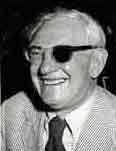
(1912 - 2004)
Julius Axelrod was born on May 30, 1912, in New York
City. He received his bachelor's degree in biology from
the College of the City of New York in 1933. Axelrod
wanted to become a physician, but was rejected from
every medical school to which he applied. He worked
breifly as a laboratory technician at New York University,
then, in 1935, he got a job with the New York City Department
of Health testing vitamin supplements added to food.
He injured his left eye when an ammonia bottle in the
lab exploded; he would wear an eyepatch for the rest
of his life. While working at the Department of Health,
he attended night school and received his Masters of
Sciences degree from New York University in 1941.
Analgesic research
In 1946, Axelrod took a position working under Bernard
Brodie at Goldwater Memorial Hospital. The research
experience and mentorship Axelrod received from Brodie
would launch him on his research career. Brodie and
Axelrod's research focused on how analgesics (pain-killers)
work. During the 1940s, users of non-aspirin analgesics
were developing a blood condition known as methemoglobinemia.
Axelrod and Brodie discovered that acetanilide, the
main ingredient of these pain-killers, was to blame,
and recommended replacement with acetaminophen (paracetamol),
better known as Tylenol.
Catecholamine research
In 1949, Axelrod began work at the National Heart
Institute, part of the National Institutes of Health
(NIH). At the National Heart Institute, he worked on
the mechanisms and effects of caffeine, which led him
to an interest in the sympathetic nervous system and
its main neurotransmitters, epinephrine and norepinephrine.
During this time, Axelrod also conducted research on
codeine, morphine, methamphetamine, and ephedrine, and
he also performed some of the first experiments on LSD.
Realizing that he could not advance his career without
a Ph.D., he took a leave of absence from the NIH in
1954 to attend George Washington University. Allowed
to submit some of his previous research toward his degree,
he graduated one year later, in 1955. Axelrod then returned
to NIH and began some of the key research of his career.
He won a share of the Nobel
Prize in Physiology or Medicine in 1970 along with Bernard
Katz and Ulf von Euler. Axelrod received the prize for his
work on the release, reuptake and storage of the neurotransmitters
epinephrine and norepinephrine, also known as adreniline
and noradreniline. Working on monoamine oxidase (MAO)
inhibitors in 1957, Axelrod showed that catecholamine
neurotransmitters do not merely stop working after they
are released into the synapse. Instead, neurotransmitters
are recaptured (reuptaken) by the pre-synaptic nerve
ending, and recycled for later transmissions. He theorized
that epinephrine is held in tissues in an inactive form
and is liberated by the nervous system when needed.
This research laid the groundwork for later selective
serotonin reuptake inhibitors (SSRIs), such as Prozac,
which block the reuptake of another neurotransmitter,
seretonin. Axelrod also discovered and characterized
the enzyme catechol-O-methyl transferase which is involved
in the breakdown of catecholamines.
Pineal gland research
Axelrod's later research focused on the pineal gland.
He and his colleagues showed that melatonin has profound
effects on the central nervous system, allowing the
pineal gland to act as a biological clock. He proved
that melatonin is a converted form of the neurotransmitter
serotonin and that the pineal gland regulates the release
of serotonin to drive the body's circadian rhythm. He
continued to work at the NIH until his retirement in
1984.
Political views
After receiving the Nobel Prize in 1970, Axelrod used
his visibility to advocate several science policy issues.
In 1973, Richard Nixon created an agency with the specific
goal of curing cancer. Axelrod, along with fellow Nobel-laurates
Marshall W. Nirenberg and Christian Anfinsen, organized
a petition by scientists opposed to the new agency,
on the grounds that by focusing solely on cancer, public
funding would not be available for research into other,
more solvable, medical problems. Axelrod also lent his
name to several protests against the imprisonment of
scientists in the Soviet Union.
Axelrod died on December 29, 2004.
The following press release from the Royal Swedish
Academy of Sciences describes Axelrod's work:
The discoveries which this
year's Nobel laureates have made have given
us answer to questions of fundamental importance
for the understanding of the mechanism underlying
the transmission between the nerve cells,
i.e. at the so-called synapses, and between
the nerve terminals and the so-called effector
organs, for instance between the motor nerve
fibers and the muscle fibers which they
innervate. The transmission between the nerve
cells, which radically differs from the
mechanisms underlying the impulse transmission
in the nerve fibers, is mediated by chemical
substances, so-called neurotransmitters,
which carry the message from one cell to
the other. The three scientists have been
working independently of each other, but
their discoveries all contribute in solving
principal questions concerning the neurotransmitters,
their storage, release and inactivation.
Dr. Julius Axelrod's discoveries concern the mechanisms
which regulate the formation of this important transmitter
in the nerve cells and the mechanisms which are involved
in the inactivation of noradrenaline, partly under the
influence of an enzyme discovered by himself.
von Euler's and Axelrod's
discoveries have not only increased our
knowledge about the transmission in the
sympathetic nervous system, they also form
the basis for the understanding of the transmission
in the central nervous system and its pharmacology.
Thus in a very significant way, the laureates
have presented basic data about the physical
and chemical mechanisms of the synaptic
transmission and thus given us basic information
about how the messages are mediated between
nerve cells. Their discoveries concerning
these regulatory mechanisms in the nervous
system are fundamental in neurophysiology
and neuropharmacology and have greatly stimulated
the search for remedies against nervous
and mental disturbances.
Sources: Picture courtesy of U.S.
National Library of Medicine, Wikipedia,
Nobelprize.org
|