Irving Berlin
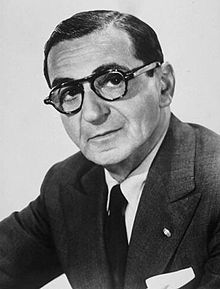
(1888 - 1989)
Irving Berlin once said that, "a patriotic
song is an emotion and you must not embarrass an audience with it, or
they will hate your guts." This philosophy made him one of
America's most outstanding writers of patriotic songs from World War
I through World War II.
Berlin was born Israel Baline in Eastern Russia on
May 11, 1888. He was one of eight children born to Leah and Moses Baline.
His father was a shochet (one who kills kosher animals as prescribed
by Jewish religious laws) who was also the cantor in the synagogue.
His family moved to New York in 1893 to escape the pogroms in Russia.
At the age of eight, he took to the streets of the Lower East Side of
New York City to help support his mother and family after his father
had died. In the early 1900s he worked as a singing waiter in many restaurants
and started writing songs. His first published hit was "Marie From
Sunny Italy." His successes continued through two years.
Berlin was married for only a year to Dorothy Goetz,
who died from typhoid contracted while on their honeymoon in Cuba in
1913. He married Ellin Mackay in 1926. She was the daughter of Clarence
Mckay, president of Postal Telegraph Company, a leading Catholic layman
who opposed the wedding. The Berlins had three daughters.
In World War I, he wrote the musical Yip, Yip,
Yaphank, which was produced by the men of Camp Upton. In this
musical, the big hit song was "Oh, How I Hate to Get Up in the
Morning," which reflected Berlin's aversion to rising early.
This musical raised more than $150,000 to build a service center at
Camp Upton.
On Armistice Day, 1938, he introduced "God Bless
America," which was sung by Kate Smith. This song threatened to
replace the national anthem because of its patriotism and popularity.
In World War II, he wrote the musical This is
the Army, which raised $10 million for the Army Emergency Relief.
His hits in this musical were "This is the Army, Mr Jones"
and I Left My Heart at the Stage Door Canteen." He also wrote
other patriotic songs such as "Any Bonds Today?,"
"Arms for the Love of America," and "Angels of
Mercy" for the American Red Cross.
Berlin was prolific: He wrote more than 900 songs,
19 musicals and the scores of 18 movies. Some of his songs that have
become classics include "There's No Business Like Show
Business," "Easter Parade," and "White
Christmas." He is the top money maker among songwriters in
America. In 1924, songwriter Jerome Kern observed "Irving Berlin
has no place in American music. He is American music."
Berlin supported Jewish charities and
organizations and donated many dollars to worthwhile causes. He was
honored in 1944 by the National Conference of Christians and Jews for
"advancing the aims of the conference to eliminate religious and
racial conflict." Five years later, he was honored by the New
York YMHA as one of "12 outstanding Americans of the Jewish
faith." On February 18, 1955, President Eisenhower presented him
with a gold medal in recognition of his services in composing many
patriotic songs for the country. Earlier, Berlin assigned the
copyright for "God Bless America" to the God Bless America
Fund, which has raised millions of dollars for the Boy Scouts and
Girl Scouts. Berlin's World War I doughboy uniform and many of his
original patriotic scores are on display in the Jewish War Veterans
Museum in Washington, D.C.
Irving Berlin died on September 22, 1989, at the
age of 101.
Following a gala 100th birthday celebration
concert at Carnegie Hall, Morton Gould, president of ASCAP, said that
"Irving Berlin's music will last not for just an hour, not for
just a day, not for just a year, but always." Not bad for a poor
immigrant who had only two years of formal schooling and who never
learned to read or write music!
Sources: Jewish Heroes and Heroines in America from Jewish Heroes & Heroines of America : 150 True Stories of American Jewish Heroism, � 1996, written by Seymour "Sy" Brody of Delray Beach, Florida, illustrated by Art Seiden of Woodmere, New York, and published by Lifetime Books, Inc., Hollywood, FL. Also, the Jewish-American Hall of Fame - Jewish Museum in Cyberspace. |