Bernice Freid
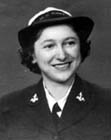
The bus was crowded that Saturday morning in 1944. I was en-route to
Oklahoma City. Standing for two and one-half hours didn't bother me;
I was engrossed in my own feelings of aloneness. Vaguely I heard the
laughter and conversation of the other WAVES. For two weeks we had been
confined to the base at Stillwater, Oklahoma A & M College. Now
we were suddenly free until Sunday night. I kept thinking how alienated,
how alone I felt. I spoke to no one.
Just last night the most awesome feeling had come over me like a
cloud enveloping my brain. At first I didn't know what bothered me.
I wasn't ill, but I was miserable. But why? I loved being in the Service
at a Naval Training Base located on a beautiful campus, studying shorthand,
typing, and Naval Procedures. But why was I feeling so lonely when
I was never alone, surrounded by women? Suddenly, the truth hit me
in the face like a dash of cold water. My gut feeling told me that
I was the only Jew on the campus among several hundred people. We
were sixty miles from the nearest city.
Although is was Friday night, it was not a Synagogue or Rabbi that I wanted.
I felt literally starved for contact with another Jew. I could not
confide in my three bunkmates or any of the other WAVES, who were
friendly; there was no anti-Semitism.
We ate the same food, wore the same uniforms, slept in the same dormitory.
On the outside we all looked alike, but inside I knew I was different.
I was a Jew. They could not understand me.
I could not tell my Platoon Leader, a cold but cordial martinet,
who read her announcements in her North Carolina accent and marched
us to class- she could not understand me.
The bus ride seemed endless. I gazed blankly out of the window,
trying to concentrate on the blue sky, clay-colored earth, and green
grass, which in Minnesota would
already be covered by ice and snow. My tortured mind could not relax.
When we finally arrived in Oklahoma City, I dashed down the street
asking for the nearest USO. There I knew I would find Jews. I entered
the building out of breath, surveying the interior frantically. To
my left I saw a huge blue velvet banner fringed in yellow bearing
the letters "JWB". I felt like a traveler dying of thirst,
reaching an oasis. My eyes filled with tears; there was a lump in
my throat as I entered the office. On a bench sat a boyish-looking,
puny, undersized sailor with horn-rimmed glasses. At any other time
I would have ignored him but I knew he was a Jew. That was all that
mattered. I sat next to him, and as we spoke, my Loneliness evaporated.
A short while later, a Jewish Welfare Board worker entered the room.
"Are there many Jewish service men nearby?" I asked hopefully.
"There are forty men stationed at Norman Air Base about forty
miles from here, but you're the first Jewish Servicewoman we've ever
seen," he answered. "Be here tonight at eight P.M.; we're
invited to a party in a Jewish home."
Sources: Courtesy of the Jewish
Women's Archives and Jewish
War Veterans |