Hayyim Nahman Bialik
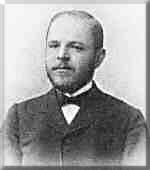
(1873 - 1934)
Hayyim Nahman Bialik was born in Radi, Volhynia in
Russia to a traditional Jewish family. Bialik studied at a yeshiva in
Zhitomir. At the age of 17, he was sent to the great Talmudic academy
in Volozhin, Lithuania where he was attracted to the Enlightenment
movement and joined the Hovevei
Zion group. Bialik gradually drifted away from yeshiva life.
His poem, HaMatmid ("The Talmud student") written in
1898, reflects his great ambivalence toward that way of life.
At 18, Bialik left for Odessa, where he became
active in Jewish literary circles and first met Ahad
Ha'am, who had a great influence on his Zionist outlook. It was at this time that his first poem was published, El
HaTzipor ("To the Bird"), which reflected his
feelings toward Zion and Russia, themes that he was to return to
frequently during this period.
Bialik was not yet a full-time writer and poet.
For some time a bookkeeper in his father-in-law's business, he later
taught, published and translated, and for six years was literary
editor of the weekly Hashiloah in Odessa. He had hopes of
becoming successful in business, but after a four-year period in the
lumber trade he decided to make his living by teaching. In 1901 his
first collection of poetry appeared and was greeted with much
acclaim. Over the next three years he wrote a considerable number of
works. Commentators say that this was his golden period. Although his
later writings became more universal in outlook, his "In the
City of Slaughter," written in response to the Kishinev pogrom
was a powerful statement of anguish at the situation of the Jews.
He moved to Berlin in 1921, where he founded the
Dvir publishing house. He moved the company to Tel
Aviv in 1924 and devoted himself to cultural activities and
public affairs. Bialik was immediately recognized as a celebrated
literary figure. In 1927 he became head of the Hebrew Writers Union
which had been established six years previously. He retained this
position until his death in 1934. Bialik's poetry and prose have been
widely translated. His poems are still read in contemporary Israel
and several have been put to music by some of the country's most
gifted composers. During his lifetime, he was called the
"national poet," a title that has remained to this day.
The work of Hayyim Nahman Bialik takes on many
genres and modes of expression. His national poetry laments the
degeneration of the Jewish nation in exile and strives to stimulate
latent forces to create a new destiny. Expressing a wide range of
emotion, his personal verse reflects the inner conflicts of modern
man. His nature poetry is rich in imagery, and his love poems show
both tenderness and violent passion. Bialik's stories deal
realistically with subjects drawn from contemporary events, and his
legends and folktales evince a fertile imagination and gentle sense
of humor. In his career called "a watershed in modern Hebrew
literature," Hayyim Nahman Bialik answered the silent cry of a
people in need of articulation in a new era.
Books Published in Hebrew
Poems, Tushia, Warsaw, 1901.Poems,
Hovevei Hashira Haivrit, Krakow, 1908.The Writings of H. N. Bialik,
Hovevei Hashira Haivrit, Berlin, 1924. Poems and Songs (children), Dvir, 1933.The Writings of H.N. Bialik (four
volumes), Dvir, 1938.Collected Poems Critical Edition, Dvir,
1983; 1990.
Books in Translation
Hadari, Atar. Ed. Songs
from Bialik: Selected Poems of Hayim Nahman Bialik. NY:
Syracuse University Press, 2000.
Writings, Yiddish: New York: Jewish National Workers
Alliance, 1946; Buenos Aires, IWO Ateneo Literario, 1964.
Aftergrowth, English, Philadelphia, J.P.S., 1939.
Hebrew Poems, French, Tunis, Editions Angel, 1945.
Az Ujheber Kulturaert, Hungarian, Budapest, Makkabea
Maunkakozossege, 1942.
Stikhi I Poemy, Russian, Tel Aviv, Dvir, 1964.
Legendes, French, Jerusalem, WZO, 1960.
Der Waldsee, German, Jerusalem, Todros Verlag, 1962.
Poems, Spanish/Hebrew, Buenos Aires, Pardes, 1986.
E Accade Un Giorno, Italian, Bergamo, Ianus, 1967.
Mantoua Minunatc, Romanian, Bucharest, Editura Bikurim,
1945.
Poems, French, Jerusalem, WZO, 1958.
Hebrew Poems, French, Paris, Rieder, 1933.
The Poems of Bialik, English, Columbus, Alpha, 1987.
Selected Poems, English: Tel Aviv, Dvir, 1981.
|