Max Born
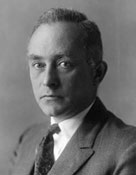
(1882 - 1970)
Max Born was born on December
11, 1882, in Breslau, Germany (now
Wroclaw, Poland).
Born studied physics at the universities
of Breslau, Heidelberg, and Zürich.
In 1909, he was appointed a lecturer at
the University of Göttingen, where
he worked until 1912, when he moved to work
at th University of Chicago. In 1915, he
returned to Germany but had to join the Germany
Army. In 1919, he became a professor at
the University of Frankfurt-am-Main, and
then professor at Göttingen in 1921.
It was during this period that Born formulated
the interpretation of the probability density
function for for ?*? in the Schrodinger equation
of quantum mechanics. His ideas replaced
the original quantum theory; today, it is
Born’s mathematical
equation that is utilized.
In 1933, Born fled Germany to escape the rising anti-Semitism and accepted the position of Stokes Lecturer at the University of Cambridge.
From 1936 to 1953, he was Tait Professor of Natural Philosophy at the
University of Edinburgh in Scotland. During this period, Born’s
work focused on nonlinear electrodynamics. In 1953, Born retired and
returned to Germany in Bad Pyrmont, near Göttingen. He became a
British subject and a Fellow of the Royal Society of London in 1939.
In 1954, Born received the Nobel
Prize in Physics for his work on the probablity density function
and his studies of wave functions. Other than winning the Nobel Prize,
Born was awarded the Stokes Medal from the University of Cambridge and
the Hughes Medal (1950).
He published numerous works including, The Restless
Universe, Einstein’s Theory of Relativity (1924), and Natural Philosophy of Cause and Chance.
Born died in Göttingen, Germany on January 5,
1970.
Sources: Nobel
Prize; The
MacTutor History of Mathematics archive; Wikipedia |