Charles E. Coughlin
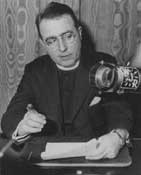
(1891-1979)
Charles E. Coughlin was an American Catholic priest
and a popular radio figure of the 1930s. Coughlin ministered at the
Shrine of the Little Flower in Royal Oak, Michigan, from 1926 to 1966,
when he retired.
In the first year of the Franklin
D. Roosevelt administration,
Coughlin supported the Democratic president,
but broke with him after a short time.
Throughout the 1930s Coughlin used his
popular weekly radio program — which
averaged 3.5 million listeners every week--and
his magazine, Social Justice, to spread
his ideas and attack his enemies. From 1934 onward Coughlin's targets included
Roosevelt, individual Jewish leaders,
and Jewish institutions, all branded as
Communists.
Coughlin, a right-wing
populist, advocated a form of corporatism
influenced by Italian Fascism. In 1934, Coughlin
organized the National Union for Social
Justice through which he argued that neither
capitalism nor democracy had a future in
America. In 1938 the National Union developed
into the Christian Front which was even more
ardent in its support of fascism and became
a mouthpiece for Nazi propaganda. Subsequently,
as war loomed in Europe, Coughlin supported
isolationism, charging that Jewish financiers
were secretly behind efforts to involve
the United States in the war.
Coughlin believed in the
existence of a secret world Jewish conspiracy.
In 1938, his magazine Social
Justice serialized
the discredited Protocols
of the Elders of Zion, which Coughlin believed to be accurate.
This tsarist forgery purported to be the
minutes of a conference of Jewish leaders
plotting to take over the world.
Coughlin repeatedly used
the “Judeo-Bolshevik threat” as a theme,
asserting that the entire Soviet leadership,
including both Lenin and Joseph
Stalin,
was Jewish. Coughlin also accused American
Jewish financiers, primarily the Wall Street
firm of Kuhn-Loeb, of collaboration with
the Bolsheviks in their efforts to uproot
Christianity in Russia. Publicly proclaiming
that he was not an antisemite, Coughlin
nevertheless argued that all the ills of
modern society were caused by a Communist-Jewish
conspiracy.
During the 1930s, Jewish
efforts to force Coughlin to tone down his
anti-Jewish rhetoric or to get him off the
air altogether failed due to his popularity
and the support he received from the Bishop
of Detroit. Coughlin continued to argue
against American participation in World
War II even after the Japanese attack on
Pearl Harbor. These arguments led to his
undoing. When a sedition trial seemed possible,
the Bishop of Detroit ordered Coughlin to
cease broadcasting and leave politics altogether.
At the height of his popularity, Coughlin received
more mail than President Roosevelt. Indeed, a public opinion poll taken
in 1938 showed that 25 percent of those polled supported all or most
of Coughlin's ideas. Coughlin was thus the most visible of the American
right-wing activists during the 1930s and his anti-Semitism deeply troubled
American Jewry.
Source: United States Holocaust Memorial Museum's Holocaust Encyclopedia |