Abdullah bin Abdulaziz al-Saud
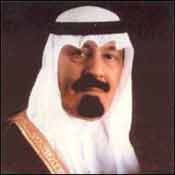
(1924 -2015)
Abdullah bin Abdulaziz al-Saud
became King of Saudi
Arabia on August 1,
2005, when his half-brother King
Fahd died. Abdullah had been Crown Prince
and acted as the de-facto regent and
ruler after King
Fahd was incapacitated by a
major stroke in 1996.
Abdullah also served as
First Deputy Prime Minister and Commander
of the Saudi National Guard. He is one of
37 sons of King
Abdulaziz bin Abdulrahman Al-Saud, the
founder of modern Saudi Arabia.
Abdullah was born in Riyadh to Ibn Saud's eighth wife, Fahda, and received
his early education that was in the Royal Court at the Princes' School
from religious authorities and intellectuals. He was given the position
of Commander of the Saudi National Guard in 1963, and the position of
First Deputy Prime Minister in June 1982.
Abdullah has four wives, seven sons and fifteen daughters.
Prince Abdullah has established two libraries in the Muslim world,
one in Riyadh (the King Abdulaziz Library) and another in Casablanca,
Morocco.
In October 1976, as Abdullah was being groomed for
greater responsibility in Riyadh, he was sent to the United States to
meet with then-President Gerald Ford. He again travelled to the United
States in October 1987, meeting then-Vice President George H. W. Bush.
In September of 1998, Abdullah made a state visit to the United States
to meet in Washington, DC with then-President Bill Clinton. He returned
again in September of 2000 to attend millennium celebrations at the
United Nations in New York, New York. Abdullah is the fourth richest
man in the world.
Since then Abdullah has visited America many times,
and there are reports that the Bush family, including President George
W. Bush consider Abdullah to be a great friend — both of America
and the Bush family.
Shortly after the September 11, 2001, terrorist attack
on the United States, as criticism of Saudi Arabia mounted, Abdullah
said, “The vicious campaign being waged against the kingdom in
the Western media is nothing but the manifestation of a deep-rooted
hatred directed against the course of Islam. Commitment to Islam and
the homeland is not up for debate.” [1]
On the second anniversary of the September 11 attack on the United
States, the prince wrote a letter to U.S. President George W. Bush,
which ended with:
"God Almighty, in His wisdom, tests the faithful
by allowing such calamities to happen. But He, in His mercy, also provides
us with the will and determination, generated by faith, to enable us
to transform such tragedies into great achievements, and crises that
seem debilitating are transformed into opportunities for the advancement
of humanity. I only hope that, with your cooperation and leadership,
a new world will emerge out of the rubble of the World Trade Center:
a world that is blessed by the virtues of freedom, peace, prosperity
and harmony." [2]
In 2002, Abdullah floated the so-called Arab
Peace Initiative, what many considered at the time to be an opening
salvo in a Saudi attempt to make peace with Israel.
The plan called for Israel to cede almost the entirety of the Occupied
Territories to the Palestinian Authority and to recognize the PA's sovereignty, with the Authority's capital
in East Jerusalem. In exchange,
Abdullah offered unprecedented consessions, including the ending of
the Arab-Israeli conflict, a peace treaty with Israel, recognition of
the state of Israel and the establishment of "normal relations"
between Arab states and Israel.
The plan was dropped after criticism from both Arab states and Israel.
Prince Abdullah is a devout Muslim and is said to
have meetings with leaders of Saudi Arabia's religious establishment
on a weekly basis to garner advice and guidance.
Like many Saudi rulers before him, Abdullah is considered
by many in the West to be a relatively moderate ruler. In recent years,
this image has been compromised however, as Saudi Arabian schools continue
to teach anti-Semitism and Saudi
Arabia's Royal Family funds madrassahs around the world that offer no
compromise regarding the West's support and lack of support of Palestinian
people. Saudi Arabia was also a major backer of the Taliban in Afghanistan.
After the September 11, 2001, attacks, Saudi Arabia and the United Arab
Emirates withdrew recognition of the Taliban government.
Abdullah bin Abdulaziz al-Saud died of natural causes at the age of 90 in his home on January 22 2014. His slightly younger, 79 year old brother Prince Salman bin Abdulaziz is expected to take his place.
Sources: Wikipedia.
This article is available under the terms of the GNU
Free Documentation License |