Joseph Erlanger
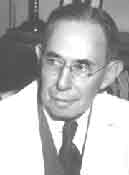
(1874 - 1965)
Joseph Erlanger was born on January 5, 1874, in San
Francisco, California. Erlanger
received his B.S. from the University of California. Later he obtained
his Medical degree from John Hopkins University in 1899. From 1900 to
1906, he worked as Instructor, Associate, and Associate Professor in
the Department of Physiology at the Medical School at John Hopkins.
In 1906, Erlanger moved to the University of Wisconsin,
Madison, where he was appointed the first Professor of Physiology at
the Medical School. At Wisconsin, Erlanger began research collaboration
with one of his students, Herbert Gasser. In 1910, he became the Professor
of Physiology at the Washington University, St. Louis. Gasser, joined
Erlanger in St. Louis, where they began studying the effects of electronics
applied to physiological investigations.
Erlanger’s main research involved electrophysiology
and the physiology of the circulatory system. By 1922, Erlanger and
Gasser were able to analyze the electrical reactions of nerve fibers
by amplifying the nerves with a cathode-ray oscilloscope. In 1932, the
two men illustrated that different fibers conduct different sizes of
wavelengths or impulses. Fibers of a nerve transmit impulses at various
rates, conditional on the fiber’s thickness.
He was awarded the Nobel
Prize in Medicine in 1944, along with Herbert
Gasser, for their
discovery of different types of nerve fibers. They demonstrated that
fibers can have different functions, even within the same nerve cord.
Erlanger died in St. Louis, Missouri on December 5,
1965.
Sources: Nobel
Prize Biography; NASA
Neurolab. Photo courtesy of the American
Physiological Society. |