Richard Feynman
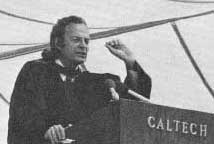
(1918-1988)
Richard Feynman was born on May 11, 1918, in Far Rockaway,
Queens, New York; his parents were Jewish, although they did not practice Judaism as a religion. The young
Feynman was heavily influenced by his father who encouraged him to ask
questions to challenge orthodox thinking. His mother instilled in him
a powerful sense of humor which he kept all his life.
As a child, he delighted in repairing radios and had
a talent for engineering. He kept experimenting on and re-creating mathematical
topics, such as the half-derivative (a mathematical operator,
which when applied twice in succession, resulted in the derivative of
a function), utilizing his own notation, before entering college.
Feynman received a bachelor's degree from the Massachusetts
Institute of Technology in 1939, and was named Putnam Fellow that same
year. He received a Ph.D. from Princeton in 1942. Feynman's thesis applied
the principle of stationary action to problems of quantum mechanics,
laying the groundwork for the "path integral" approach and
Feynman diagrams. While researching his Ph.D., Feynman married, Arline
Greenbaum.
At Princeton, the physicist Robert R. Wilson encouraged
Feynman to participate in the Manhattan Project—the wartime U.S.
Army project at Los Alamos developing the atomic bomb. He visited his
wife, who had been diagnosed with tuberculosis, in a sanitarium in Albuquerque
on weekends, right up until her death in July 1945.
He immersed himself in work on the project, and was
present at the Trinity bomb test. Feynman claimed to be the only person
to see the explosion without the dark glasses provided, looking through
a truck windshield to screen out harmful ultraviolet frequencies.
As a junior physicist, his work on the project was
relatively removed from the major action, consisting mostly of administering
the computation group of human computers in the Theoretical division,
and then, with Nicholas Metropolis, setting up the system for using
IBM punch cards for computation.
Feynman's other work at Los Alamos included calculating
neutron equations for the Los Alamos "Water Boiler," a small
nuclear reactor at the desert lab, in order to measure how close a particular
assembly of fissile material was to becoming critical. After this work,
he was transferred to the Oak Ridge facility, where he aided engineers
in calculating safety procedures for material storage (so that inadvertent
criticality accidents could be avoided). He also did crucial theoretical
and calculation work on the theoretical uranium-hydride bomb, which
was later proven to be infeasible.
Los Alamos was isolated; in his own words, "There
wasn't anything to do there." Bored, Feynman indulged his mischievous
sense of humour to mock a self important director (one of the few non-scientists
on site). The director's only important responsibility was for document
security. He irritated Feynman and other scientists with petty rules
for handling documents. Feynman embarrassed the director by breaking
into the document safe and leaving a mischievous note. The Director
responded by procuring a series of ever more sophisticated safes, each
time thinking finally to have outsmarted Feynman, only to discover in
short order a new note in each new safe.
As a drummer, Feynman would find an isolated section
of the mesa to drum Indian-style. These antics did not go unnoticed,
but no one knew that "Injun Joe" was actually Feynman. He
became a friend of laboratory head J. Robert Oppenheimer, who unsuccessfully
tried to court him away from his other commitments to work at the University
of California, Berkeley after the war.
After the project, Feynman started working as a professor
at Cornell University, where Hans Bethe (who proved that the Sun's source
of energy was nuclear fusion) worked. Feynman felt uninspired there;
despairing that he had burned out, he turned to less useful, but fun
problems, such as analyzing the physics of a twirling, rotating dish,
as it is being balanced by a juggler. (As it turned out, this work served
him in future research.) He was therefore surprised to be offered professorships
from competing universities, eventually choosing to work at the California
Institute of Technology in Pasadena, California, despite being offered
a position near Princeton, at the Institute for Advanced Study (which
included, at that time, such distinguished faculty as Albert
Einstein).
Feynman rejected the Institute on the grounds that
there were no teaching duties. Feynman found his students to be a source
of inspiration and also, during uncreative times, comfort. He felt that
if he could not be creative, at least he could teach.
Feynman is sometimes called the "Great Explainer";
he took great care when explaining topics to his students, making it
a point not to make a topic arcane, but accessible to others. His principle
was that if a topic could not be explained in a freshman lecture, it
was not fully understood yet. He opposed rote learning and other teaching
methods that emphasized form over function, everywhere from a conference
on education in Brazil to a state commission on school textbook selection.
Clear thinking and clear presentation were fundamental prerequisites
for his attention.
During one sabbatical year, he returned to Newton's Principia to study it anew; what he learned from Newton, he also
passed along to his students, such as Newton's attempted explanation
of diffraction.
Feynman did much of his best work while at Caltech,
including research in:
• Quantum electrodynamics. The theory for which Feynman
won his Nobel Prize is known for its extremely accurate predictions.
He helped develop a functional integral formulation of quantum mechanics,
in which every possible path from one state to the next is considered,
the final path being a sum over the possibilities.
• Physics of the superfluidity of supercooled liquid helium,
where helium seems to display a lack of viscosity when flowing. Applying
the Schrödinger equation to the question showed that the superfluid
was displaying quantum mechanical behavior observable on a macroscopic
scale. This helped enormously with the problem of superconductivity.
• A model of weak decay, which showed that the current coupling
in the process is a combination of vector and axial. (An example of
weak decay is the decay of a neutron into an electron, a proton, and
an anti-neutrino.) Although E.C. George Sudharsan and Robert Marshak
developed the theory nearly simultaneously, Feynman's collaboration
with Murray Gell-Mann was seen as the seminal one, the theory was
of massive importance, and the weak interaction was neatly described.
He also developed Feynman diagrams, a bookkeeping
device which helps in conceptualizing and calculating interactions
between particles in spacetime, notably the interactions between electrons
and their antimatter counterparts, positrons. This device allowed him,
and now others, to work with concepts that would have been less approachable
without it, such as time reversibility and other fundamental processes.
These diagrams are now fundamental for string theory and M-theory, and
have even been extended topologically. Feynman's mental picture for
these diagrams started with the hard sphere approximation, and
the interactions could be thought of as collisions at first.
It was not until decades later that physicists thought of analyzing
the nodes of the Feynman diagrams more closely. The world-lines of the diagrams have become tubes to better model the more complicated
objects such as strings and M-branes.
From his diagrams of a small number of particles interacting
in spacetime, Feynman could then model all of physics in terms
of those particles' spins and the range of coupling of the fundamental
forces. The quark model, however, was a rival to Feynman's parton formulation.
Feynman did not dispute the quark model; for example, when the 5th quark
was discovered, Feynman immediately pointed out to his students that
the discovery implied the existence of a 6th quark, which was duly discovered
in the decade after his death.
After the success of quantum electrodynamics, Feynman
turned to quantum gravity. By analogy with the photon, which has spin
1, he investigated the consequences of a free massless spin 2 field,
and was able to derive the Einstein field equation of general relativity.
Unfortunately, at this time he became exhausted by working on multiple
major projects at the same time, including his Lectures in Physics.
While at Caltech, Feynman was asked to "spruce
up" the teaching of undergraduates. After three years devoted to
the task, a series of lectures was produced, eventually becoming the
famous Feynman Lectures on Physics, which are a major reason
that Feynman is still regarded by most physicists as one of the greatest teachers of physics ever. Feynman later won the Oersted Medal
for teaching, of which he seemed especially proud. His students competed
keenly for his attention; once he was awakened when a student solved
a problem and dropped it in his mailbox at home; glimpsing the student
sneaking across his lawn, he could not go back to sleep, and he read
the student's solution. That morning his breakfast was interrupted by
another triumphant student, but Feynman informed this student that he
was too late.
Feynman was a keen and influential popularizer of
physics in both his books and lectures, notably a seminal 1959 talk
on nanotechnology called There's Plenty of Room at the Bottom.
Feynman offered $1000 prizes for two of his challenges in nanotechnology.
He was also one of the first scientists to realize the possibility of
quantum computers. Many of his lectures and other miscellaneous talks
were turned into books such as The Character of Physical Law and
QED: The Strange Theory of Light and Matter. He would give lectures
that his students often annotated into books, such as Statistical
Mechanics and Lectures on Gravity. The Feynman Lectures on Physics took two physicists, Robert B. Leighton and Matthew Sands as full-time
editors a number of years. Even though they were not adopted by the
universities as textbooks, the books continue to be bestsellers, as
they provide a deep understanding about physics.
In 1965, Feynman was awarded the Nobel
Prize for Physics.
Feynman's first wife died while he was working on
the Manhattan project. He married a second time, to Mary Louise Bell
of Neodesha, Kansas in June 1952; this marriage was brief and unsuccessful.
Feynman later married Gweneth Howarth from the United
Kingdom, who shared his enthusiasm for life. Besides their home in Altadena,
California, they had a beach house in Baja California. They had a son,
Carl in 1962, and adopted a daughter, Michelle, in 1968.
According to Professor Steven Frautschi, a colleague
of Feynman, Feynman was the only person in the Altadena region to buy
flood insurance after the massive 1978 fire, predicting correctly that
the fire's destruction would lead to land erosion, causing mudslides
and flooding. The flood occurred in 1979 after winter rains and destroyed
multiple houses in the neighborhood.
Feynman did not work only on physics, and had a large
circle of friends from all walks of life, including the arts. He took
up painting at one time and enjoyed some success under the pseudonym
“Ofey.” He learned to play drums (frigideira) in
acceptable samba style in Brazil by persistence and practice, and participated
in a samba “school.” Such actions earned him a reputation
of eccentricity.
Feynman had very liberal views on sexuality and was
not ashamed of admitting it. In Surely You're Joking, Mr. Feynman!,
he gives advice on the best way to pick up a girl in a hostess bar and
drew a decoration for a massage parlor. His favorite place was nude/topless
bars, which he used to visit six times a week. In addition, he admitted
to being a cannabis user as well as having experimented with LSD and
Ketamine. Feynman also enjoyed bike riding and being interviewed.
Feynman was asked to serve on the presidential Rogers
Commission that investigated the Challenger disaster of 1986. Fed clues
from a source with inside information, Feynman famously showed on television
the crucial role in the disaster played by the booster's O-ring flexible
gas seals with a simple demonstration using a glass of ice water and
a sample of o-ring material. His opinion of the cause of the accident
differed from the official findings and was considerably more critical
of the role of management in sidelining the concerns of engineers. After
much petitioning, Feynman's minority report was included as an appendix
to the official document. The book, What Do You Care What Other People
Think? includes stories from Feynman's work on the commission. His
engineering skill is reflected in his estimate of the reliability of
the Space Shuttle (98%), which was unfortunately verified by the two
failures over the 100-odd flights of the Space Shuttle as of 2003.
Feynman died of cancer on February 15, 1988.
Sources: Wikipedia, Nobel Prize Website
|