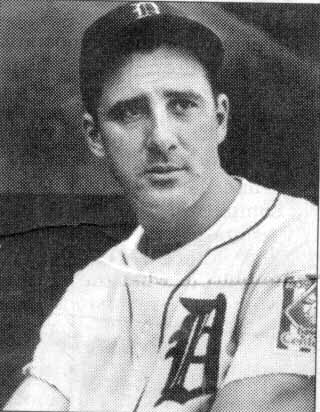
Hank Benjamin Greenberg is one of the most famous Jewish American baseball players of all time.
Greenberg (born January 1, 1911; died September 4, 1986) was born into an Orthodox Jewish household. By the time he reached high school in the
Bronx, Greenberg stood 6'3" and was an All-City athlete in soccer and basketball, but his favorite
sport was baseball. Somewhat awkward in the field, Greenberg chose first base as his position. In
1929, Greenberg was offered a contract by the New York Yankees but turned it down because
the immortal iron man Lou Gehrig was the incumbent Yankee first baseman. Instead, after
spending a year at New York University, Greenberg signed a contract with the Detroit
Tigers.
Greenberg spent three years in the minor leagues, working hard each day to improve his fielding
and hitting. After being named Most Valuable Player in the Texas League, he was promoted to
the Tigers in 1933, batting .301 and driving in 87 runs.
In 1934, led by Greenberg's
.339 batting average, the Tigers jumped from
fifth place in the American League to battle
for the pennant. Never before had a player
filled such a significant role for a major
league team, and for the first time, Greenberg
— and Jewish baseball fans all over the
country — faced a dilemma. September
10 was Rosh
Hashanah, and the Tigers, who led the
league by four games in the standings, were
playing the Boston Red Sox. Fans and rabbis debated whether Greenberg, who by his accomplishments
on the field was winning acceptance for Jews
among non-Jewish Americans, should play on
the High Holy Days. Greenberg came up with
his own compromise: He played on Rosh
Hashanah and hit two home runs that won
the game, 2-1; ten days later, he spent Yom
Kippur in a synagogue, and the Tigers
lost. Greenberg's observance inspired Edgar
Guest to write a poem, which read in part:
Come Yom Kippur - holy fast day wide-world over to the Jew -
And Hank Greenberg to his teaching and the old tradition true
Spent the day among his people and he didn't come to play
Said Murphy to Mulrooney, 'We shall lose the game today!
We shall miss him in the infield and shall miss him at the bat,
But he's true to his religion - and / honor him for that!
The Tigers won the pennant but lost the World Series to the Cardinals in seven games. A year
later, the Tigers won the World Series and Greenberg was the first Jew voted Most Valuable
Player in either major league.
The 1938 season brought more drama for Greenberg when he challenged Babe Ruth's record of
60 home runs in a season. With five games left, Greenberg had hit 58. With the eyes of the world
on Greenberg in those last five games, several pitchers chose to walk him rather than give him a
chance to break Ruth's record. While Greenberg never complained, many observers believed that
major league baseball did not want a Jew breaking Ruth's record.
In May 1940, Greenberg's baseball career was interrupted when he was drafted into the Army.
One of baseball's highest paid stars, his salary dropped from $11,000 to $21 per month. In
August, Congress decided that men over 28 years old need not serve, and Greenberg was
honorably discharged. He planned to return to the Tigers the next season, but on December 7,
1941, the Japanese bombed Pearl Harbor and the U.S. declared war. Greenberg was the first
major leaguer to enlist in the Army, even though he had been excused from serving. While he
could have had a stateside job as an athletic instructor, Greenberg chose to serve in the Army Air
Corps in the China Burma-India Theater, where he had a distinguished record.
When the war ended in 1945, Greenberg, age 34, returned to the Tiger lineup in midsummer and
hit a home run in his first game back. Greenberg led the Tigers to another World Series victory
that year, personally clinching the American League pennant with a grand slam home run on the
final day of the season. Greenberg played two more seasons and then retired.
After retirement, Greenberg compiled another series of “firsts”: He became the first
Jewish owner/general manager in baseball, assembling the 1954 Cleveland Indians team that
won a record 111 games. Greenberg and Bill Veeck then purchased the Chicago White Sox in
1959. That year, the White Sox won the pennant for the first time in 40 years. In 1961,
Greenberg sold his baseball interests and went on to a successful career in Wall Street.
In 1954, Hank Greenberg became the
first Jewish player to be elected to baseball's
Hall of Fame in Cooperstown. His pioneering
efforts as a player and owner paved the way
for Jews in the top ranks of major league
baseball, whether as a Hall of Famer like Sandy
Koufax, a general manager like Al Rosen,
or an owner and commissioner of major league
baseball like Bud Selig of the Milwaukee Brewers.