Al Jolson
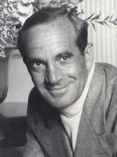
(1886-1950)
Al Jolson was never a soldier in the United States Army,
but he did his best to support it in four wars. When he
was fourteen years old, he tried to enlist during the
Spanish-American War; during World War I, he sold Liberty
Bonds; and he entertained the troops at home and abroad
during World War II and the Korean War.
Born Asa Yoelson on May 26, 1886, in Srednike, Lithuania,
he was the youngest of four children of Rabbi Moses Reuben Yoelson and
his wife, Naomi (Cantor). Anti-Jewish pogroms were common and the family
immigrated to Washington, D.C., in 1880, where Rabbi Yoelson obtained
a job as a cantor in a synagogue.
Jolson's mother died when he was 10. His formal education wasn't
much but he learned much more from the streets, where he would sing
and dance on the corner to earn spending money. In constant conflict
with his father, who wanted him to follow a religious life, Al ran away
to New York to join his older brother, Harry, who had left home and
changed his name to Jolson. Al also changed his family name to Jolson
and in 1899, he appeared as an extra in a Jewish play called Children of
the Ghetto. At 15, he joined his brother in a three-man comedy act that
toured the vaudeville circuits. They were known as Jolson, Palmer and
Jolson. It was during this tour that he used burnt cork to darken his
face, which became his trademark in show business.
After a few years with the group, he left them to be on his own.
Jolson, who was not used to the pressures of delivering a set script,
loved to improvise and to ad lib during his act. While he was in San
Francisco playing the small night clubs, he decided to liven up his act.
He came out in black face and sang a few songs with a southern style.
The audience called him back for three encores and he was on his way
to stardom.
He appeared in Hammerstein's shows in New York and then he
went to work for the Schuberts in 1911. In the show Bombo, 1921, he
introduced his famous song "My Mammy" and three other songs that
were to be a part of his fame: "Toot, Toot, Tootsie," "California, Here I
Come" and "April Showers." His records sold in the millions.
In 1927, Jolson was the first to star in a talking picture, The Jazz
Singer, based on his own life. The talking picture put an end to the
silent movies of the day and Jolson's career and success moved forward.
He worked with Parkyakarkas and Martha Rae in a comedy
radio series for the Columbia Broadcasting System.
His personal life was as turbulent as his career.
He was married four times, his third wife being to Ruby Keeler, star
of the Ziegfeld Follies and the stage. He had three adopted children.
During World War II, Jolson performed at the USOs at home and
abroad. During the Korean War, he gave 42 shows in 16 days. Proud
of the soldiers, he said, after returning home, "I am going to look over
my income tax return to make sure that I paid enough. These guys are
wonderful."
Shortly after returning from a strenuous entertainment trip to
Korea, Jolson had a heart attack and died in San Francisco, on October
23, 1950. He was given a Jewish funeral and interred at the Hillside
Memorial Park, in Los Angeles. He left millions to Jewish and other
charities and received posthumously the Congressional Order of Merit.
Sources: This is one of the 150 illustrated true stories of American heroism included
in Jewish
Heroes & Heroines of America : 150 True Stories of American Jewish
Heroism, © 1996, written by Seymour "Sy" Brody
of Delray Beach, Florida, illustrated by Art Seiden of Woodmere, New York,
and published by Lifetime Books, Inc., Hollywood, FL.
|