Jerome Karle
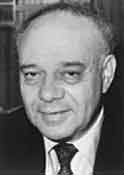
(1918 - 2013)
Jerome Karle was born in New York City on June 18,
1918. He entered the College of New York in 1933, where he received
B.S. in biology. In 1938, he received a master’s degree in biology
from Harvard University. After college, Karle began working in the New
York State Health Department in Albany where he developed a method for
resolving the quantity of fluorine in water.
In 1940, Karle returned to school to the Chemistry
Department at the University of Michigan. In 1944, he received his Ph.D.
in physical chemistry. Jerome Karle married Isabella Karle in 1942,
a physical science student at the University. They worked together on
much of their research investigations and scientific efforts.
After completing his doctorate,
Karle went to work on the Manhattan Project
at the University of Chicago. Later that
year, Karle returned to the University of
Michigan to work in the Naval Research Laboratory.
In 1946, Karle moved permanently to Washington,
D.C. to work at the Naval Research Laboratory
where, in 1967, he became its head scientist
for study on the structure of matter. At
this time, Herbert
Hauptman joined Karle
at the laboratory where they resolved the
propositions of crystal structures, which
ultimately improved the direct methods of
X-ray crystallography and structural analysis.
Hauptman and Karle’s 1953 monograph, “Solution
of the Phase Problem I. The Centrosymmetric Crystal,” introduced
probabilistic methods, which were crucial for phase determination of
X-ray crystallography. They formed mathematical equations for reasoning
the molecular structure of chemical compounds from the configurations
formed when X-rays are diffracted. By 1954, they had laid the foundation
for the direct method of X-ray crystallography (a technique in crystallography
in which the pattern produced by the diffraction of x-rays through the
closely spaced lattice of atoms in a crystal is recorded and then analyzed
to reveal the nature of that lattice). Crystallography is the experimental
science of determining the arrangement of atoms in solids.
Along with Herbert Hauptman, Karle received the Nobel
Prize for Chemistry in 1985, for their collaborative work on crystallography.
Throughout the 1960s and 70s, Karle continued his work
in crystal structure analysis, molecular structure analysis, and furthering
diffraction methods. He developed a linear algebraic formula to determine
any type of anomalous scatter and any amount of wavelengths.
In addition to his research at the Naval Research Laboratory,
Karle has taught numerous courses on physics and mathematics at the
University of Maryland. Karle has also served as President of the International
Union of Crystallography from 1981-1984.
The following press release
from the Royal Swedish Academy of Sciences
describes Hauptman and Karle's work:
This year's Nobel Prizewinners
in Chemistry, Herbert A. Hauptman and Jerome
Karle, have developed what are termed "direct
methods" for the determination of crystal
structure. This development of a method
merits a Nobel Prize since the method now
plays an increasingly important role in
chemical research. It is therefore of importance
to consider the method first.
As early as the turn
of the century, chemists possessed a good
understanding of the geometrical arrangement
of the atoms in carbon compounds. But it
is only through structure determination
using X-ray crystallography that we have
been able to obtain a detailed picture
of the distances between the atoms and
of the angles between the various bonds.
Spectroscopy and electron diffraction have
played a complementary role, especially
in the case of simpler molecules.
The need for exact knowledge
of structure is great within two areas
of chemistry. One of these areas concerns
structural problems, especially those associated
with the function of molecules in biological
contexts. Here, a large number of processes
are considered in similar ways under the
heading "signal - receptor processes".
Examples of these processes are enzyme
activity, antigen - antibody and scent
substance - scent receptor. For understanding
these signal-receptor processes it is necessary
to gain as detailed a knowledge as possible
of both signal molecules and receptor molecules
(active site). The signal molecules are
relatively small and their structure can
be determined. The structure of the receptor
molecule can also be perceived by analogy
with low-molecular compounds. Where giant
molecules are involved, structure determination
of the type for which Perutz and Kendrew
received a Nobel Prize is required. For
determining the low-molecular signal molecules
the Hauptman-Karle direct method must be
used.
In the other important
area, the mechanism and chemical dynamics
of reactions are studied. Questions being
asked also by chemists working with organic
synthesis are, for instance: How, at molecular
level, does a chemical reaction take place?
How does a molecule move, and how is the
structure changed in chemical reactions?
The most important answers are coming from
researchers within theoretical chemistry,
but these must in turn have accurate knowledge
of the structures of reacting molecules.
To summarize: the last
fifteen years have seen a large increase
in structure determinations accomplished
within both inorganic and organic chemistry,
including natural product chemistry. These
determinations have been carried out predominantly
using "direct methods". Looking into the
future we can predict a further increased
need for structure determinations of this
kind.
While it is easy to explain
the importance for chemistry of the two
prizewinners' development of the methods,
it is considerably more difficult without
recourse to mathematical formulae to describe
the achievement itself in a way that is
easy to understand.
When X-rays strike a
crystal, they will be deflected only in
certain definite directions, where the
intensity of irradiation may be measured.
To determine the arrangement of atoms in
a crystal, however, it is not enough to
know the direction and intensity. The "phase" of
each ray so deflected must also be known.
In special cases, it has been possible
to solve this "phase problem" by making
use of the fact that "heavy" atoms containing
many electrons spread the X-rays more strongly
than "light" atoms do. This property of
heavy atoms is used both in "Patterson
methodology", which has been very important
in structural inorganic chemistry, and
in "isomorph substition". The latter is
used when determining the structure of
giant molecules such as proteins. In this
case the heavy atoms can be bound to the
protein without its structure being appreciably
altered. This however is not possible for
the large number of compounds.
Two facts have created
the conditions for the development of the "direct" methods.
The first is that electron density, which
diffuses the X-rays, can never be negative.
The other is that the number of measurements
is much greater than the number of equations
to be solved, which permits the use of
statistical methods. In work done between
1950 and 1956, Hauptman and Karle laid
the foundations for a rational exploitation
of these possibilities, specially the use
of inequalities.
The immense importance
of this work for subsequent development
may easily be followed in the literature.
This is not to say that Hauptman and Karle
alone are responsible for the development,
and other names must be mentioned in particular.
Before Hauptman and Karle published their
work, D. Harker and J.S. Kasper proposed
the use of one inequality, which represents
a special case in the Hauptman-Karle system,
and determined a complicated structure
using it. Important conceptual contributions
were also made by D. Sayre, who anticipated
the practical approach which has later
come to be used. Isabel Karle´s and
M. Woolfson's contributions to the practical
utilization of direct methods have been
crucial, and in this connection the development
of fast computers has been a prerequisite
for the full realization of the value of
the method.
Sources: Wikipedia;
"Jerome
Karle Autobiography"; Britannica;
Nobelprize.org.
Photo courtesy of International
Peace Foundation. |