Simon Kuznets
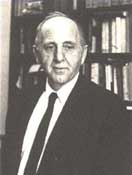
(1901 - 1985)
Simon Kuznets was born in
Kharkiv, Ukraine, on April 30, 1901; he
moved to the United States with his father
in 1922. He attended Columbia University
and received his B.Sc. in 1923, M.A. in
1924, and Ph.D. in 1926. From 1925 to 1926,
Kuznets spent time studying economic patterns
in prices as the Research Fellow at the Social
Science Research Council. It was this work
that led to his book Secular Movements
in Production and Prices, published
in 1930.
From 1931 until 1936, Kuznets was a part-time professor
at the University of Pennsylvania; becoming a full-time professor 1936
until 1954. In 1954, Kuznets moved to John Hopkins University, where
he was Professor of Political Economy until 1960. From 1961 until his
retirement in 1970, Kuznets taught at Harvard.
Kuznets is credited with revolutionising econometrics,
and this work is credited with fueling the Keynesian Revolution. His
most important book is National Income and Its Composition, 1919–1938.
Published in 1941, it is one of the most historically significant works
on Gross National Product. Much of Kuznets’ research and experience
with domestic economics came from his working for the National Bureau
of Economic Research, from 1927 to the 1960s. His work on the business
cycle and disequilibrium aspects of economic growth helped launch development
economics. He also studied inequality over time, and his results formed
the Kuznets Curve.
Simon Kuznets was elected president of the American
Economics Association in 1954. He was awarded the Nobel
Prize for Economics in 1971 for his experimental work on economic
growth. He identified a new economic era, which he titled “modern
economic growth,” which began in Europe and spread toward the
east and south.
Simon Kuznets died on July 8, 1985, at the age of
84.
Sources: Wikipedia;
Nobelprize.org; The
Concise Encyclopedia of Economics.
Photo: wikipedia |