Wanda Landowska
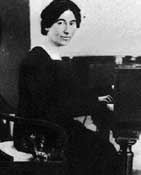
(1879 - 1959)
One of the many debts of gratitude we owe to Wanda
Landowska is for her having viewed music as a continuum rather than
a progressing art ever perfecting itself. Due to this approach she understood
that great work is achieved in any period and embodies a synthesis of
preceding scores as well as a reflection of its own age, if not that
of a vision beyond its own present. Therefore in order to recreate the
spirit behind the music, Landowska immersed herself into a lifelong
study of performance practice and the style surrounding works in other
artistic disciplines. This became not a final goal but a point of departure,
as she eventually came to understand the comedies of Moliere and Marivaux,
the paintings of Watteau as she did her Couperin and Bach.
One view of Landowska's musical impact comes from
Denise Restout, who worked with the harpsichordist for some twenty-six
years. To hear the Goldberg Variations played for the first time this
century on the harpsichord, one of Landowska's great achievements, was
an astonishing experience in which Restout found herself "stunned
more than anything else. It was like being in front of one of the greatest
works of nature." Restout became her assistant, and now, an octogenarian,
possesses a lucid ability to recall her mentor's life and art. While
Restout supervised and edited one volume of Landowska's writings, there
is a great deal awaiting publication. This is an urgent matter as she
is compelled to teach daily to maintain herself, unable to devote all
her efforts to produce a biography of Landowska and edit her unpublished
writings and correspondence. In a lengthy interview with Restout in
Landowska's house in Lakeville, Connecticut, we learn of events in Landowska's
life which clarify how her art came into being.
A desire to explore the music for her instrument constantly
drew Landowska to explore libraries, "even when she was on tour"
as Restout pointed out, in order to copy manuscripts. While her scholarship
was impeccable, she was and is often criticized, even for her instrument,
especially its use of a 16 foot stop. While this overlooks the fact
that Handel had such a harpsichord and it is present on English and
German models from the 18th century, Restout also added that the current
inclination for copying surviving French models is in itself suspect:
"Don't the instrument makers know that during the Revolution the
large harpsichords owned by the wealthy were destroyed? Landowska never
took authenticity for a god. She was trying to bring the music to life."
How the quest for recreating music of the past initiated was due to
Landowska's genius and attraction to this forgotten and lost repertoire.
Her home environment was atypical and nurturing for her art: Landowska's
father was a lawyer in Warsaw while her mother, an expert in six languages,
was the first to translate Mark Twain into Polish. Restout spoke of
her mentor's formation:
"As a little girl her teacher was a Chopin player,
Michalowski [who also taught Levitski and Sofronitsky]. She was at first
educated in that school. But from a very early age, her personal taste
was for music of older times. She once heard a pianist play a piece
by Rameau, which was very rare in those times, and she was fascinated,
she loved it. Her teachers realized that she was really a musical genius
and that they should not impose on her too much. Even her first teacher
Klenczynski [who interviewed Chopin's associates for his study of the
composer] was much too lenient and Wanda's mother said she could not
continue with him- 'he will let you do anything you want and it should
not be done that way.' So she went to Michalowski who was much more
strict with her but understood who she was and let her play Bach. These
men did not know the real interpretation of Bach. It was the time when
the Bach tradition was gone. She studied Chopin with him and was a wonderful
Chopin player herself and people would have given anything to have her
record or play Chopin more often. There was a conflict in this way as
she was brought up in the late Romantic tradition and wanting to do
something else- to go back to the old masters. But what happened to
her was that first of all, when she was about sixteen she developed
a small growth in the hand. What was she going to do? She had a lovely
voice and even thought of becoming a singer. But her mother sent her
to Berlin to study composition and she studied with Urban, who had been
the teacher of Paderewski. While she studied composition in Berlin and
her hand was finally better and she could play again, she met a young
Polish man who became her husband- Henry Lew. He was not exactly a musician
but was interested in Polish folklore, mostly a writer. And he understood
that she would not develop in the way she wanted to go if she stayed
in Berlin. He knew that in Paris she would have many more chances. So
they went to Paris and married, and there she was introduced to the
Schola Cantorum, where there was Vincent D'Indy and all the great musicologists
of the day, Pirro, and Albert Schweitzer, who came from Alsace very
often to play organ at their concerts. So she was soon drawn into that
circle in Paris where all the research was done into the work of Bach
but not the harpsichord works, mostly the Cantatas, the Passions and
orchestral works. She was introduced to French music, to Couperin and
Rameau. But she knew the piano was not the right instrument for it so
she visited all the museums in Europe with old instruments and she even
took the chief engineer of Pleyel with her to take notes and measurements
of all the instruments in Brussels, in Leipzig, in England. Because
the thing she discovered very quickly was that there were no harpsichords
that were alike. Pianos are all made in a series and are alike but not
harpsichords. Some builders would have small instruments, others large,
some builders were good, others bad, and in all kinds of instruments
from the 16th century to the end of the 18th century there were improvements
in the building. So she asked this man to study all of this because
when she arrived in Paris in 1900 Pleyel had already built a harpsichord,
smaller than this [her model], which was not bad but not very good.
Louis Diemer [Alfred Cortot's teacher] played on it, but he was a pianist
who played old music but did not go into the research of how to play
it and it sounded boring to most people who heard him on the piano or
the harpsichord because he didn't know how to get it from the harpsichord
and he did not have a proper instrument. The first performers were not
successful because the audience was not prepared for that type of music
in the first place. They just didn't like it. Wanda once had quite an
experience when she first came to Paris because she used to buy her
music in a store, and one day the [proprietor] told her that he just
acquired a very special instrument from an exhibition in Paris in 1900,
so she went to see it. It was a harpsichord with three keyboards, which
was tremendous and there was a painting on the lid that represented
a copy of the harpsichord and a man standing in front of it seeming
to offer it to a woman sitting on a throne, and the story was that the
man was Poniatowski offering the harpsichord to Catherine the Great
of Russia. It was quite a story. So she started to play on this instrument
and she was absolutely in love with it, although the instrument was
not in very good shape. It was a Hasse, a German builder, with a lower
16 foot register, an 8 foot, 4 foot and even a 2 foot register. She
was absolutely stunned by it but it was at a time when she had to leave
Paris for a few months for a concert tour."
Landowska acquired many old instruments and soon began
touring with the Pleyels made for her own use, incorporating the best
features of what had been examined amongst the museum instruments, capable
of adapting to serve the entire literature, as well as new works written
for her by Poulenc, Falla, Rieti and others. The Poulenc on this disc
is the sole example of Landowska's performance of contemporary music.
Poulenc had attended the premiere of Falla's Retablo de Maese Pedro
, which has a harpsichord part. Poulenc recalled:
"It was there that I met Wanda Landowska, who
was playing the harpsichord in Falla's Retablo . It was the first time
that the harpsichord had entered a modern orchestra. I was fascinated
by the work and by Wanda. 'Write a concerto for me' she said. I promised
her to try. My encounter with Landowska was a capital event in my career.
I have for her as much artistic respect as human tenderness. I am proud
of her friendship, and I shall never be able to say how much I owe her.
"I wrote the Concerto Champetre from October
1927 to September 1928, or rather I wrote it a first time. You know
that Wanda Landowska is an interpreter of genius. The way in which she
has resuscitated and recreated the harpsichord is a sort of miracle.
I worked with her on the first version of my concerto. we went over
it note by note, measure by measure."
When Poulenc received a copy of this performance with
Stokowski, he wrote to Landowska: "How can I tell you my emotion
at hearing my goddess play the Champetre ? What joy you gave me! I suddenly
felt rejuvenated, happy. The cherries from your garden at Saint-Leu
were in my mouth. I confess to stealing some in those days, long ago,
when I was but a student musician. Now that i wonder every day if my
music will live, you have given me the illusion that it will. For this,
thank you from the bottom of my heart."
Landowska's home in Saint-Leu became a center for
the study and performance of old music, a rare experiment in a Paris
dominated by an inflexible Conservatoire which primarily concerned with
virtuosity. It all began on a Sunday, July 3, 1927, with the inauguration
of a concert hall. More than 250 invited guests came. One journalist
reported on the event:
"At a quarter past three appeared Wanda Landowska
and Alfred Cortot on the platform. A great ovation greeted the celebrated
artists. Before the beginning of the musical part, Mme. Landowska addressed
a short speech to the audience. She expressed her happiness in having
realized the dream of her life and her thanks to her friends who helped
her in this task. She said that this day was the happiest in her life.
"The concert began with J. S. Bach's Concerto
a due Cembali certati, performed on two pianos by Wanda Landowska and
Alfred Cortot. Mme. Landowska afterward played two preludes and fugues
from the 'Wohltemperirtes Clavier' on the harpsichord. Together with
Cortot she performed an Allemande by Couperin and a sonata by Pasquini,
and afterwards played several pieces for harpsichord by Couperin, Dandrieu,
Rameau and ChambonniËres. Mozart's Sonata for two pianos, performed
by Mme. Landowska and Alfred Cortot, closed the unusual program."
Restout describes the activities at what many had
considered a "Temple of Music":
"The house itself was in a suburb of Paris. It
had three floors and a lovely garden. Wanda decided in the back of the
garden to build a small concert hall. It contained about 300 people
and she gave 12 concerts every summer followed by 12 public master classes.
Students came from all over the world and there were not only harpsichordists
but singers, flutists, every [kind of] musician came to study there.
In the audience there were many writers, who came because the way Landowska
spoke French was so beautiful that, although they did not know much
about music, they loved the way she spoke French, to hear her French.
She had a Polish accent but it was very refined. She had many friends
who were great writers and had lived in that atmosphere for a number
of years: she had known Rene Lalou, Andre Rousseau, Colette. I still
have a letter from Colette. Here she knew Virgil Thomson very well.
When I first met Landowska in 1933 I was a student at the Paris Conservatoire,
studying piano and not liking it very much. I was studying with Lazare
Levy [pupil of Diemer] but I did not like the atmosphere of practicing
eight hours a day. It was not music, it was slavery. I decided to change
instruments, perhaps to organ. We happened to live in the same town
as Landowska and my mother insisted that I meet her for advice."
Restout spoke with her after a concert: as she had her wait, sitting
by her side, Restout was amazed to see "all the great musicians
of our time coming to greet her." Poulenc was a frequent guest,
as was Alfred Cortot, who sent his pupils to Landowska to study Bach
with her. Restout continues: "Before she had St.-Leu, she was teaching
in Cortot's school in Paris." Landowska asked her to play, and
Restout auditioned with a Bach Prelude and Fugue and a work by Debussy.
Landowska began making suggestions as to ornamentation and pedaling,
"not criticizing, but saying what was good and just telling me
what to do. It was so wonderful. Afterwards she said 'I think I will
give you an introduction to Joseph Bonnet, he will be a good teacher
for you.' I was a little anxious and she asked 'Do you like the harpsichord?'
and I answered that I did and she asked 'Then why don't you study organ
and harpsichord too because they are not far apart?' So I started with
Bonnet and her and it was like going into paradise because her way of
teaching was so totally different from what I had seen before. It was
music in the first place. Only music must be the important thing. Of
course we had to go through a very rigorous training. She had devised
herself many exercises for the fingers, for relaxation and of course
the harpsichord has a special technique very different from the piano.
But this was only the means, so that with a good preparation of the
fingers we could play properly the music of Bach, Handel, Scarlatti,
Couperin. The next thing which was important to me was the way she explained
the style of the composers, because all the teachers I had studied with,
whether you worked on Bach, Chopin or Rachmaninoff, it was all the same,
there was no explanation. There was no sense of historical perspective.
With Wanda it was different- everything became alive with her. Then
the atmosphere was wonderful because there were students from many different
countries. It was so marvelous that after three years I stopped playing
the organ and concentrated on the harpsichord. Bonnet was an interesting
musician to work with because he was interested in French organ music
of the 17th and 18th centuries. I found myself in a strange position
once because he admired Landowska very much and knew that her knowledge
of the ornaments was tremendous. When he had questions, he would ask
me 'Would you ask Landowska. . .?' And she was interested in the organ
so she would ask me 'Would you ask Bonnet about. . .?'
"It's a completely different approach. This was
at the end of the romantic era of pianism. Landowska was brought up
first in that way."
The idyllic St.-Leu came to an end with the arrival
of the Nazis in France. Landowska and Restout escaped to Portugal and
sailed to the United States. A new existence in America unfolded inside
an old Victorian house in a small Connecticut village where Georges
Simenon lived. A yellow porch with a green-stained roof leads one inside
the Victorian house. Restout guides one through the rooms past two Pleyel
harpsichords, a Steinway grand piano, and photos of the young musician
with Tolstoy. In Landowska's workroom the dining table became her desk.
A painting of a Madonna and child hangs nearby: "She had found
it on a concert tour in Spain and brought it back to France wrapped
in the harpsichord box. It was in St.-Leu and was one of the few things
the Nazis didn't take." The walls have portraits of Landowska.
Above the bookshelf a portrait of FranÁois Couperin. Restout
described their flight:
"We came from France because of the Nazi's advance
and we had to leave, sailing from Lisbon. We arrived in New York the
day of Pearl Harbor and had no idea what had happened. We were sent
to Ellis Island and that was quite an ordeal, with thousands of Japanese
who had been brought up there to be detained. The second day we were
in this enormous hall trying to find a place to sit. Wanda was inching
around the wall and found a piano, which was a small upright, dirty
as could be. She said, 'We don't know why we're here or how long we'll
be here, so I can work.' And she did. Finally she was called and it
was like a judgment. Fortunately a friend in New York who saw that we
did not come out of the ship went to all the great musicians asking
for letters of recommendation, saying who she was and why she was coming
to this country and so forth. After lots of deliberation they finally
let us out and we had to deposit bonds, 500 dollars for each of us and
we had arrived with 1,300 dollars! We had already been refugees in the
south of France for a year and a half. We left St.-Leu, where her home
and school had been, in 1940. The beginning of the war was rather strange-
you didn't know what was going to happen. All the French warned her
not to stay, as she was a naturalized French subject but born Polish,
and one thing they didn't like very much- that she was of Jewish origin.
Her parents and grandparents had been converted but still that was not
enough for the Nazis. And besides that they knew who she was and exactly
what she had in her wonderful collection of old instruments and a library
of about 10,000 volumes and manuscripts. They were very interested in
that. Wanda herself never realized the imminent danger and wanted to
stay in St.- Leu. Finally when we began to hear the fighting fifteen
miles from St.-Leu we decided it was time to go. We piled into a few
suitcases some clothes, a few books and music. When we had two boxes
together a friend drove us south to a town along the Loire river. We
spent the night in a hotel and the next day a student of hers who lived
there came in white as a sheet saying 'You cannot stay here, the Germans
are coming! They are already in Paris.' We didn't know what to do so
I went to the station hoping to find trains going south. There were
hundreds of people and no train. I tried to rent a car and went to all
the garages and there was not a car to be had. I was desperate. I had
a crazy idea: I can go on bicycle and put Wanda on my back. At least
we can go better than on foot. It led to something interesting. I saw
a bicycle shop and went in and in the courtyard there was a beautiful
car so I asked 'Is this your car?' The driver was going to carry people
to Paris, so I offered more to take us south. 'You have to leave early,
at 4 in the morning, there is a lot of traffic on the roads south.'
I went back to the hotel and told Wanda we had a car and had to leave
early and she said 'Four in the morning?!' She didn't like it but for
once I was disrespectful and said 'like it or not, we are going at four'.
She was a night person, she liked to work at night. We went further
south to Mountaubon and knew some people there and managed to find a
room but the news was getting worse all the time. We then went to the
Pyrenees to Banyuls-sur-Mer where her friend the sculptor Aristide Maillol
had his studio. It never got better. In early 1941 we began to realize
that something was really wrong. Through the underground I got news
from my parents that something terrible had happened to Landowska's
house in St.- Leu. Her home had been completely looted of everything-
the old instrument museum, the manuscripts, only some furniture remained."
Upon arriving in America, Landowska played a recital
of Bach's Goldberg Variations and soon afterwards appeared as pianist
in performances of Mozart. While her harpsichord playing has been well
documented on recordings, Landowska's activity as a pianist would have
remained a greater mystery had not these two Mozart concertos survived.
Landowska approached the harpsichord and its literature by taking risks
and playing with an astonishing expressivity in a highly florid manner.
In her time, such an approach was given to the piano, making it all
the more fascinating to hear her on this instrument as she performs
on it in a manner completely opposed to the virtuosic style of the period,
using the pedal sparingly and giving more focus to the fingers' articulation
and implementation of improvised flourishes, the eingange which are
referred to in her writings on the composer. One keen observer and admirer
was the critic and composer Virgil Thomson, who knew her in France before
the Second World War. The following review, of an evening given in New
York's Town Hall on which she performed on both harpsichord and piano,
featured Mozart's Sonata in D, K.311. His comments equally apply to
the concertos present on this disc, offering the reflections of a highly
sensitive listener focusing in on a pianism as unique as her harpsichord
playing:
"Wanda Landowska's playing of the harpsichord
at Town Hall last night reminded one all over again that there is nothing
in the world like it. There does not exist in the world today, nor has
there existed in my lifetime, another soloist of this or of any instrument
whose work is so dependable, so authoritative and so thoroughly satisfactory.
From all the points of view- historical knowledge, style, taste, understanding
and spontaneous musicality- her renderings of harpsichord repertoire
are, for our epoch, definitive. Criticism is unavailing against them,
has been so, indeed, for thirty years.
"Her piano playing is another story. She likes
to play Mozart in evocation of the way Mozart himself must have, or
might have, played on the early fortepiano. To this end she employs,
as Mozart certainly employed, a high- fingered technique similar to
that which gives the best result in harpsichord playing. She never plays
louder than forte , not because she wishes to keep Mozart's music small
but because she wishes to keep it musical. The modern pianoforte gives
another kind of sound, in many cases an ugly one, when played with arm
weight. In any case, the extension of piano writing into the domain
of modern power pianism, an extension that began only with Beethoven,
seems inappropriate to her, as it does to many modern musicians.
"And so, limiting her dynamic range to approximately
what was available to Mozart on the Stein fortepiano, she plays his
solo sonatas for the musical contrasts that they unquestionably possess
rather than for those for which they were never planned. As to rhythm,
tempo, phrasing and ornamentation- all the rendering of their basic
musical content- her performance is matchless. She makes them large
and alive and vivid, just as she does the harpsichord works of Couperin
and Scarlatti and Rameau and Bach. Her conceptions and interpretations
are a lesson to any musician. Pianistically, all the same, her execution
is a little unsatisfactory.
"It is not unsatisfactory because of any technical
inefficiency. It is unsatisfactory because the modern pianoforte, a
less brilliant instrument than Mozart's, does not yield what brilliance
it has save by the exploitation of its full dynamic range. And Mozart's
piano music, as we know, was of brilliance and virtuosity all compact.
It need not glitter, but it has to shine. Landowska gives us a photograph
of it on the modern piano, very much as other pianists give us a photograph
of Bach's harpsichord music.
"Our instrument is closer to Mozart's than it
is to the plucked instruments. But it is not the same instrument. That
is why Mozart's symphonies and operas and chamber music always sound
more vivid to us in execution than his piano music does. Fiddles, wind
instruments and voices do not have to walk through Mozart on tiptoes.
The pianoforte, no matter how elegant its phrasing, inevitably sounds
clumsy and a little meticulous.
"I recommend Landowska's pianoforte Mozart, because
I recommend any music she touches. It is the best piano Mozart I know.
It is a model of understanding musically, as it is a tour de force technically.
Nevertheless, by the very fact of being a translation- which her harpsichord
playing of course, is not- it is a slightly less authentic, less vigorous
reconstitution."
Landowska writes of the C major Concerto, K.415:
"The first movement . . . is a type of alla marcia
which advances in canonic imitations. Tranquil at first, it augments
little by little and develops into the same kind of triplet motive which
marks the opening of the Jupiter Symphony. Thus this concerto, which
has been neglected and ignored for so long, contains from its first
notes elements of grandeur and dramatic power.
"The Andante is a tender and lyrical dialogue
between the soloist and the strings, the latter supported from time
to time by oboes, bassoons, and horns. But above all it is the Finale,
a frolicsome dance in 6/8, which deserves our fullest attention. [A]
letter of Mozart to his father from Vienna, January 22, 1783, throws
much more penetrating and informative light on the subject: 'I shall
send the cadenzas and Eingange (short introductory passages announcing
the approach of new moods; they had to be extemporized like the cadenzas,
although they represented a very different aspect of improvisation),
to my dear sister at the first opportunity. I have not yet altered the
Eingange in the rondo, for whenever I play this concerto, I always play
whatever occurs to me at the moment.'
"The use of cadenzas at the end of each movement
is still common today, while the small fermatas, upon which we come
unexpectedly here and there, and most significantly at the Eingange
, which twice announce the approach of the sublime adagio in C minor,
have been virtually ignored since the performances by Mozart himself
or by the musicians of his time. At the end of the rondo, Mozart introduces
a popular folksong, ingratiating and fresh in mood, against the murmurings
of the strings."
Concerto in E-flat, K.482:
"The Concerto. . . belongs to the period of Mozart's
great virtuosity, which extended from August 1784 to January 1786. Mozart
had become the fashionable musician of the day in Vienna; he was feted
by the Emperor, the aristocracy, and even by his own colleagues. During
this period he composed a great number of works which were performed
in public and at private academies. Mozart played the E Flat Major Concerto
in Vienna on December 16, 1785.
"The Allegro, with its symphonic features, is
powerful, joyous, and solidly built, with broad themes against which
garlands and light arabesques tenderly nestle. Between this movement
and the happy spirited Finale, the admirable Andante- a sorrowful and
touching lament- gravely stands out. Ornamented throughout with infinite
care by the master himself, this Andante is perhaps one of the most
beautiful in all of Mozart's works. The sweet serenity of a little interlude
by woodwind instruments interrupts this pathetic and poignant lament
so divinely simple. Mozart had to repeat this movement after the first
performance of the concerto.
"In the Finale, a marvel of grace and sprightliness,
Mozart seems to have forgotten his despair and his tears. From the very
first note it bounces with that waggish gaiety that is Mozart's alone.
The effervescence of a Neapolitan dance mingles with the sentimental
tenderness of a Viennese landler . The strings set upon a mischievous
chase; the whole piece rings out in exuberant joy. The bassoon suddenly
takes on an unsuspected agility; it whirls about, curtsies, and touches
us by its efforts at being light-footed. Over a pedal-point the flute
sings away madly with the tender abandonment of a prima donna, with
trills, mordents, and appoggiaturas in the purest Italian tradition.
"In this Finale, all is gay, light, carefree,
and diaphanous, although it is solidly built and inexorably strong.
It is filled with radiance, sonorous cascades, and arabesques. Everything
in it sings, laughs, and dances; it is like a small opera buffa with
its outbursts of tender feelings and happiness. But toward the end a
surprise awaits us- a strange and delicious intermezzo. There is a sudden
modulation and a fermata that invites the soloist to improvise. Then
a minuet, andantino cantabile, appears, stately, delicate, ad somewhat
precious, as if amazed at finding itself in the midst of those exuberant
and tumultuous voices. Its structure is so clear that we become immediately
aware of Mozart's intention. It is a dialogue; the orchestra proposes
a theme of simple outlines h the soloist takes up and must embellish
with ornaments according to the laws of the time."
Sources: Arbiter
Records. Copyright Allan Evens, 1996. |