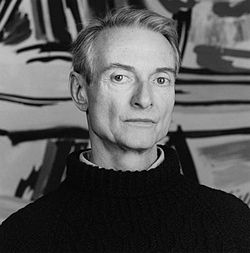
Roy Lichtenstein was a Jewish American pop artist.
From his studio in New York City, Roy Lichtenstein
did cartoon inspired paintings that helped launch
the Pop Art movement. He was unique in that
he developed a new visual language in an avant-garde
style that was disruptive to viewers and yet
was accessible and popular with them. He also
did innovative art work that incorporated many
late 20th-century movements and addressed a
number of social issues.
His thirty-five year career of public recognition
was celebrated in 1993-94 by The Solomon R.
Guggenheim Museum in New York with a large
scale retrospective of his work.
He
was born in Manhattan and went to high school there. By age
14, he was taking art classes at the Parsons School of Design
and also studied briefly with Reginald Marsh at the Art Students
League in 1939. He then attended Ohio State University where
his major influence was Hoyt Sherman, whose figure-ground
relationships inspired Lichtenstein's treatment of cliche
subjects.
In 1943, he was drafted
into the Army and served in Europe and then
returned to Ohio State, completing his BFA
and MFA and then teaching at that campus.
From Cleveland, Ohio, he made frequent trips
to New York and started to exhibit there in
1949. In the 1950s, he used various techniques
of Abstract Expressionism, did figurative
work, and like many of his generation, began
employing pop art images. But he was searching
for a style.
In 1957, he left Cleveland to teach at New
York University in Oswego, New York, and in
1961, he began teaching at Rudgers University,
where one of his colleagues, Allan Kaprow,
used cartoon figures. Through Kaprow, he met
many renegade New York artists including Claes
Oldenburg and Jim Dine; it was a circuitous
return to the New York from where he had a
long journey.
In
1962, he had a landmark exhibition at the Castelli Gallery
that showed enlarged depictions of advertisements and comic
strip images. In fact, it was gallery owner Leo Castelli
who, as a major promoter of the contemporary art scene, was
a key person in launching his career.
Although Lichtenstein's pop paintings had
widespread popular acceptance, he began in
1965 to do Abstract Expressionism, but in
contrast to others in that style, he did work
that was hard and static. In the 1990s, he
did large-scale abstract interiors, and he
also worked in ceramics and enamelled steel.
Throughout his career, he appeared in many
documentary films and did posters for entertainments including
Bill Clinton's United States presidential campaign. Lichtenstein's
murals are in Dusseldorf, Germany; Tel
Aviv, Israel; and
New York City. He died unexpectedly on September 29, 1997,
from virul pneumonia, having worked until the time of his
death.