Karl Marx
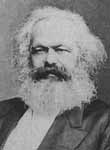
(1818 - 1883)
Karl Marx, the son of Hirschel and Henrietta Marx,
was born in Trier, Germany, in 1818. Hirschel Marx was a lawyer and
to escape anti-Semitism decided
to abandon his Jewish faith when Karl was a child. Although the
majority of people living in Trier were Catholics, Marx decided to
become a Protestant. He also changed his name from Hirschel to
Heinrich.
After schooling in Trier (1830-35), Marx entered
Bonn University to study law. At university he spent much of his time
socializing and running up large debts. His father was horrified when
he discovered that Karl had been wounded in a duel. Heinrich Marx
agreed to pay off his son's debts but insisted that he moved to the
more sedate Berlin University.
The move to Berlin resulted in a change in Marx
and for the next few years he worked hard at his studies. Marx came
under the influence of one of his lecturers, Bruno Bauer, whose
atheism and radical political opinions got him into trouble with the
authorities. Bauer introduced Marx to the writings of G. W. F. Hegel,
who had been the professor of philosophy at Berlin until his death in
1831.
Marx was especially impressed by Hegel's theory
that a thing or thought could not be separated from its opposite. For
example, the slave could not exist without the master, and vice
versa. Hegel argued that unity would eventually be achieved by the
equalizing of all opposites, by means of the dialectic (logical
progression) of thesis, antithesis and synthesis. This was Hegel's
theory of the evolving process of history.
Heinrich Marx died in 1838. Marx now had to earn
his own living and he decided to become a university lecturer. After
completing his doctoral thesis at the University of Jena, Marx hoped
that his mentor, Bruno Bauer, would help find him a teaching post.
However, in 1842 Bauer was dismissed as a result of his outspoken
atheism and was unable to help.
Marx now tried journalism but his radical
political views meant that most editors were unwilling to publish his
articles. He moved to Cologne where the city's liberal opposition
movement was fairly strong. Known as the Cologne Circle, this liberal
group had its own newspaper, The Rhenish Gazette. The
newspaper published an article by Marx where he defended the freedom
of the press. The group was impressed by the article and in October,
1842, Marx was appointed editor of the newspaper.
In Cologne Karl Marx met Moses
Hess, a radical who called himself a socialist. Marx began
attending socialist meetings organized by Hess. Members of the group
told Marx of the sufferings being endured by the German working-class
and explained how they believed that only socialism could bring this
to an end. Based on what he heard at these meetings, Marx decided to
write an article on the poverty of the Mosel wine-farmers. The
article was also critical of the government and soon after it was
published in the Rhenish Gazette in January 1843, the
newspaper was banned by the Prussian authorities.
Warned that he might be arrested Marx quickly
married his girlfriend, Jenny von Westphalen, and moved to Paris
where he was offered the post of editor of a new political journal, Franco-German
Annals. Among the contributors to the journal was his old mentor,
Bruno Bauer, the Russian anarchist, Michael Bakunin and the radical
son of a wealthy German industrialist, Friedrich Engels.
In Paris Marx began mixing with members of the
working class for the first time. Marx was shocked by their poverty
but impressed by their sense of comradeship. In an article that he
wrote for the Franco-German Annals, Marx applied Hegel's
dialectic theory to what he had observed in Paris. Marx, who now
described himself as a communist, argued that the working class (the
proletariat), would eventually be the emancipators of society. When
published in February 1844, the journal was immediately banned in
Germany. Marx also upset the owner of the journal, Arnold Ruge, who
objected to his editor's attack on capitalism.
Marx had now become a close friend of Friedrich
Engels, who had just finished writing a book about the lives of the
industrial workers in England.
Engels shared Marx's views on capitalism and after their first
meeting Engels wrote that there was virtually "complete
agreement in all theoretical fields". Marx and Engels decided to
work together. It was a good partnership, whereas Marx was at his
best when dealing with difficult abstract concepts, Engels had the
ability to write for a mass audience.
While working on their first article together, The
Holy Family, the Prussian authorities put pressure on the French
government to expel Marx from the country. On 25th January 1845, Marx
received an order deporting him from France. Marx and Engels decided
to move to Belgium, a country that permitted greater freedom of
expression than any other European state. Marx went to live in
Brussels, where there was a sizable community of political exiles,
including the man who converted him to socialism, Moses
Hess.
Friedrich Engels helped to financially support
Marx and his family. Engels gave Marx the royalties of his recently
published book, Condition of the Working Class in England and
arranged for other sympathizers to make donations. This enabled Marx
the time to study and develop his economic and political theories.
Marx spent his time trying to understand the workings of capitalist
society, the factors governing the process of history and how the
proletariat could help bring about a socialist revolution. Unlike
previous philosophers, Marx was not only interested in discovering
the truth. As he was to write later, in the past "philosophers
have only interpreted the world in various ways; the point is, to
change it".
In July 1845 Marx and Engels visited England. They
spent most of the time consulting books in Manchester Library. Marx
also visited London where he met the Chartist leader, George Julian
Harney and political exiles from Europe.
When Karl Marx returned to Brussels he
concentrated on finishing his book, The German Ideology. In
the book Marx developed his materialist conception of history, a
theory of history in which human activity, rather than thought, plays
the crucial role. Marx was unable to find a publisher for the book,
and like much of his work, was not published in his lifetime.
In January 1846 Marx set up a Communist
Correspondence Committee. The plan was to try and link together
socialist leaders living in different parts of Europe. Influenced by
Marx's ideas, socialists in England held a conference in London where
they formed a new organization called the Communist League. Marx
formed a branch in Brussels and in December 1847 attended a meeting
of the Communist League' Central Committee in London. At the meeting
it was decided that the aims of the organization was "the
overthrow of the bourgeoisie, the domination of the proletariat, the
abolition of the old bourgeois society based on class antagonisms,
and the establishment of a new society without classes and without
private property".
When Marx returned to Brussels had concentrated on
writing The Communist Manifesto. Based on a first draft
produced by Friedrich Engels called the Principles of Communism,
Marx finished the 12,000 word pamphlet in six weeks. Unlike most of
Marx's work, it was an accessible account of communist ideology.
Written for a mass audience, The Communist Manifesto summarized the forthcoming revolution and the nature of the communist
society that would be established by the proletariat.
The Communist Manifesto was published in
February, 1848. The following month, the government expelled Marx
from Belgium. Marx and Engels visited Paris before moving to Cologne
where they founded a radical newspaper, New Rhenish Gazette.
The men hoped to use the newspaper to encourage the revolutionary
atmosphere that they had witnessed in Paris.
After examples of police brutality in Cologne,
Marx helped establish a Committee of Public Safety to protect the
people against the power of the authorities. The New Rhenish
Gazette continued to publish reports of revolutionary activity
all over Europe, including the Democrats seizure of power in Austria
and the decision by the Emperor to flee the country.
Marx's excitement about the possibility of world
revolution began to subside in 1849. The army had managed to help the
Emperor of Austria return to power and attempts at uprisings in
Dresden, Baden and the Rhur were quickly put down. On 9th May, 1849,
Marx received news he was to be expelled from the country. The last
edition of the New Rhenish Gazette appeared on 18th May and
was printed in red. Marx wrote that although he was being forced to
leave, his ideas would continue to be spread until the
"emancipation of the working class".
Marx now went to Paris where he believed a
socialist revolution was likely to take place at any time. However,
within a month of arriving, the French police ordered him out of the
capital. Only one country remained who would take him, and on 15th
September he sailed for England. Soon after settling in London Jenny
Marx gave birth to her fourth child. The Prussian authorities applied
pressure on the British government to expel Marx but the Prime
Minister, John Russell, held liberal views on freedom of expression
and refused.
With only the money that Engels could raise, the
Marx family lived in extreme poverty. In March 1850 they were ejected
from their two-roomed flat in Chelsea for failing to pay the rent.
They found cheaper accommodation at 28 Dean Street, Soho, where they
stayed for six years. Their fifth child, Franziska, was born at their
new flat but she only lived for a year. Eleanor was born in 1855 but
later that year, Edgar became Jenny Marx's third child to die.
Marx spent most of the time in the Reading Room of
the British Museum, where he read the back numbers of The
Economist and other books and journals that would help him
analyze capitalist society. In order to help supply Marx with an
income, Friedrich Engels returned to work for his father in Germany.
The two kept in constant contact and over the next twenty years they
wrote to each other on average once every two days.
Friedrich Engels sent postal orders or £1 or £5
notes, cut in half and sent in separate envelopes. In this way the
Marx family was able to survive. The poverty of the Marx's family was
confirmed by a Prussian police agent who visited the Dean Street flat
in 1852. In his report he pointed out that the family had sold most
of their possessions and that they did not own one "solid piece
of furniture".
Jenny helped her husband with his work and later
wrote that "the memory of the days I spent in his little study
copying his scrawled articles is among the happiest of my life."
The only relief from the misery of poverty was on a Sunday when they
went for family picnics on Hampstead Heath.
In 1852, Charles Dana, the socialist editor of the New York Daily Tribune, offered Marx the opportunity to write
for his newspaper. Over the next ten years the newspaper published
487 articles by Marx (125 of them had actually been written by Engels).
Another radical in the USA, George Ripley, commissioned Marx to write
for the New American Cyclopaedia. With the money from Marx's
journalism and the £120 inherited from Jenny's mother, the family
were able to move to 9 Grafton Terrace, Kentish Town.
In 1856 Jenny Marx, who was now aged 42, gave
birth to a still-born child. Her health took a further blow when she
contacted smallpox. Although she survived this serious illness, it
left her deaf and badly scarred. Marx's health was also bad and he
wrote to Engels claiming that "such a lousy life is not worth
living". After a bad bout of boils in 1863 Marx told Engels that
the only consolation was that "it was a truly proletarian
disease".
By the 1860s the work for the New York Daily
Tribune came to an end and Marx's money problems returned. Engels
sent him £5 a month but this failed to stop him getting deeply into
debt. Ferdinand Lassalle, a wealthy socialist
from Berlin also began sending money to Marx and offered him work as
an editor of a planned new radical newspaper in Germany. Marx,
unwilling to return to his homeland and rejected the job. Lassalle
continued to send Marx money until he was killed in a duel on 28th
August 1864.
Despite all his problems Marx continued to work
and in 1867 the first volume of Das Kapital was published. A
detailed analysis of capitalism, the book dealt with important
concepts such as surplus value (the notion that a worker receives
only the exchange-value, not the use-value, of his labour); division
of labour (where workers become a "mere appendage of the
machine") and the industrial reserve army (the theory that
capitalism creates unemployment as a means of keeping the workers in
check).
In the final part of Das Kapital Marx deals
with the issue of revolution. Marx argued that the laws of capitalism
will bring about its destruction. Capitalist competition will lead to
a diminishing number of monopoly capitalists, while at the same time,
the misery and oppression of the proletariat would increase. Marx
claimed that as a class, the proletariat will gradually become
"disciplined, united and organised by the very mechanism of the
process of capitalist production" and eventually will overthrow
the system that is the cause of their suffering.
Marx now began work on the second volume of Das
Kapital. By 1871 his sixteen year old daughter, Eleanor Marx, was
helping him with his work. Taught at home by her father, Eleanor
already had a detailed understanding of the capitalist system and was
to play an important role in the future of the British labor
movement. On one occasion Marx told his children that "Jenny
(his eldest daughter) is most like me, but Tussy (Eleanor) is
me."
Marx was encouraged by the formation of the Paris
Commune in March 1871 and the abdication of Louis Napoleon. Marx
called it the "greatest achievement" since the revolutions
of 1848, but by May the revolt had collapsed and about 30,000
Communards were slaughtered by government troops.
This failure depressed Marx and after this date
his energy began to diminish. He continued to work on the second
volume of Das Kapital but progress was slow, especially after
Eleanor Marx left home to become a schoolteacher in Brighton.
Eleanor returned to the family home in 1881 to
nurse her parents who were both very ill. Marx, who had a swollen
liver, survived, but Jenny Marx died on 2nd December, 1881. Karl Marx
was also devastated by the death of his eldest daughter in January
1883 from cancer of the bladder. Karl Marx died two months later on
the 14th March, 1883.
(1) Karl Marx and Friedrich Engels, The
Communist Manifesto (1848)
Communists openly declare that their ends can be attained only by the
forcible overthrow of all existing social conditions. Let the ruling
classes tremble at a Communistic revolution. The proletarians have
nothing to lose but their chains. They have a world to win.
Working men of all countries, unite!
(2) Karl Marx, New Rhenish Gazette (January, 1849)
The liberation of Europe is dependent on a
successful uprising by the French working class. But every French
social upheaval necessarily founders on the English bourgeoisie, on
the industrial and commercial world-domination of Great Britain.
England will only be overthrown by a world war,
which is the only thing that could provide the Chartists, the
organized party of the English workers, with the conditions for a
successful rising against their gigantic oppressors.
(3) In a letter written in March 1850, Jenny Marx
described being evicted from their home in London.
The landlady demanded £5 that we still owed her.
As we did not have the money at the time two bailiffs came and
sequestrated all my few possessions - linen, beds, clothes -
everything, even my poor child's cradle and the best toys of my
daughters, who stood there weeping bitterly.
(4) In January 1883, Eleanor Marx had the
task of informing her father that his eldest daughter had died of
cancer.
I have lived many a sad hour, but none so bad as
that. I felt that I was bringing my father his death sentence. I
racked my brain to find how I could break the news to him. But I did
not need to, my face gave me away. My father said at once "our
Jennychen is dead".
(5) Prussian police agent report on Karl Marx in
1852.
In the whole apartment there is not one clean and
solid piece of furniture. Everything is broken. There is a chair with
only three legs. In private life he is an extremely disorderly
cynical human being, and a bad host. He leads a real gypsy existence.
Washing, grooming and changing his linen are things he does rarely.
He has no fixed times for going to sleep and waking up. He often
stays up all night, and then lies down fully clothed on the sofa at
midday and sleeps till evening.
(6) Frederick Lessner, first met Karl Marx at a
meeting of the Communist League in December 1847.
Marx greatly impressed as all. He was of medium
height, broad-shouldered, powerful in build, and vigorous in his
movements. His forehead was high and finely shaped, his hair thick
and pitch-black, his gaze piercing. Marx was a born leader of the
people. His speech was brief, convincing and compelling in its logic.
He never said a superfluous word; every sentence contained an idea
and every idea was an essential link in the chain of his argument.
(7) Karl Marx, The Eastern Question (1885)
The redeeming feature of war is that it puts a
nation to the test. As exposure to the atmosphere reduces all mummies
to instant dissolution, so war passes supreme judgment upon social
systems that have outlived their vitality.
Source: Spartacus Educational |