Giacomo Meyerbeer
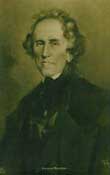
(1791 - 1864)
Giacomo Meyerbeer was a renowned Prussian composer. With the birth name Jacob Liebmann Beer, Meyerbeer
was born in 1791 in Tasdorf, near Berlin,
in what was then the capital of Prussia.
He grew up in a wealthy and very Jewish home as his father led the local Jewish community in a private synagogue in their home. Meyerbeer himself was known for never having tried to
convert from Judaism or hide his Jewish identity.
A well-known composer even in his own time, Meyerbeer’s
most famous operatic works include “Il Crociatto in Egitto,”
“Robert le Diable” and “Les Huguenots,” all
of which have been performed in the great European opera houses. He began his musical career as a pianist, but then turned
to opera and spent several years in Italy studying and composing music.
“Il Crociatto in Egitto,” which Meyerbeer wrote in 1824,
was the first to propel him to fame across Europe, but when he wrote
“Robert le diable” in 1831 he became a bigger celebrity.
He wrote “Les Huguenots” in 1836 and “Le prophete”
in 1849, and his last opera, “L’Africaine,” was performed
posthumously. His work was so well-liked that he was the most frequently-performed
composer at the world’s most prominent opera houses in the 1800s.
In spite of Meyerbeer’s operatic prowess, Richard
Wagner – a former student and recipient of Meyerbeer’s
financial support – turned on his mentor and denounced Meyerbeer’s
name and success. Under a pseudonym, Wagner published an essay in 1850 called “Jewishness in Music,”
in which he condemned his teacher without mentioning his name. Mostly
due to Wagner’s detraction of Meyerbeer, the former rose to prominence
while Meyerbeer’s works were performed less and less in the Paris
Opera House in 1890, for example.
During the last few decades, increasing numbers of
people have become interested in Meyerbeer’s work, and his operas
are being performed more frequently. For instance, London’s Royal
Opera House will perform his “Robert le Diable” in 2013
for the first time in 120 years.
Sources: David B. Green, “This Day in Jewish history / A star composer
is born,” Haaretz,
September 5, 2012;
Wikipedia |