Milton Friedman
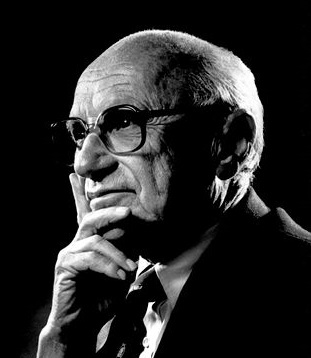
(1912 - 2006)
Milton Friedman, recipient
of the 1976 Nobel Memorial Prize for economic science, has been a senior research fellow at the Hoover
Institution since 1977. He is also the Paul Snowden Russell Distinguished
Service Professor Emeritus of Economics at the University of Chicago,
where he taught from 1946 to 1976, and was a member of the research
staff of the National Bureau of Economic Research from 1937 to 1981.
Friedman was awarded the Presidential Medal of Freedom
in 1988 and received the National Medal of Science the same year.
He is widely regarded as the leader of the Chicago
School of monetary economics, which stresses the importance of the quantity
of money as an instrument of government policy and as a determinant
of business cycles and inflation.
In addition to his scientific work, Friedman has also
written extensively on public policy, always with a primary emphasis
on the preservation and extension of individual freedom. His most important
books in this field are (with Rose D. Friedman) Capitalism and Freedom (University of Chicago Press, 1962); Bright Promises, Dismal Performance (Thomas Horton and Daughters, 1983), which consists mostly of reprints
of columns he wrote for Newsweek from 1966 to 1983; (with Rose
D. Friedman) Free to Choose (Harcourt Brace Jovanovich, 1980),
which complements a ten-part television series of the same name shown
over the Public Broadcasting Service (PBS) network in early 1980; and
(with Rose D. Friedman) Tyranny of the Status Quo (Harcourt Brace
Jovanovich, 1984), which complements a three-part television series
of the same name, shown over PBS in early 1984.
He was a member of the President's Commission on an
All-Volunteer Armed Force and the President's Commission on White House
Fellows. He was a member of President Ronald Reagan's Economic Policy
Advisory Board (a group of experts from outside the government named
in 1981 by President Reagan).
He has also been active in public affairs, serving
as an informal economic adviser to Senator Barry Goldwater in his unsuccessful
campaign for the presidency in 1964, to Richard Nixon in his successful
1968 campaign, to President Nixon subsequently, and to Ronald Reagan
in his 1980 campaign.
He has published many books and articles, most notably A Theory of the Consumption Function, The Optimum Quantity
of Money and Other Essays, and (with A. J. Schwartz) A Monetary
History of the United States, Monetary Statistics of the United
States, and Monetary Trends in the United States and the United
Kingdom.
He is a past president of the American Economic Association,
the Western Economic Association, and the Mont Pelerin Society and is
a member of the American Philosophical Society and the National Academy
of Sciences.
He also has been awarded honorary degrees by universities
in the United States, Japan, Israel, and Guatemala, as well as the Grand
Cordon of the First Class Order of the Sacred Treasure by the Japanese
government in 1986.
Friedman received a B.A. in 1932 from Rutgers University,
an M.A. in 1933 from the University of Chicago, and a Ph.D. in 1946
from Columbia University.
Two Lucky People, his and Rose D. Friedman's
memoirs, were published in 1998 by the University of Chicago Press.
Friedman was born in New York City in 1912 to Jewish immigrants from what is now Ukraine. He died of heart failure in San Francisco on November 16, 2006.
Sources: Hoover Institution |