Michael Arad
(1969 - )
When the first plane slammed into the North Tower of
the World Trade Center on the morning of Sept. 11, 2001, Michael Arad
was in his East Village apartment getting ready to start his day. He
happened to be listening to the radio. When he heard the news announcement,
he looked out of his window, saw the wall of billowing smoke and raced
to the roof, where he watched in horror as the second plane hit the
South Tower.
He immediately realized that his wife, Melanie, a tax attorney with
an office on Broad Street, was a short walk from the Twin Towers. "I
tried to get in touch with her, but I couldn't get through so I jumped
on my bicycle and headed downtown to try to find her," he says.
He dodged rescue vehicles, sirens screaming as they raced to the scene,
and weaved his way among the droves of frantic drivers who were heading
uptown and the thousands of people who were walking in the streets,
trying to escape, trying to make sense of what was happening. "It
was a very chaotic scene," he says.
When he arrived at his wife's office, everyone had been evacuated and
was milling around the plaza next door. "I found her, and I felt
a sense of urgency to get out," he says. "One of her co-workers
wanted to stay and get her purse, which was in the office, so she stayed.
A few minutes later, when the first tower collapsed, a cloud of smoke
came rushing down the street toward their building. We were walking
by the South Street Seaport when it happened, and people were screaming
and running and I didn't understand that one of the towers had fallen.
By the time we were up past the Williamsburg Bridge, by the East River,
we saw the second tower falling."
In the nights that followed, when he couldn't sleep, Arad found himself
attending the various vigils that were set up around the city. "I'd
go to Washington Square Park at 2 or 3 in the morning, and I'd see a
dozen people, strangers, standing there together and sharing a moment
of understanding. I thought that being able to create a space that could
do something like this was very important."
Thousands of New Yorkers have similar stories to tell, but it is important,
indeed it is crucial, to know and understand who Arad is and what happened
to him on 9/11 because he has been chosen to design the World Trade
Center memorial that pays homage to the 2,752 victims who perished in
the Twin Towers that day, the 224 people killed in the 9/11 simultaneous
hijacking crashes at the Pentagon and in Shanksville, Pennsylvania,
and the six people killed in the 1993 terrorist truck-bombing at the
WTC.
Arad, an Israeli who has lived in Manhattan since 1999, is the only
unknown architect who is working on the Ground Zero project; at 34,
he's also the youngest, by decades, on the design team. Until he resigned
in February to work full-time on the memorial, he was an architect with
the New York City Housing Authority, where he assisted on the design
of two police stations. Previously, he worked for Kohn Pedersen Fox,
where he was on the design teams that worked on Union Station Tower,
a 108-story skyscraper in Hong Kong, and Espirito Santo Plaza, a 37-story
tower in Miami that won the New York American Institute of Architects
award in 2001. In contrast, Daniel Libeskind, who devised the master
plan for the 16-acre site, which includes a glass-encased Freedom Tower
that rises 1,776 feet in the sky, making it the world's tallest building
in the world (at least for now), is the designer of the Jewish Museum
Berlin; WTC PATH Terminal designer Santiago Calatrava is a world-renowned
architect whose projects have included the Olympic Sports Complex and
the Milwaukee Art Museum, and Arad's collaborator, landscape architect
Peter Walker, has been in business for decades and has designed projects
around the globe, including the Millennium Park for the 2000 Olympics
in Australia.
Arad's "Reflecting Absence," which was chosen from more than
5,000 entries from around the world during an eight-month competition,
is a starkly simple tribute consisting of a pair of square reflecting
pools that evoke the footprints of the Twin Towers. Trees, arranged
in informal clusters, clearings and groves, form the serene backdrop
for the recessed pools, which are defined by a cascade of water. Ramps
lead to the underground memorial space.
"As they descend, visitors are removed from the sights and sounds
of the city and are immersed in cool darkness," Arad says. "As
they proceed, the sound of water falling grows louder and more daylight
filters in from below. At the bottom, they find themselves behind a
curtain of water, staring out at an enormous pool, which is surrounded
by a continuous ribbon of names. The enormity of the space and the multitude
of names that form this endless ribbon underscore the vast scope of
the destruction. Standing there at the water's edge, looking at a pool
of water that is flowing away into an abyss, a visitor can sense that
what is beyond this curtain of water and ribbon of names is inaccessible.
At this moment, you have the greatest empathy; for a split second you
start to grasp the magnitude of the event that happened there, the hundreds
of names, and all you're seeing at this point is one of two pools. The
other pool is just as big with just as many names around it."
In a visual symbol of hope for the future, memorial visitors go from
light to darkness and re-emerge in the light.
The 13 members of the jury who selected Arad's design, praised it, commenting,
"Reflecting Absence,' has made the voids left by the destruction
the primary symbols of our loss. It is a memorial that expressed both
the incalculable loss of life and its consoling renewal, a place where
all of us come together to remember from generation to generation."
Arad's first idea was to create a memorial in the Hudson River, where
he proposed a floating fountain with two voids. "It was hard for
me to imagine building a memorial on the site, especially because it
was a site of devastation," he says. The Hudson River memorial
would be a physical reminder, "visible and close yet inaccessible,
which worked with my idea, my understanding of that day."
Following his selection as one of the eight finalists, Arad decided
to take a six-month leave from the New York City Housing Authority so
he could devote all of his time to designing the memorial.
"I was very affected by what happened on 9/11," he says, "and
I felt the need to express some of these feelings I had. This was a
way for me to work through this."
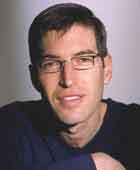
Arad, a tall, lanky man whose intense gray-blue eyes belie the fact
that he looks more like a teenager than a new father, makes it clear
that he's not comfortable in the spotlight. He's been giving lots of
interviews-The New York Times and other major publications have featured
him, and he nervously unveiled his final design in January to the world
news media as New York Governor George Pataki and New York City Mayor
Michael Bloomberg looked on-but he downplays his own role and instead
emphasizes that the credit does not belong to him alone.
He spent much time consulting with his architect friends, including
Bruno Caballe, who helped him prepare his competition board, and since
Arad's selection, Kohn Pedersen Fox has been donating employee time
and temporary office space until the young architect's practice is up
and running. Then there was the matter of a model, complete with running
water, that helped him explore his ideas for the memorial-it was fabricated
gratis by Awad Architectural Models, an act that Arad calls "incredibly
generous." Although his first design caught the attention of the
jury, and he was declared a finalist, he was sent back to the drawing
board to spruce up the sparse landscaping. "They thought the plaza
appeared too bleak, too somber," he says. "They suggested
I contact a landscape architect. I decided I wanted to collaborate with
Peter Walker, whose work I've always admired; he's a legend in the world
of architecture." So Arad, the unknown architect, made a cold call
and Walker, the famous landscape architect, agreed to come on board
immediately. "We had a very quick and intense process of getting
to know each other," Arad says.
If Arad came to the memorial competition early in life it may be because
he came to architecture rather late in life. The child of an Israeli
diplomat, Arad, who was born in London on July 21, 1969-the day after
the first moon landing, his parents always like to tell him-spent his
childhood in Israel, the United States and Mexico.
After earning a bachelor's degree in government studies from Dartmouth
College, where he finished his major requirements a year early, he began
taking an eclectic array of courses, everything from philosophy and
art history to studio art. That's when he made the bricks and mortar
connection with architecture that led him to earn a Master's degree
from Georgia Tech's College of Architecture. After working for three
years for Kohn Pedersen Fox, he joined the design staff of the New York
City Housing Authority.
"I had a hard time deciding whether I wanted to go to law school
or into architecture," he says, "but ultimately it was architecture.
A building or space that moves you-it's a very powerful thing. I was
interested in architecture for a long time but I was also intimidated
by it because I thought it is very difficult to do work that is strong,
beautiful and moving. I entered the field with hesitation because I
wasn't sure if I could do what I hoped to do."
He need not have doubted himself. By all accounts, "Reflecting
Absence" is strong, beautiful and moving. "The strength of
the memorial design is in no small part due to the personal importance
it has to me," Arad says. "It influenced the clarity of the
design."
The reality is that Arad's memorial design will be a living testimonial
to those who lost their lives in this, the worst disaster on American
soil. "The memorial plaza is designed to be a meditating space,"
Arad says. "It belongs both to the city and to the memorial. It
encourages use by New Yorkers on a daily basis. The memorial grounds
will not be isolated from the rest of the city; they will be a living
part of it."
Soon, Arad, who confesses that he "never entered the competition
with the expectation of winning," will be setting up his own architectural
office while he works on the project, which is expected to be completed
in 2008. "It's a tremendous amount of responsibility because of
the high expectations everyone has. I have to demand more of myself."
But right now, he's reflecting on laying the foundation for "Reflecting
Absence." "I'm focusing on the short-term," he says.
"In the future, though, I'd love to do more public projects."
Sources: Lifestyles |