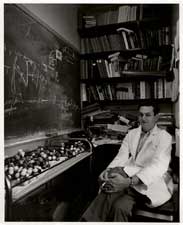
Marshall Warren Nirenberg was a Jewish American biochemist and geneticist who shared the 1968 Nobel Prize in Medicine.
Nirenberg (born April 10, 1927; died January 15, 2010) was born
in New York City, He developed an early interest in biology. In 1948,
he received his B.S. degree and, in 1952, a master's degree in zoology
from the University of Florida at Gainesville. He received his Ph.D.
in biochemistry from the University of Michigan, Ann Arbor in 1957.
He began his postdoctoral work at the National Institutes
of Health (NIH) in 1957 as a fellow of the American Cancer Society.
In 1960, he became a research biochemist at the NIH. In 1959, he began
to study the steps that relate DNA, RNA and protein. Nirenberg's groundbreaking
experiments advanced him to become the head of the Section of Biochemical
Genetics in 1962.
Nirenberg was awarded the National Medal of Science
in 1966 and the National Medal of Honor in 1968 by President Lyndon
B. Johnson. In 1968, he won the Nobel
Prize in Medicine with Har Khorana and Robert Holley, for describing
the genetic code and how it operates in protein synthesis. He was elected
to the American Philosophical Society in 2001.
By 1959, experiments by Oswald Avery, Francis Crick,
James D. Watson, and others had shown DNA to be the molecule of genetic
information. It was not known, however, how DNA was replicated, how
DNA directed the expression of proteins, or what role RNA had in these
processes. Nirenberg teamed up with Heinrich J. Matthaei at the National
Institutes of Health to answer these questions. They produced RNA comprised
solely of uracil, a nucleotide that only occurs in RNA. They then added
this synthetic poly-uracil RNA into a cell-free extract of Escherichia
coli which contained the DNA, RNA, ribosomes and other cellular machinery
for protein synthesis. They added DNase, which breaks apart the DNA,
so that no additional proteins would be produced other than that from
their synthetic RNA. They then added 1 radioactively labeled amino acid,
the building blocks of proteins, and 19 unlabeled amino acids to the
extract, varying the labeled amino acid in each sample. In the extract
containing the radioactively labeled phenylalanine, the resulting protein
was also radioactive. They realized that they had found the genetic
code for phenylalanine: UUU (three uracil bases in a row) on RNA. This
was the first step in deciphering the codons of the genetic code and
the first demonstration of messenger RNA.
Within a few years, his research team had performed
similar experiments and found that three-base repeats of adenosine (AAA)
produced the amino acid lysine, cytosine repeats (CCC) produced proline
and guanine repeats (GGG) produced nothing at all. The next breakthrough
came when Phillip Leder, a postdoctoral researcher in Nirenberg's lab,
developed a method for determining the genetic code on pieces of tRNA.
This greatly sped up the assignment of three-base codons to amino acids
so that 50 codons were identified in this way. Khorana's experiments
confirmed these results and completed the genetic code translation.
Nirenberg's later research focused on neuroscience,
neural development, and the homeobox genes.
His wife, Perola Zaltzman, died in 2001, and Nirenberg died nine years later, on January 15, 2010. Nirenberg was 82 years old.