Barney Ross
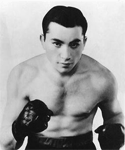
(1909 - 1967)
As. a boy growing up in Chicago, Barnet Rasofsky
planned to be a Talmudic scholar and Hebrew teacher. In 1924,
however, when Barnet was 14 years old, his father, an immigrant rabbi
and grocer, was shot and killed by two men who robbed the family
store. Barnet’s mother, left with five children to support had a
nervous breakdown and was sent to live with relatives. Barnet and his
oldest brother, Morrie, went to live with a cousin; his three
youngest siblings were placed in an orphanage.
In his grief, Barnet Rasofsky renounced his
Orthodox faith and sought revenge on the world by becoming a petty
thief, numbers runner and brawler. He vowed to make enough money —
by whatever means he could to reunite his family. Barnet took up
amateur boxing, pawning the medals he won for the few dollars they
would bring. Sometimes, he would take six fights in a week. Barnet
grew tougher with each confrontation. At age 19, he turned
professional and took the name Barney Ross, so his mother, now back
on her feet, wouldn’t know he was fighting. As Barney Ross, he won
championships and election to the Boxing Hall of Fame.
Ross’ big break came in 1933, when he fought
tough Tony Canzoneri in Chicago for the world lightweight (137-pound)
title and won by a split decision. To prove that his victory was no
fluke, Rose agreed to a rematch in Canzoneri’s hometown, New York
City. Before a pro-Canzoneri crowd of 60,000, Ross won a unanimous
decision. Never a powerful puncher, Ross showed unflinching courage
by counterpunching when hit hard and always staying on his feet, a
formula that served him throughout his life.
Ross entered the ranks of boxing’s greats in a
brutal series of three fights for the welterweight (147-pound) crown
against Jimmy McLarnin, who outweighed Ross by several pounds, was a
harder puncher and had a reputation for beating Jewish boxers. In
their first fight, Ross defeated McLarnin in a bloody battle by a
split decision. Ross offered McLarnin a rematch five months later,
and McLarnin avenged the defeat in a vicious battle, ft only fight in
which Ross ever suffered a knockdown. When they met again for the
third time, Ross took the rematch in a fight that showed his clear
superiority as a boxer.
Ross’ most courageous prize fight was his last,
in 1938, against Henry Armstrong, the only man to hold the
featherweight, lightweight and welterweight crowns. By the time he
fought Armstrong, Ross — although only 28 years old —had fought
almost 300 times. Although he started strong, Ross fired after the
fourth round and Armstrong pummeled him at will. After the tenth
round, the referee asked Ross if he wanted to stop, but the champion
said no. After the twelfth, the referee approached Ross’ managers,
asking them to throw in the towel, but, Ross told them, "You do
that and I’ll never talk to you again. I want to go out like a
champion." To Ross that meant standing on his feet when the
final bell sounded, Through rounds thirteen, fourteen and fifteen,
Armstrong pounded away at the exhausted Ross, who would not go down.
Voices in the crowd pleaded with the referee to stop the fight, but
he respected Ross’ wish to end his career never having failed to go
the distance. In the last minute of the fight, Ross rallied and stood
toe to toe with Armstrong, exchanging blows. The crowd was on its
feet many with tears in their eyes, cheering for Ross, knowing they
had seen the heart of a true champion.
Ross retired after that fight and opened a
restaurant. When the Japanese, attacked Pearl Harbor, Ross — beyond
draft age at 32 — received a waiver to join the Marines. Assigned
to serve as a boxing instructor, Ross instead asked for combat duty
and was shipped to Guadalcanal, sow* of some of ft bloodiest fighting
in the Pacific. On patrol one night Ross and three comrades were
attacked by a superior force of Japanese troops. All three of Ross’
comrades were wounded. He gathered them in a shell crater and
defended them through the night by firing more than 400 rifle rounds.
When he ran out of bullets, Ross threw 22 grenades at enemy machine
gun positions. Ross claimed that he said two hours of prayers,
"many in Hebrew," hoping to make it through the night.
Finally, at dawn, with two of his three comrades dead, wounded in the
leg and foot himself and out of ammunition, Ross — who weighed less
than 140 pounds — picked up his surviving wounded comrade (who
weighed 230 pounds) and carried him to safety. Ross, whose helmet had
more than 30 shrapnel dents, was awarded the Silver Star for heroism.

At the military hospital where he was treated for
his wounds, medics gave Ross all the morphine he asked for. When he
got out of the hospital, Ross toured military plants to raise morale
among workers, but couldn’t shake his need for morphine. When his
habit began to cost him $500 per week and his wife left him, Ross
sought admission to a federal drug treatment facility. While few gave
him much chance of breaking the habit, Ross went "cold
turkey" and, after much agony from withdrawal, emerged 120 days
later having kicked the habit. While he lived in constant pain from
his wounds, Ross spent the remainder of his life speaking out against
drug abuse. Hollywood later turned Ross’ autobiographical account
of his addiction into the movie "Monkey on My Back."
In his autobiography, No Man Stands Alone,
Ross recounted that a rabbi once told him that, since he was a Jew in
the public eye, he would have to lead an exemplary life. Barney Ross
did not let his rabbi — or his people down. But of all the things
Ross achieved in his life and all the obstacles he overcame, the one
that meant the most to him was having earned enough money in the
first Canzoneri fight to reunite his mother with her three youngest
children who had been placed in an orphanage.
Sources: American
Jewish Historical Society (AJHS). Photo of
Ross in uniform courtesy of Greg Powers from
the papers of Kenneth P. Behr. |