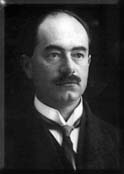
Arthur Ruppin was known as “ the father of Zionist settlement” and “the father of Jewish sociology,”
titles that reflect his two convergent careers.
Born in Germany to an affluent family that had fallen
on bad times, Ruppin at the age of 15 had to leave
high school in order to get a job. He received his
high school diploma in 1899 as an external student,
and went on to study law and economics in the
university, earning a doctorate, and then working for
several years in a court.
While working in law, Ruppin also launched what
was to become a career in sociology, directing
Berlin’s Bureau for Jewish Statistics and
Demography from 1902 to 1907. His sociological
research, which he began publishing in the early
1900’s, strengthened Ruppin’s connection with his
own Jewish roots. In 1907, he was sent by the Jewish
Agency to Eretz Yisrael to assess the possibilities for
Zionist settlement there; one year later he himself
moved to Eretz Yisrael, settling in Jaffa and directing
the Zionist Organization’s Eretz Yisrael Office, which
was responsible for acquiring land and establishing
Jewish settlements all over the country.
From this point on, Ruppin labored tirelessly for
Jewish settlement. He became an advocate of pragmatic Zionism, believing that the most immediate
need was to amass land and, through a variety of
urban and rural communities, systematically settle the
country and thus build a state. Coinciding with the
period of the Second Aliyah, Ruppin’s efforts
affirmed the importance of Jewish labor and Jewish
settlements, and offered official support to the
pioneers.
Ruppin’s interest was in lands throughout the
country, and he was instrumental in obtaining
financial assistance for Ahuzat Bayit, later Tel Aviv,
as well as in acquiring land on the Carmel, in the
Jezreel Valley, and in Jerusalem. He also promoted a
variety of settlement possibilities, including the
kibbutz, agricultural farms, and types of
cooperatives. It is here that Ruppin’s background in
demography and sociology helped map out the
settlement of the Yishuv. Although initially a
supporter of Brit Shalom, which called for a
bi-national state in Palestine, he rejected the idea
following the Arab riots of 1929, insisting on the
need for a single Jewish state. In Ruppin’s opinion,
the practical opportunity for realizing this goal rested
on the successful acquisition and settlement of land.
In 1926, Ruppin joined the faculty of Hebrew University and taught sociology of the Jews. He
combined his academic responsibilities and research
with public interest work. He assisted in settling the
mass of German immigrants during the Nazi rise to
power, and in the absorption of Yemenite Jews. He
died in Jerusalem in 1943.