Anwar al-Sadat
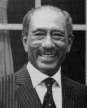
(1918 - 1981)
Born into a family of 13 children in 1918, Anwar al-Sadat
grew up among average Egyptian villagers in the town of Mit Abul Kom
40 miles to the north of Cairo. Having completed a grade school education,
Sadat's father worked as a clerk in the local military hospital. By
the time of his birth, Anwar's Egypt had become a British colony. Crippling debt had forced the Egyptian
government to sell the British government its interests in the French
engineered Suez Canal linking the Mediteranian Sea with the Indian Ocean.
The British and French had used these resources to establish enough
political control over Egyptian affairs to refer to Egypt as a British
colony.
Four figures affected Sadat's early life. The first,
a man named Zahran, came from a small village like Sadat's. In a famous
incident of colonial rule, the British hanged Zahran for participating
in a riot which had resulted in the death of a British officer. Sadat
admired the courage Zahran exhibit on the way to the gallows. The second,
Kemel Ataturk, created the modern state of Turkey by forcing the downfall
of the Ottoman Empire. Not only had Ataturk thrown off the shackles
of colonialism, but he established a number of civil service reforms,
which Sadat admired. The third man was Mohandas Gandhi. Touring Egypt
in 1932, Gandhi had preached the power of nonviolence in combating injustice.
And finally, the young Sadat admired Adolf
Hitler whom the anticolonialist Sadat viewed as a potential rival
to British control.
In 1936, as part of a deal between the British and
the Wafd party, the British agreed to create a military school in Egypt.
Sadat was among its first students. Besides the traditional training
in math and science, each student learned to analyze battles. Sadat
even studied the Battle of Gettysburg, the turning point in America's
civil war. Upon graduating from the academy, the government posted Sadat
to a distant outpost. There he met Gamal
Abdel Nasser, beginning a long political association which eventually
led to the Egyptian presidency. At this outpost, Sadat, Nasser and the
other young officers formed a revolutionary group destined to overthrow
British rule.
Commitment to their revolution led Sadat to jail
twice. During his second stay in jail, Sadat taught himself French
and English. But the grueling loneliness of jail took its toll. After
leaving prison, Sadat returned to civilian life. He acted for a bit,
and he joined in several business deals. Through one of his deals,
Sadat met Jihan whom he would eventually marry.
Sadat recontacted his old associate Nasser to find
that their revolutionary movement had grown considerably while he was
in prison. On July 23, 1952, the Free Officers Organization staged a
coup overthrowing the monarchy. From the moment of the coup, Sadat
began as Nasser's public relations minister and trusted lieutenant.
Nasser assigned Sadat the task of overseeing the official abdication
of King Farouk. Working with Nasser Sadat learned the dangerous game
of nation-building in a world of superpower rivalries. Egypt
eventually became the leading "non-aligned" country in the
world, giving a voice, through Nasser, to the desires of the
undeveloped and post-colonial societies. Their most important trial
came over the Suez Canal, which Nasser nationalized in 1956. In a coordinated effort, the British, French, and the new
nation of Israel launched an attack on Egypt hoping to reestablish
colonial control over the Canal and its profits. The 1956
war ended only after the United States pressured its allies to
withdraw. Egypt emerged from the war a hero of the non-aligned
countries, having successfully resisted colonial powers and
maintained its control of the Suez.
Nasser's prominence suffered greatly from the
debacle of the Six Day War. In it, the Israeli military completely destroyed the Egyptian air
forces (mostly caught unawares on the ground) and swept through the
Sinai to the Suez Canal routing the Egyptian army, killing at least
3,000 soldiers. The devastation also threatened to bankrupt the
government. Internal squabbling among Arab nations and the growing
Palestinian movement eventually strained Nasser's abilities to the
limit. Under the strain, Nasser collapsed and died on September 29,
1970.
When he succeeded Nasser, Sadat was completely
unknown and untested. Over the next 11 years, however, Sadat proved
his leadership abilities. His first trial on the international scene
involved the aftermath of the Six
Day War. Sadat openly offered the Israelis a peace treaty in
exchange for the return of the Sinai lands taken in the attack.
Domestic crisis and international intrigue presented
Sadat with seemingly insurmountable problems. The Egyptian economy continued
to reel from war with Israel and the Egyptians' continuing relationship
with the Soviet Union deteriorated as the Soviets proved unreliable
allies. When pressed for more military support to replace the devastation
of the Six Day War, the
Soviets simply ignored Sadat's requests. In a bold move, which soon
became his trademark, Sadat expelled the Soviets. This grand gesture
solidified Egyptian internal support at a time when the average Egyptian
suffered greatly.
Behind the scenes, however, Sadat plotted to
retake the Egyptian Sinai if the Israelis continued to refuse the
Egyptian peace initiative. On October
6, 1973, Sadat struck. With exceptional military precision, the
Egyptian army crossed the Suez back into the Sinai and began driving
the Israeli army into the desert. Though short-lived, the attack
created a new momentum for peace both in Egypt and in Israel. These
pressures coincided with continued domestic problems in Egypt.
The deteriorating economy in Egypt, accompanied by
a growing distance between rich and poor, led to internal strife,
riots, strikes, attacks on the rich. These internal pressures raised
the attention of the international community, particularly the United
States, concerned that internal strife would weaken Sadat's moderate
policies.
Convinced that peace with Israel would reap an enormous
"peace dividend," Sadat initiated his most important diplomatic
ploy. In a speech to the Egyptian parliament in 1977, Sadat affirmed
his desire to go anywhere to negotiate a peace with the Israelis. Even,
he affirmed, he would go to the Israeli parliament to speak for peace.
The Israelis responded with an invitation to do just that and Sadat's speech to the Israeli Knesset initiated a new momentum for peace that would eventually culminate in
the 1978 Camp David
Accords and a final peace
treaty with Israel in 1979. For his efforts, Sadat won the Nobel
Prize for Peace.
At home, Sadat's new relationship with the west and
his peace treaty generated considerable domestic opposition, especially
among fundamentalist Muslim groups. In 1980 and in 1981, Sadat took
desperate gambles to respond to these new internal problems. He negotiated
a number of loans to support improvements in everyday life. And he simultaneously
enacted laws outlawing protest and declared that the Shari'a would be the basis of all new Egyptian law. Sadat died at the hands
of Muslim fundamentalist assassins on October 6, 1981, during a military review
celebrating the Suez crossing in 1973. He was succeeded by his Vice
President, Hosni Mubarak.
Sources: Camp
David Accords — Framework for Peace |