Paul Samuelson
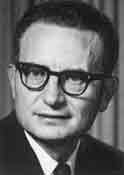
(1915 - 2009)
Paul Anthony Samuelson was born on May 15, 1915,
in Gary, Indiana. He earned a bachelor’s degree of Arts from the
University of Chicago in 1935, and a Ph.D. in Philosophy from Harvard
University in 1941. After completing his studies, Samuelson became an
Assistant Professor of economics at MIT, Associate Professor in 1944,
and Professor in 1947. In 1947, he published his first major work, Foundations
of Economic Analysis in which he demonstrated the integration of
mathematics and that it was essential to understanding the fundamentals
of economics. He was also the author of an influential economics textbook, Economics: An Introductory Analysis, first published in 1948,
and revised regularly for the following fifty years.
Paul Samuelson is considered by many to be the founder
of neoclassical economics. In welfare economics he helped to establish
the criteria for deciding whether an action will improve welfare; these
criteria came to be known as the Lindahl-Bowen-Samuelson condition.
Samuelson is predominantly acknowledged for his public finance theory
on determining the optimal allocation of resources in the presence of
both public goods and private goods. Finally, Samuelson has influenced
international economics through two important theories of international
trade: the Balassa-Samuelson effect (consumer price levels are systematically
higher in wealthier countries than in poor countries) and the Hecksher-Ohlin
model (a General equilibrium mathematical model of the macroeconomy
in international trade), in which the Stolper-Samuelson theorem (a basic
theorem in trade theory which describes a relation between the relative
prices of output goods and relative factor rewards) is utilized.
He was awarded the John Bates Clark Medal by the American
Association of Economics in 1947, which is awarded to outstanding economists
under the age of forty. Samuelson also received The Bank of Sweden Prize
in Economic Sciences in 1970. Samuelson has served on many committees
and honorary boards, including the National Resources Planning Board
(1941-1943), United States Treasury (1945-1952), and the Council of
Economic Affairs. He also was nominated as president of the American
Association of Economics in 1961 and president of the International
Economic Association in 1965.
Paul Samuelson was the first Jew to receive the Nobel
Prize for Economics in 1970 for his contributions in numerous fields
of economics. The following is an excerpt from the reasons for awarding
Samuelson the Nobel Prize:
Generally speaking, Samuelson's contribution has
been that, more than any other contemporary economist, he has contributed
to raising the general analytical and methodological level in economic
science. He has in fact simply rewritten considerable parts of economic
theory. He has also shown the fundamental unity of both the problems
and analytical techniques in economics, partly by a systematic application
of the methodology of maximization for a broad set of problems. This
means that Samuelson's contributions range over a large number of
different fields.
Sources: Wikipedia;
"Paul
Sameulson Biography"; Cartage |