Superman
by Blair Kramer
As a popular means to express such American virtues as honesty, patriotism and chivalry, no medium
can compete with the comic book. Since the 1930s, American comic books have been populated by
heroes who save innocent victims, entire nations, even the world, from characters representing evil.
Crime fighters like Dick Tracy and Batman, fighters against foreign espionage like the Green Lantern
and that forerunner of modern feminism, the goddess-like Wonder Woman, are among the best-known
comic book superheroes.
But no comic book hero embodies American ideals as does Superman. As everyone knows, the man
with the “S” on his chest symbolizes “truth, justice and the American Way,” What fewer people know
is that the creators and definers of Superman's Americanism were Jerry Siegel (1914-1996) and Joe
Shuster (1914-1992), two Jewish teenagers from Cleveland.
Superman's early development was awkward. Siegel first used the name in 1933 for a science fiction
story titled, “The Reign of Superman,” with illustrations by Schuster. Inspired by the German
philosopher Nietzsche, Siegel's first Superman was an evil mastermind with advanced mental powers.
Unfortunately, the text of this story has been lost to history.
After Adolf Hitler and the Nazi Party came to power in Germany in 1933 and proceeded to distort Nietzsche's concept of
Superman, Siegel and Shuster decided to rethink their own concept of Superman's character. They
changed their Jewish-created Superman to a force for good. Their biggest challenge was finding a
publisher interested in producing a Superman comic. It took five years to find one.
In 1938, just before the outbreak of war in Europe and at a low point in the Depression, Siegel and
Shuster were working for Harry Donenfeld and Jack Liebowitz at D.C. Comics in New York. There, an
editor finally agreed to let Superman appear in the first issue of Action Comics to be released in June
1938. Possessing superhuman powers, Superman leaped tall buildings in a single bound and bullets
bounced off his chest as he lifted automobiles and ripped steel doors from their hinges. In the first
issue, Superman even rescued battered wives from abusive husbands.
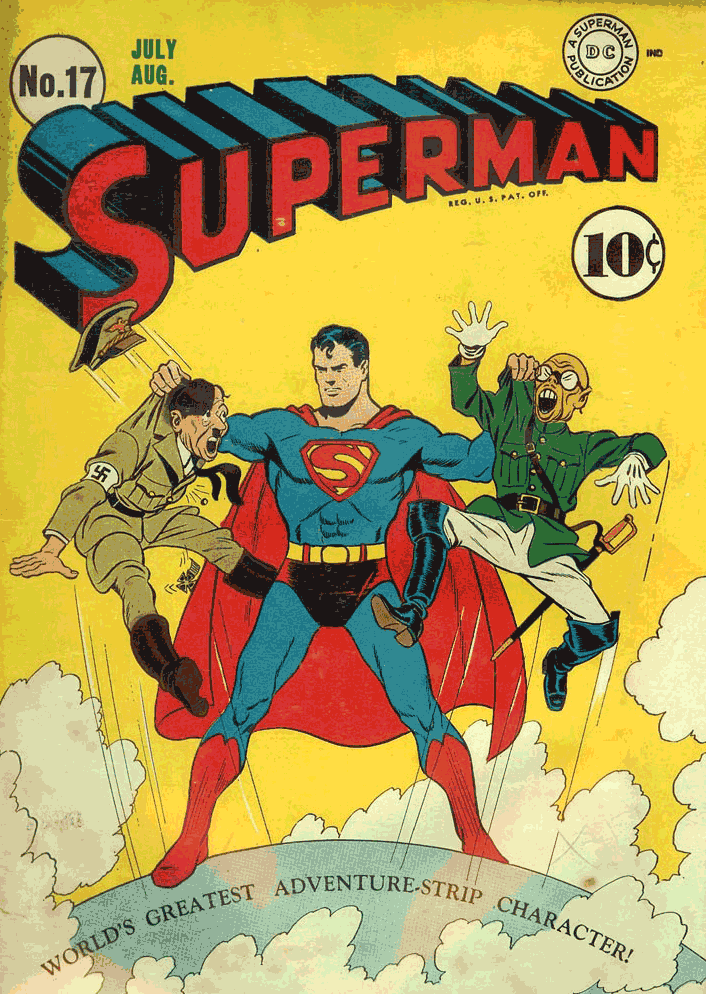
When the United States entered World War II after the Japanese attack on Pearl Harbor, Superman's character
evolved into a combat hero. He destroyed Nazi armor, Japanese submarines and everything else that
was thrown at the Allies. In fact, the cover of a 1944 issue of Superman featured the Man of Steel
throttling Hitler and Tojo by the collar.
Despite his superhuman powers, Superman shared some characteristic traits with a majority of
American Jews in the 1940s. Like them, he had arrived in America from a foreign world. His entire
family, and in fact his entire race, had been wiped out in a holocaust-like disaster on his home planet,
Krypton. Like the German Jewish parents who had sent their children on the kindertransports or baby
Moses set adrift in the bull rushes of the Nile River, Superman's parents launched him to Earth in hopes that he would
survive. And while the mild-mannered Clark Kent held a white collar job as a reporter by day, the
“real” man behind Kent's meek exterior was a virile, indestructible crusader for justice. This fantasy
must have resonated among American Jews, who felt powerless to help their brethren in the death
camps of Europe.
Superman obeys the Talmudic injunction to do good for its own sake and heal the world where he can.
Siegel and Shuster had created a mythic character who reflected their own Jewish values.
By the 1950's, however, Siegel and Schuster grew dissatisfied with their personal financial return from D.C.
Comics's exploitation of their character, and they sued the company for the ownership rights to
Superman. Eventually, D.C. Comics agreed to pay them a royalty for the rest of their lives.
Today, Siegel and Shuster are largely forgotten. But the most influential individuals ever to work in the
American comic book industry left an enormous mark on America's collective imagination with a little
help from Superman.
Sources: Patricia Sullivan, “Arthur Ochs Sulzberger, former New York Times
publisher, dies at 86,” New
York Times, September 29, 2012.; Wikipedia; Photo copyright New York Times |