Shaul Tchernichovsky
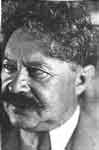
(1875 - 1943)
Shaul Tchernichovsky was born in Mikhailovka,
Russia, and grew up in a religious home that was open to the ideas of
the Enlightenment and Zionism.
He attended a modern Hebrew school, where he studied mainly Hebrew
and Bible, and at ten entered a Russian school.
At fourteen, Tchernichovsky was sent to Odessa to
further his education. He was especially interested in languages and
his study of German, French, English, Greek and Latin later enabled
him to translate extensively. In Odessa in the 1890s, he was drawn to
Zionist and Hebrew literary circles. His first poems were published
in Krakow in 1892. Failing to gain admission to a Russian university,
Tchernichovsky studied medicine in Heidelberg. He completed his
medical studies in Lausanne in 1905. Back in Russia, unable to find a
post because he had not studied at a Russian university, he wandered
from place to place. When his degree was finally recognized he
settled in St. Petersburg.
At the outbreak of World War I, he was drafted and
served as an army doctor. After the Bolshevik revolution his economic
situation deteriorated and in 1919 he settled in Odessa, where he
earned a scant livelihood as a physician. After three years he left
Russia permanently. Following a brief stay in Constantinople, where
he attempted to secure a position as a doctor in Eretz Israel,
Tchernichovsky moved to Berlin. There he edited the natural sciences
and medicine section of an encyclopaedia, the literary section of a
magazine, wrote stories and articles, and mainly devoted himself to
translation (Sophocles, Goethe, Moliere, Shakespeare, and others).
In 1931 Tchernichovsky was commissioned to edit The
Book of Medical and Scientific Terms (in Latin, Hebrew and
English), and thus was able to settle in Eretz Israel. Upon
completion of the work (1934), he was appointed physician of the
municipal schools in Tel
Aviv. In 1936 he signed a contract with Schocken Publishing
House, and moved to Jerusalem for
the remainder of his life.
Books Published in Hebrew
Melodies and Liturgy I, Warsaw-Tushia,, 1898 [Hezyonot
Ve-Manginot Alef]
Melodies and Liturgy II, Tushia, 1901 [Hezyonot Ve-Manginot Beit]
Poems for the Children of Israel (children), Tushia, 1907 [Shirim
Le-Yaldei Israel]
Poems, Odessa-Hashiloah, 1911 [Shirim]
Stories, Dvir, 1922 [Sipurim]
Idylls, Berlin-Moriah, 1922 [Sefer Ha-Idiliot]
The Flute (children), Dvir, 1923 [He-Halil]
Bar-Kochva (play), Stybel, 1924 [Bar-Kochva]
New Poems, Stybel, 1924 [Shirim Hadashim]
Sonnets, Dvir, 1922 [Mahberet Sonetot]
Collected Works (10 volumes), Va'ad Hayovel, 1929-1932 [Col
Kitvei Shaul Tchernichovsky]
Ballads, Omanut, 1930 [Sefer Ha-Baladot]
The Threshing Floor (children), Stybel, 1936
Poems by Shaul Tchernichovsky for his Young Brothers (children), Riga, 1936 [Shirei Tchernichovsky Le-Ehav Ha-Tzeirim]
Collected Poems, Schocken, 1937 [Col Shirei Shaul
Tchernichovsky]
You See, O Earth (poems), Schocken, 1940 [Ho Adamah]
Thirty-Three Stories, Schocken, 1941 [Shloshim Ve-Shlosshah
Sipurim]
That Which Never Was (children), Yavne, 1942 [Asher Haya Ve-Lo
Haya]
Poems, Hayovel, 1943 [Shirim]
Collected Works, Am Oved, 1990-98 [Col Kitvei Shaul
Tchernichovsky]
Books in Translation
Selected Poems
English: London, Hasefer, 1929; New York, Jewish Education Committee,
1944
French: Jerusalem, Organisation Sioniste Mondiale, 1949
Russian: Jerusalem, Biblioteka Aliya, 1974
Spanish: Granada, Universidad de Granada, 1993
Yiddish: New York, published by the Jewish Community of Caracas,
Venezuela, 1957
Individual poems have been published in: Arabic, Czech, Dutch,
English, Esperanto, Estonian, French, Greek, Hungarian, Italian,
Japanese, Polish, Portuguese, Russian, Spanish, Yiddish.
Sources: Copyright The
Institute for the Translation of Hebrew Literature. Reprinted by
kind permission of The
Institute for the Translation of Hebrew Literature, Ramat Gan
Israel. The Institute web site contains biographies of 300 Israeli
authors. |