Judah Touro
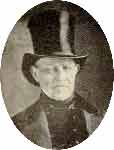
(1775 - 1854)
According to Judah Touro's tombstone, he is inscribed in “the Book of Philanthropy, to be remembered forever.”
No epitaph could be more deserving. Touro's name is indelibly associated with American Jewish philanthropy, a
community trait of which American Jews can be proud.
Touro grew up in Newport, Rhode Island, the second son of Isaac Touro, who was hazzan of Yesuat Israel,
Newport's Sephardic synagogue. The Revolutionary War destroyed Newport's prosperity, and Judah's childhood
was marked by poverty. A Tory, Judah's father remained with his family in Newport after the British captured the
city. The Touros became dependent on the charity of British troops, who ultimately helped the Touros relocate to
Jamaica, West Indies, where Isaac died in 1783. His mother took Judah and his siblings to Boston to live with
her brother, Moses Michael Hays.
When Judah's mother died in 1787, Hays raised the Touro children. He taught Judah and his brother Abraham to
observe Jewish traditions and apprenticed them in his international commercial ventures. In 1801, Judah
unexpectedly left for New Orleans. No one is certain why he left in such haste, but the gossip of the time had it
that his uncle refused to allow him to marry his first cousin, Catherine Hays. In any case, Touro never married.
When the U.S. acquired New Orleans in 1803, its economy boomed, and Judah established himself as a
merchant, shipper and leader in local social life. During the war with England in 1812, Touro fought as a
volunteer under the command of General Andrew Jackson. In the great battle of Jan. 1, 1815, Touro was severely
wounded and near death, but over the next year a close friend nursed Touro back to health. The wound appeared
to have had psychological as well as physical effects: The previously social Touro withdrew almost entirely from
civic life and devoted himself to his businesses.
Despite his success, Judah always remembered his youthful poverty and lived modestly. He invested in real
estate but never mortgaged his properties to finance other ventures. Touro was reported to have said, “I have
saved a fortune by strict economy, while others had spent one by their liberal expenditures.”
In his 50s and 60s, most of Judah's charity was directed to non-Jewish causes. Most significantly, he donated the
final $10,000 needed to complete the Bunker Hill Monument in Boston, which for nearly 20 years had
languished as an unfinished stump for want of funding. He made a major gift to the public library in his native
Newport, and in New Orleans he contributed to a number of Protestant churches and to the building of the
Catholic cathedral.
In his early 70s, his life was significantly influenced by his acquaintance with two outstanding Jewish leaders.
Touro developed a friendship with Gershom Kursheedt of New Orleans and conducted a correspondence with
Rabbi Isaac Leeser of Philadelphia. These men convinced Touro of the importance of being Jewish in more than
words. Touro helped found congregation Nefuzoth Yehuda in New Orleans, which followed the Sephardic rituals
of his youth. He subsequently built its synagogue and began to attend services regularly, provided the land and
funds for its religious school, bought land for its cemetery and annually made up for any deficits incurred. He
also founded the city's Jewish hospital, the Touro Infirmary.
In the last year of his life, Touro wrote a will which set the standard of American Jewish philanthropy. After
modest bequests to family members and friends, Touro donated the bulk of his fortune to strengthen Jewish life.
He left $100,000 to the two leading Jewish congregations and Jewish benevolent organizations in New Orleans.
Another $150,000 went to Jewish congregations and charitable institutions in 18 other cities around the United
States. He directed that $60,000 be dispensed to relieve poverty and provide freedom of worship to Jews in
Palestine. He also left bequests to non-Jewish institutions such as Massachusetts General Hospital, which his
brother had helped found.
At his request, Touro was buried with his family in Newport. One of his legacies made it possible to reopen and
restore the long-abandoned Newport synagogue where his father had served as hazzan and which now bears the
family name. The Jewish Encyclopedia observes that, in his day, “No American Jew had ever given so much to
so many agencies and causes; nor had any non-Jew done so much in such varied ways.”
Sources: American Jewish
Historical Society |