The Jews of Corfu
Three nineteenth-century Corfu ketuboth illustrate
form following life. The second largest of the Greek isles, Corfu,
both island and city, was the home of an old, cosmopolitan Jewish
community. The twelfth-century Jewish traveler, Benjamin of Tudela,
found only one Jew there in 1147, but not long thereafter when the
island came under the sovereignty of the Angevin kings of Naples, a
large number of Jews settled there. Over the course of time three
Jewish communities were established on Corfu: Greek, Spanish, and
Italian. For a time each retained a separate identity with their own
synagogues, burial places, customs, and liturgies; but gradual, then
more rapid integration took place, especially in the nineteenth
century. That century also saw great discrimination against and
oppression of the Jews. Under French rule (1805-1815), as the Jewish
Encyclopedia states, "the Jews enjoyed all the rights of
citizenship, and their rabbi ranked with the Catholic bishop and the
Orthodox archbishop. But when, together with other Ionian islands
[Corfu] formed a republic under the protectorate of England
(1815-1863), the Jews were not only forbidden to practice in the
courts, but lost all their rights." The rights were regained
when Greece annexed Corfu in 1863, but the following year Jews
suffered from anti- Semitic riots which caused many Jews to leave. In
1891 a "blood libel" accusation led to an even greater
exodus.
Three Corfu ketuboth are among the treasures of
the Hebraic Section. The first begins:
On the third day of the week, the third day of
the month Mar-Heshvan, in the year of creation 5573 [1812]
and 1745 years since the destruction of the Second Temple, may it
be rebuilt soon in our time, and in the time of the whole House of
Israel, Amen! as we are accustomed to count time here in the isle
and city of Corfu, may the Lord protect it ... we the undersigned
bear witness that ... the young man Yani Osmo, the son of the
honored Raphael De Osmo, said to the virgin ... Esther, daughter of
the honored David De Mordo ... be thou my wife.
Corfu ketuboth are distinguished for using
double dating, the year since creation and the year since the
destruction of the Temple. The two dates on this ketubah read at
the wedding of Yani, the son of Raphael De Osmo, and Esther,
daughter of David De Mordo, are 5573 and 1745. The decoration is
calligraphic, inscribing verses from the Books of Isaiah and Ruth
which speak of bridegroom, bride, rejoicing, and blessings, (Ketubah,
Corfu, 3 Heshvan, 5573 (1812), Hebraic Section, Library of Congress Photo).
 |
This ketubah follows the unique tradition of Corfu
ketuboth in dual reckoning of time, from the creation of the world
and the destruction of the Temple, but it departs from the Italianate
rococo style of ketubah illumination in use in Corfu at that time, as
may be seen in the 1804 and 1819 ketuboth in the Israel Museum. What
makes this departure more striking is that both the De Osmos and the
De Mordos were old and well-known families in Corfu's Italian Jewish
community.
The decoration on this Corfu ketubah is solely
calligraphic. Framed biblical verses enclose the text:
I will greatly rejoice in the Lord,
My soul shall be joyful in my God;
For He hath clothed me with the garments of salvation,
He hath covered me with the robe of victory,
As a bridegroom putteth on a priestly diadem,
And as a bride adorneth herself with her jewels.
(Isaiah, 6 1: 10)
For as a young man espouseth a virgin,
So shall thy sons espouse thee;
And as the bridegroom rejoiceth over the bride,
So shall thy God rejoice over thee.
(Isaiah, 62:5)
So God give thee of the dew of heaven,
And of the fat places of the earth,
And plenty of corn and wine
(Genesis, 27:28)
The blessing with which Isaac blessed his son
Jacob is followed by the blessing with which his neighbors blessed
Boaz, when he took Ruth as his wife.
The Lord make the woman that is come unto thy
house like Rachel and like Leah, which two did build the house of
Israel ... and let thy house be like the house of Perez, whom Tamar
bore unto Judah, of the seed which the Lord shall give thee of this
young woman.
(Ruth, 4:11-12)
The "seed" that came of the 1812 wedding
was the bridegroom at another De Osmo-De Mordo wedding, this one in
1835, when Raphael De Osmo married Rembizia De Mordo. In content,
these are twin ketuboth, though twenty-three years apart. But styles
had changed, as life changed; life was quieter in 1835 than it had
been in the war year 1812. A renewed exuberance of spirit and
artistic style produced a colorful ketubah, framed by a yellow and
orange decorative border, adorned by flowered cornucopia and flowers
and geometric designs.
In 1835 another De Osmo-De Mordo wedding was
celebrated, Raphael to Rembizia. Calligraphy gave way to
decoration; flowers and geometric designs in color were used to
frame this ketubah, (Ketubah, Corfu, 1835. Hebraic Section, Library of Congress Photo).
 |
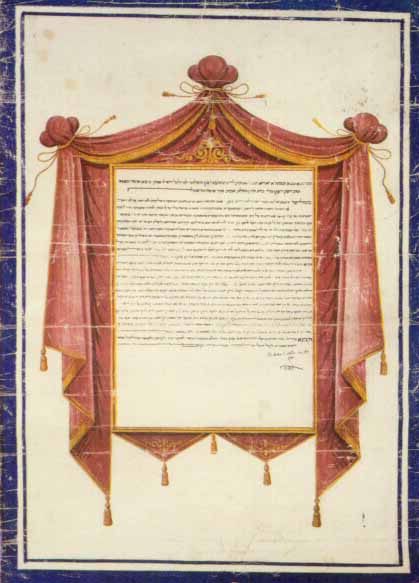
The third Corfu ketubah, written in 1874 for the
wedding of Joshua Raphael Eliasoff and Hannah Belleli, is framed by
full wine-colored drapes. The Bellelis were among the early Greek
families on the Isle. Under the Greek constitution the Jews were then
enjoying equal rights. The carefully arranged, symmetrical lush
drapes exude bourgeois well-being. They would perfectly fit in the
room of the family celebrating the seder, depicted in the rare
Haggadah published in Corfu in 1877, of which the Library has a fine
copy. Sixty years separate the three ketuboth. Yet the texts remain
the same, except for the names of the celebrants and the dowries
brought. Through their ornamentation, however, the ketuboth provide
indications of the changes wrought by political, social, and cultural
developments in the life of the Corfu Jewish community in the
nineteenth century.
This 1874 Corfu ketubah's decoration is rich
looking, symmetrically folded drapes, done by professional hand.
The artist seems to wish for the bridegroom, Joshua Raphael
Eliasoff, and his bride Hannah Belleli, a well-ordered, richly
endowed, harmonious life together, (Ketubah, Corfu, 1874, Hebraic
Section, Library of Congress
Photo).
 |
Sources: Abraham J. Karp, From
the Ends of the Earth: Judaic Treasures of the Library of Congress,
(DC: Library of Congress, 1991).
|