The Washington Haggadah
Even more than the megillah of Esther, the Haggadah
which is read in Jewish homes at the Passover seder, and which tells of the Exodus from Egypt, has been reproduced in
many and varied forms of artistic decoration. An illuminated manuscript
Haggadah, also fashioned in northern Italy, is the Library's justly famed
Washington Haggadah. The anonymous artisan who produced the megillah was a
pedestrian calligrapher and illustrator and, perhaps precisely because of
that, his megillah has a folk vitality and naive charm often lacking in the
work of more sophisticated and gifted artists. It is a fine example of what
a moderately skilled scribe aspiring at hiddur mitzvah can
accomplish. As such it is a valuable contribution to Jewish folk art. The
Washington Haggadah is of another order. Its creator, Joel ben Simeon, was
the most prolific Hebrew artist-scribe of the fifteenth century. No less
than eleven manuscripts bearing his name, written in his native Rhineland
and in Northern Italy, are now the treasured possessions of libraries in
Europe, Israel, and America. "Most of Joel's illuminations,"
Bezalel Narkiss writes, "consist of colored pen drawings.... The best
... is the expressively drawn Washington Haggadah of 1478." Narkiss
includes it among the sixty beautiful and important works which comprise
his Hebrew Illuminated Manuscripts, first published in Jerusalem in
1969, and more recently in 1984, in a revised and improved Hebrew edition.
He describes it:
It is illuminated entirely in Italian style, with no
trace of German motifs other than the iconography. All of the illustrations
are placed in the margins, and are mainly ritual or literal ... Beside the
four sons, other illustrations typical of German iconography are the
cooking and the roasting of the Passover lamb and a man pointing to his
wife while saying maror zeh.
Joel ben Simeon, called Feibush Ashkenazi of Bonn, calls
himself the humblest of scribes, stating that "the work was completed
on the 25th of Shevat, 5238" [January 29, 1478].
What appeals most to this observer about the Washington
Haggadah is its economy of decoration and its use of the illustrations,
even their place upon the page, to express a point of view. Illustrations
are only in the margins, preserving the centrality of the text; decorations
are there to adorn and may not intrude upon the text. The wise and wicked
sons are and should be farther apart from one another than the simple sons.
Why should the wise one not seem to be shoving the wicked one downward?
More than half of the figure of the wicked son is below the text, removed
from it, as the wicked son "removed himself from the congregation [of
Israel]." The artist becomes the subtle commentator, in the tradition
of Jewish religious works: text and commentary.
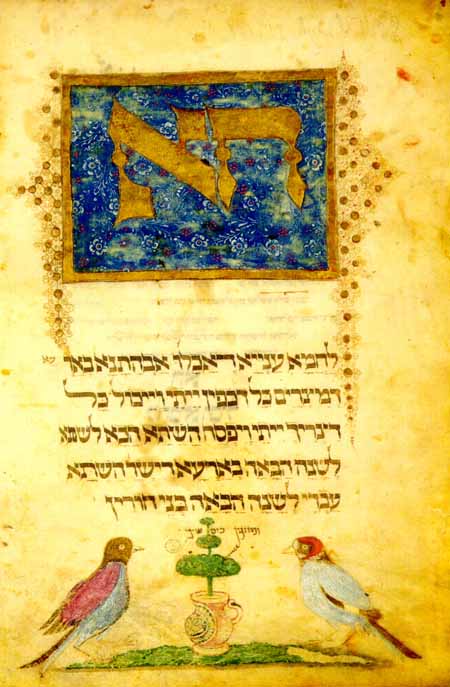
Ho Lahma, "This bread of affliction"
Among the greatest of medieval Hebrew illuminated
manuscripts is the Washington Haggadah fashioned by Joel ben Simeon, the
most productive scribe and illuminator of Hebrew manuscripts in the
fifteenth century. Though not elaborately illustrated as many other
illuminated Haggadot, the beauty of its caligraphy, which is never
subordinated to the illustrations, the proportions of the page, and the
vividness of the illumination, which has come down in unusally fine
condition, make this one of the most admired of Hebrew manuscripts. We
display four pages, The Washington Haggadah, Illuminated, Central Europe,
1478, Hebraic Section, (Library of Congress
Photo).
 |
Speaking of the sons: the wise one sits on a chair, book
in hands on lap, as if in the process of teaching. The simple son is not a
simpleton; he too has a book before him, but he sits on the floor as an
inquiring student. He does ask, "What is this?" and in a question
is the beginning of wisdom. The artist-scribe does not fall into the error
of so many illustrators of the Haggadah who depict the tam as a
simpleton, a tradition brought to a head by Jakob Steinhardt who places a
dunce cap on the tam in his Berlin, 1923, Haggadah. Tam means
innocent and simple, honest, and harmless. A faith tradition which extols
the question-the Talmud begins with a question, the Haggadah itself flows
from the Four Questions-would never view a questioner as a simpleton. A
simpleton is one who "lacks the capacity to ask a question," and
he is so portrayed in the manuscript, as a fool or jester. Our
artist-scribe knows he is a scribe first, copying a sacred text, then
adorning it and illuminating it with subtle visual commentary, but the text
must dominate.
The Four Sons
 |
The Messiah Heralded
 |
There are a considerable number of illuminated Haggadot,
larger in format and richer in illustrations. They are finer artistic
creations than the Washington Haggadah, but very few, if any, are grander
Haggadot, i.e., sacred liturgical texts whose purpose is to help the
celebrant reexperience history and renew his appreciation for the gift of
freedom. Its modest size, six inches by nine, indicates that it was meant
to be used at the seder table, and the pale wine stains on its vellum bear
witness that it was.
"Or Le Arba'ah Asar"
 |
Sources: Abraham J. Karp, From
the Ends of the Earth: Judaic Treasures of the Library of Congress,
(DC: Library of Congress, 1991).
|