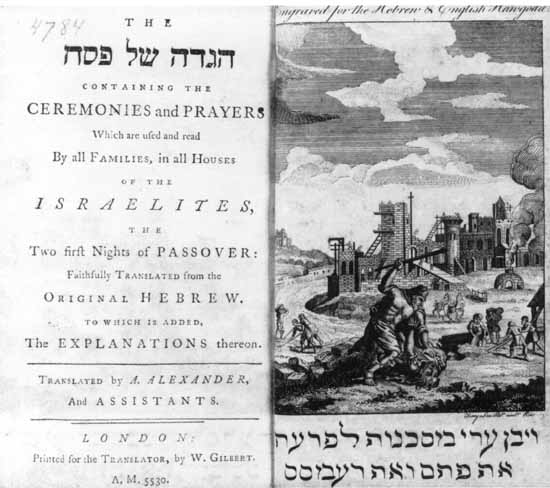
The First English Translation of the Haggadah
The first edition of the Haggadah with an English
translation, done by "A. Alexander and Assistants" and
printed for him, was published by the translator in London, 1770.
Having published a bilingual edition of "our Tephilloth, or
Common-Prayer-Book," Alexander now undertook a "second
Attempt, in Publishing this small Book of the Haggadah or the
Ceremonies of the Passover" accompanied by an explanatory
introduction and notes. Facing the title page is a frontispiece whose
engraved Hebrew legend declares, "And they built for Pharaoh
store-cities Pithom and Raameses." Depicted are medieval towers
being built, slaves laboring, and an overseer cruelly beating a
slave, mouth wide open in a scream of pain — again a copy of an
illustration in the Amsterdam Haggadah.
Alexander Alexander, having published the
prayer book in Hebrew with an English translation in London,
1770, undertook "a second attempt," publishing in the
same year "this small Book of the Haggadah, or the
ceremonies of Passover, together with a Notation thereon."
His English is poor in both translation and "Notation,"
nor did it improve in the Festival and Holy Days prayer books and
the Pentateuch which he subsequently published, and which his son
Levy Alexander republished. The frontispiece, Moses slaying the
Egyptian, "Engraved for the Hebrew Hawgoda," is a copy
of bar Jacob's illustration in the Amsterdam Haggadah, which
itself is a copy of a biblical engraving by Matthaeus Merian, (Haggadah
shel Pesah (Passover Haggadah), London, 1770. Hebraic
Section, Library of Congress
Photo).
Sources: Abraham J. Karp, From
the Ends of the Earth: Judaic Treasures of the Library of Congress,
(DC: Library of Congress, 1991).
|