Illustrated Haggadot
The illuminated Haggadah manuscripts paved the way
for unending editions of illustrated Haggadot which continue to the
present day. From the Library's impressive collection of Haggadot, we
choose seven. Four illustrate the ongoing influence of early and late
seventeenth- century editions; three are pictorial departures which
appeared once and were never copied.
In 1609, a Haggadah of singular beauty was
published in Venice by Israel ben David Zifroni, a veteran printer
and copy editor of Hebrew books in Italy and Switzerland. Each page
is framed by an artistically wrought border. Woodcut illustrations of
the Passover ritual and the
contents of the Haggadah abound, as well as depictions of Moses, Aaron, Kings David and
Solomon, and miniature vignettes framed by the large initial letters.
What is most rewarding to the student of history are illustrations of
contemporary preparations for the holiday, including the baking of
matzoh. This Haggadah appeared in three versions, with translations
and instructions in Judeo-German (Yiddish), Judeo-Italian, and
Judeo-Spanish (Ladino), all printed in Hebrew letters. A second
printing appeared in 1629, with a new title page extolling the beauty
of the illustrations and announcing the inclusion of a commentary Tseli
Esh (Roasted in Fire), an abridgement by Leone da Modena of Isaac
Abrabanel's Zebah Pesah (Passover Sacrifice), because
It already includes illustrations to delight the
eye, how much better it now is to add explanations which will
delight the "spiritual eye" [the soul].
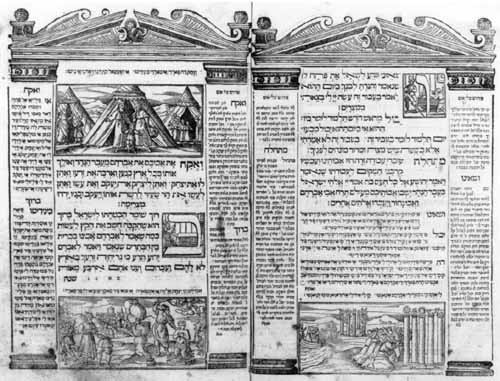
This profusely illustrated Haggadah was
edited by the noted seventeenth-century Venetian rabbi and
author, Leone da Modena, who provided a Judeo-Italian translation
and a new commentary Tseli Esh (Roasted in Fire), an
abridgement of the commentary of Isaac Abravanel, Zevah Pesah (Passover Sacrificial Offering). The illustrations shown depict
incidents in the life of the patriarch Abraham. At the top:
Abraham's choice of his younger son Isaac and rejection of the
older, Ishmael, is indicated by the placement of Abraham, Sarah,
and Isaac at the center tent, while Hagar and Ishmael stand alone
at theirs. At the bottom: the sacrifice of Isaac, (Seder
Haggadah shel Pesah (Passover Haggadah), Venice, 1629,
Hebraic Section, Library of
Congress Photo).
 |
The edition was commissioned by Moses ben Gershon
Parenzo, the last of three generations of Hebrew printers, and issued
by the Bragadini press. The Library's crisp copies of this edition
and one published in 1740 display the durability and popularity of
those illustrations by an artist whose name is unknown but whose
creations continued to beautify Haggadot published in the nineteenth
and the twentieth centuries, as for example, in a 1904 Livorno
edition with an Arabic translation for Tunisian Jews.
The Venice 1740 Haggadah edition also has a
Judeo-Italian translation, but it is meant to appeal to Yiddish-
speaking German Jews as well, for the hymn Adir Hu (Exalted Be He) appears with a translation in Judeo-German. The
Hebrew alphabetical acrostic is matched by one in Yiddish
extolling God's virtues, Seder Haggadah shel Pesah (Passover Haggadah), Venice, 1740, Hebraic Section, Library of Congress Photo).
 |
The illustrations most widely copied in
illuminated manuscripts (e.g., the exact copy by the artist-scribe
Ya'akov ben Yehudah Leib, written in Hamburg in 1728) and in hundreds
of printed editions are those which first appeared in a lavishly
illustrated and beautifully printed Haggadah published in Amsterdam
in 1695. For the first time in any edition of a Haggadah, the
illustrator is identified, Abraham bar Jacob "of the family of
Abraham our Father," i.e., a proselyte to Judaism. For the first
time, too, the illustrations are copper engravings rather than the
woodcuts of earlier editions. Engraving made possible more richly
detailed delineations, and these were copies or adaptations of
biblical engravings by the Swiss artist Mattaeus Merian, which were
first published in 1625-30. The simple son is copied from Merian's
depiction of Saul as he was being anointed by the Prophet Samuel. The
shepherd's crook held by Saul is changed into a staff, and the person
portrayed is "Judaized" by placing a hat on what was, in
Merian's depiction, a bald head. The look of the simple country
bumpkin is retained. The most dramatic depictions are of the Children
of Israel leaving Egypt and standing at Mt. Sinai, Moses descending
from the mountain, a Tablet of the Law in each hand, and Aaron
waiting below, surrounded by tents and people in Oriental and
medieval garb.
The title page of this Haggadah extols this
edition's virtues: a fine commentary and beautiful illustrations
of the miracles wrought by God for our ancestors. Added to that,
all the journey through the wilderness until the division of the
land among the tribes, and a depiction of the Temple, may it be
rebuilt and renewed, soon, in our day, Amen, and so may it be Thy
will. Engraved on Copper plates by the young man Abram bar Jacob,
of the family of Abraham our Father [i.e., a proselyte to
Judaism].
The illustrations were reproduced in many subsequent editions
until the present day. We see Moses and Aaron before the Pharaoh;
the enslaved Children of Israel at labor are in the background, (Seder
Haggadah shel Pesah (Passover Haggadah), Amsterdam, 1695,
Hebraic Section, Library of
Congress Photo).
 |
The Library's fine copy contains the inserted map,
previously described, which is missing in many copies, no doubt
removed for framing by devotees of cartography. It is perhaps ironic
that illustrations which for over two centuries have been the most
widely reproduced (e.g., the crude copies in the Furth, 1755 edition;
or the perfected engravings in the Vienna, 1823 printing) -which for
almost three centuries have been viewed as the most authentic
Haggadah depictions-stem from biblical scenes drawn by a Christian.
The Viennese publisher Anton Schmidt issued a
number of printings of the Haggadah utilizing the delicately
engraved popular illustrations of Abraham bar Jacob. They are
especially expertly executed in this 1823 issue. Two popular
commentaries by Moses Alscheich and Ephraim Lenczycz added to the
popular illustrations made for many editions. The Haggadah is
opened to the illustrations depicting the order of the seder, (Ma'ale
Bet Horin, Vienna, 1823, Hebraic Section, Library of Congress Photo).
 |
Sources: Abraham J. Karp, From
the Ends of the Earth: Judaic Treasures of the Library of Congress,
(DC: Library of Congress, 1991).
|