Islamic Influence
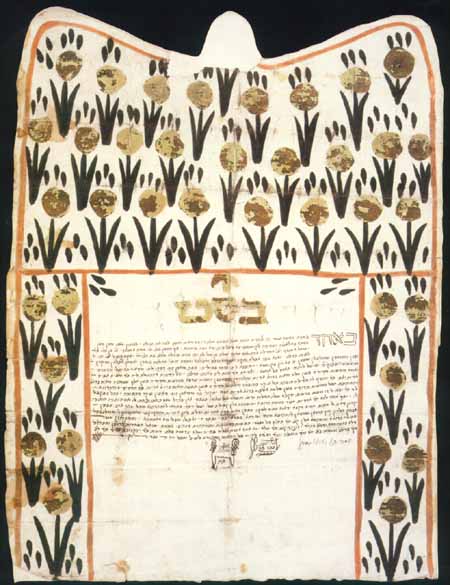
Galata was a section of Constantinople inhabited
by Jews in the nineteenth century. There on 17 Tevet, 5601 (January
10, 1841), the wedding of Shamma ben Yisrael Ashkenazi and Mirele bat
Ya'akov Kopel was solemnized. The ketubah reflects the Islamic
environment and is indicative of the artistic sensibilities and
skills of the Jewish calligraphers. it is not representational;
flowers and trees are suggested, but not depicted. The colors are
strong-black, green, and metallic gold-so that the bold primitive
nature of the illustrations makes them look modernistic. The
serviceable calligraphy makes no attempt at beauty. The ornamentation
is typical of that time and place, as may be seen from a ketubah
written in Constantinople a decade earlier, which is now in the
British Library. The Islamic venue would, of course, preclude
depictions of man or nature; its strong primitive harshness may well
indicate the quality of life in that place at that time.
Galata, a Jewish neighborhood in
Constantinople, celebrated the wedding of Shamma ben Yisrael
Ashkenazi to Mirele bat Ya'akov Kopel. The whole community,
Ashkenazi as well as Sefardi, must have joined in the
festivities, for the groom named Ashkenazi was a Sefardi and the
bride, Mirele, an Ashkenazi. The ketubah decoration reflects the
Islamic environment. The decoration is nonrepresentational-trees
and flowers are suggested not depicted-as was the Islamic custom,
Ketubah, Galata, 1841, Hebraic Section, Library of Congress Photo).
 |
Sources: Abraham J. Karp, From
the Ends of the Earth: Judaic Treasures of the Library of Congress,
(DC: Library of Congress, 1991).
|