Nineteenth Century Illustrators
In the nineteenth century, illustrators departed
from the slavish copying of the early Venice editions by Italian
publishers, and of the early Amsterdam by central and eastern
European printers. A most attractive edition, both for its Hebrew
typography and its elegantly executed woodcut illustrations, was
published in Basel in 1816, by Solomon Coschelberg at the press of
Wilhelm Haas. It is, as stated, "a simple edition without
commentary ... but a correct text, printed in large letters and with
many appropriate illustrations." The illustrations, twenty-four
in number, are copied from Friedrich Battier's, which appeared in a
1710 edition of a Basel German Bible. The spare woodcuts and the
square Basel type blend harmoniously. One note which may raise an
eyebrow is the depiction of a seder scene with twelve men surrounding
a long-haired central figure seated at a set table, the classic
portrayal of the Last Supper. A seder scene, to be sure, and one
fraught with memory. It must have escaped the scrutiny of the Jewish
publisher, because it was hardly an appropriate replacement for the
historic seder scene of the Amsterdam edition in which "Rabbis
seated in Bnei Brak are discussing the exodus from Egypt," or
the contemporary seder shown in the Venice editions.
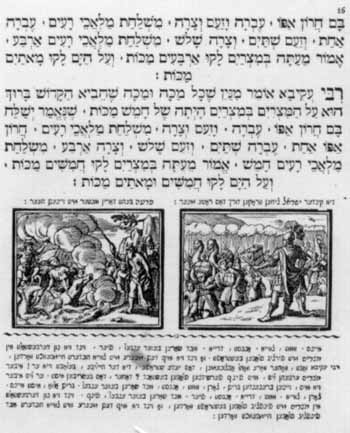
This Haggadah's type is pleasing to the eye
and easy to read; the German translation in Hebrew characters by
Joel Brill is in fine literary language; and the woodcut
illustrations are copied from a Bible printed in Basel in 1710.
Editor Solomon Coschelberg put them together to form this
charming Haggadah. The illustration on the right depicts the
Children of Israel crossing the Red Sea in safety while the
Egyptians go under; the one on the left shows the Children of
Israel gathering food and drawing water in the wilderness, (Haggadah
shel Pesah (Passover Haggadah), Basel, 1816, Hebraic Section, Library of Congress Photo).
 |
The beautifully illustrated Trieste, 1864 Haggadah
was published by Colombo Coen (Joshua Cohen) and edited by Abraham
Hayyim Morpurgo, the editor of Corriere Israelitico and scion
of a noted scholarly Italian Jewish family. The illustrations are by
a young artist, K. Kirchmayer whose name is inscribed at the bottom
of the title page, on which appear David and Solomon crowned, Aaron
mitred, and Moses bareheaded, rays of light shining from his brow.
Most of the illustrations are updated redrawings of those found in
the Venice editions. Thus, father and son still search for leaven,
mother is still doing her pre-Passover cleaning, but they are now
dressed in modern clothing, and the house furnishings are those of a
mid-nineteenth-century middle-class Italian home. This edition, too,
has a jarring note. Moses is depicted kneeling before the burning
bush, and clearly visible in the bush is the bearded face of God. The
figure and face of God can be seen in many Christian biblical
illustrations, but this is the only one in a Jewish publication,
except the barely noticeable face of the divine in the "Ezekiel
and the dry bones" panel on the engraved title page of the Minhat
Shai edition of the Hebrew Bible, published by Raphael Hayim,
Italia, Mantua, 1744. Did both Cohen and Morpurgo overlook it or,
seeing it, did they deem it appropriate?
The vivid, expertly executed illustrations by
K. Kirchmayer on almost every page have made this Haggadah a
favorite of connoisseurs and collectors. Edited by Abraham Hayyim
Morpurgo, it was published in variant issues-all Hebrew or Hebrew
with an Italian translation. Illustrated is Moses at the burning
bush; and almost unique in Jewish iconography, God's face is
depicted! (Seder ha-Haggadah shel Pesah (The Order of the
Passover Haggadah), Trieste, 1864, Hebraic Section, Library of Congress Photo).
 |
Sources: Abraham J. Karp, From
the Ends of the Earth: Judaic Treasures of the Library of Congress,
(DC: Library of Congress, 1991).
|