Secret Weddings
Meshed, in the northeastern section of Persia near
the Afghan border, is, in the Shiite Moslem tradition, "a place
of martyrdom," the site of the tomb of Imam Riza, who is
supposed to have been poisoned by the Caliph Mamun. In Jewish
historical memory it is also a place of martyrdom. in March 1839, a
mob broke into the Jewish quarter, burned the synagogue, and was
intent upon murdering all the Jews. Only mass conversion to Islam
prevented the complete annihilation of the Jewish community. The new
Muslims continued, however, to practice Judaism, remaining Muslims in
name only. Many left the city in order to live openly as Jews, while
others remained, living as best they could as crypto-Jews.
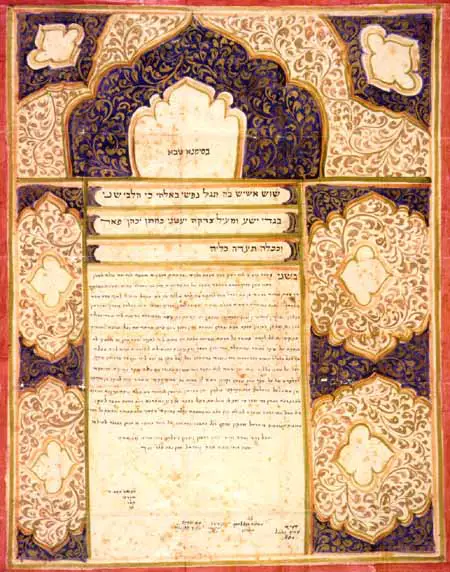
This Meshed ketubah reflects its provenance,
for its form, colors, and decorative patterns suggest a Persian
prayer rug. The ketubah, however, represents mute evidence of the
power of the Jewish spirit to resist environmental pressure when
it threatens Jewish survival. In 1839, the Jewish community was
forced to convert to Islam, but it did so only formally,
retaining Jewish loyalties and living as Jews secretly. Now fifty
years later, there is a Jewish wedding, expressing a passion for
Jewish survival, and a richly illuminated ketubah celebrating
commitment to Jewish continuity, (Ketubah, Meshed, Persia, 1889,
Hebraic Section, Library of
Congress Photo).
 |
When getting married they conducted a Jewish
ceremony in secret, then proceeded to the mosque for the public one.
"For the marriage ceremony it was their custom to write two
ketuboth, simultaneously," David Davidovitch reports in The
Ketubah. "One was an Islamic marriage contract ... written
in ... Arabic script in the Arabic and Persian languages ... the
other was an 'illegal' ketubah in Hebrew and Aramaic," the
traditional ketubah. The Library's Meshed ketubah is in Hebrew and
Aramaic on paper, as Meshed ketuboth are, and colorfully illuminated
with floral and geometric designs, and a red border which frames and
rises to an angular dome shape at the top. Within the frame are
decorative adornments in bright blue and gold. The groom is Rahamin
ben Yisrael; the bride, Malka bat Yehezkel. The wedding took place in
1889, fifty years after the Jewish community there was forced to
convert to Islam.
Sources:Abraham J. Karp, From
the Ends of the Earth: Judaic Treasures of the Library of Congress,
(DC: Library of Congress, 1991).
|