Tributes to Lincoln After his Death
The American synagogue paid its tribute to the
martyred president at special services on April 19, and again on the
day designated for memorial services by President Andrew Johnson,
June 1, 1865, which happened to be the second day of the Festival
of Shavuot. Of the many memorial discourses heard in Jewish
houses of worship, nine-five in German and four in English-were
issued as special publications. The Library has eight of the nine.
Listed below, these brief excerpts give some source of their mood and
content.
1. An Address on the Death of Abraham Lincoln,
President of the United States, Delivered Before Congregation Mikve
Israel of Philadelphia ... by the Rev. S. Morais, Minister of the
Congregation. On Wednesday, April 19, 1865, Philadelphia, 1865.
The stillness of the grave reigns abroad. Where is
the joyous throng that enlivened this city of loyalty? Seek it now,
my friends, in the shrines of holiness. There, it lies prostrate;
there, it tearfully bemoans an irretrievable loss, Oh! tell it not in
the country of the Gauls; publish it not in the streets of Albion,
lest the children of iniquity rejoice, lest the son of Belial
triumph. For the heart which abhorred wickedness has ceased to throb;
the hand which had stemmed a flood of unrighteousness, is withered in
death.
The Rev. Sabato Morais,
Congregation Mikve Israel, Philadelphia, April 19, 1865.
 |
2. A Discourse Delivered Before the
Congregation Mikve Israel ... Thursday, June 1, 1865, the Day
Appointed for Fasting, Humiliation, and Prayer, for the Untimely
Death of the Late Lamented President of the United States, Abraham
Lincoln by the Rev. S. Morais ... Philadelphia, 1865
If the essence of religion is what the great
Hillel taught us, then I unhesitatingly say that the breast of our
lamented President was ever kindled with that divine spark. "To
forbear doing unto others what would displease us" . . . is the
maxim he illustrated in the immortal document of emancipation that
bears his honorable signature. It is that which he exemplified by his
numerous acts of clemency ...
We must bear his name with a blessing upon our
lips.
The Rev. Sabato Morais,
Congregation Mikve Israel, Philadelphia, June 1, 1865.
 |
3. Trauer-Rede (Mourning Discourse) gehalten em
19ten April 1865 . . . Abraham Lincoln Präsidenten der Vereinigten
Staaten, in Tempel der Keneseth Israel Gemeinde zu Philadelphia von
Dr. David Einhorn (Philadelphia, 1865).
The murder of this high-priest of freedom must and
will unite all who still have a spark of moral feeling into a
brotherhood to preserve the union and crush that shameful institution
[slavery]. All those who in former times misunderstood the deceased
and denigrated his world-historic deed, must now learn to love and
honor both. This would be the truly meaningful fulfilment of the
saying of our Sages: "The death of the righteous atone for the
age."
If Abraham Lincoln had one fault, it was his
excessive generosity toward the rebels; he, whom the demagogues and
the murderer himself called a tyrant!
The Rev. David Einhorn,
Congregation Keneseth Israel, Philadelphia, April 19, 1865.
 |
4. Vaterland und Freiheit (Fatherland and
Freedom) Predigt bei der Erinnerungsfeier des verstorbenen
Prasidenten Abraham Lincoln, am 1. Juni, 1865 ... gehalten von
Benjamin Szold, Rabbiner der Oheb-Schalom Gemeinde in Baltimore,
Baltimore, 1865.
Abraham Lincoln took the reins of government at a
time when the Fatherland lay mortally ill, when there was little hope
for its survival and revival ... How Abraham Lincoln loved the
suffering Fatherland. [In this day of Shavuot, this joyful holiday]
we should feel joy that such a great moral figure lived among us, in
our time, and that the history of this Republic became enriched
through another great name, that by the side of Washington now stands
Lincoln.
The Rev. Benjamin Szold,
Congregation Oheb Schalom, Baltimore, June 1, 1865.
 |
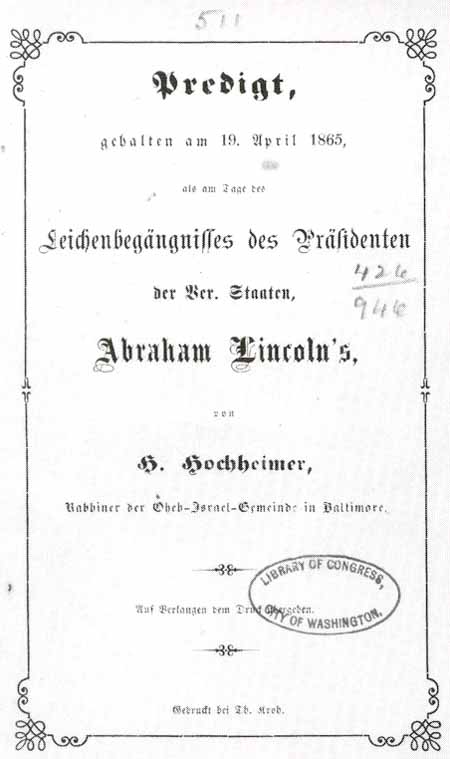
5. Predigt ... 19, April 1865 ... Abraham
Lincoln's von H. Hochheimer, Rabbiner der Oheb-Israel Gemeinde in
Baltimore (Baltimore, 1865).
The Rev. Henry Hochheimer,
Congregation Oheb Israel, Baltimore, April 19, 1865.
 |
6. Fest-und Fasttag (Commemoration and Fast
Day) ... am 1. Juni 1865 ... zum Gedachtnisse des ermordeten
Prasidenten Abraham Lincoln ... von H. Hochheimer ... (Baltimore,
1865).
When victory after victory were announced by his
warriors, did he glory in the defeat of his enemies? No. He stretched
forth his hand to the fallen. He spared them humiliation, offered
them conditions honorable beyond their dreams, and as Abraham of old,
he called out to them: "Let there not be strife between us, for
we are brothers" [Genesis, 13:8].
The Rev. Henry Hochheimer,
Congregation Oheb Israel, Baltimore, June 1, 1865.
 |
7. Charakteristik Abraham Lincolns ... einer
Trauer-Predigt ... am 19. April 1865, von Jonas Bondi, in der
Synagogue der Gemeinde Poel Zedek, New York 1865:
Abraham Lincoln was a religious man, imbued with
the fear of God, faithful to the religion of his ancestors, faithful
also to the faith he absorbed with his mother's milk. That is not to
say he was a fanatic, as some thought, that he would disdain one who
in his eyes did not appear to be religious, Oh No! His conception of
the faith into which he was born was his own private, personal
conviction. He respected every true and ethical conception of Faith,
respected every pious one, no matter what form that piety took. Who
would question that Abraham Lincoln was a truly humane human being?
His last act, the capitulation of Lee, proved that his was the mind
of a noble victor, a person exemplifying the true biblical
love-loving one's neighbor.
The Rev. Jonas Bondi,
Congregation Poel Zedek, New York, April 19, 1865.
 |
8. An Address: Delivered on Request of the
Congregation, by P. J. Joachimsen, At the Place of Worship of the
Hebrew Association Temimi Derech, at New Orleans, On Saturday, April
29th, 1865, New York, 1865.
Alas! that we should have occasion for an addition
to our services to deplore the untimely loss, by violence, of the
Chief Magistrate of the American people. Alas! that we should have to
pray to God that in the history of the American people this may be
forever the only time when national mourning shall be accompanied by
national humiliation and national shame ... Unaided by worldly
fortune or powerful friends, he [Lincoln] attained to the fame of the
most eminent patriots and statesmen-aye, even of Washington, the
Father of his country. You can point him out to your children as one
of the men worthy of emulation, as a pattern and as an example.
And we, as Jews, had a distinct ground to love,
respect and esteem him ... When an order was made to banish Jews as a
class from a particular Department, and their immediate and
indiscriminate departure was being carried out, our deceased
President at once revoked the unauthorized command ...
We can carry the memory of Abraham Lincoln with us
as that of a triumphant martyr to humanity, and we can also carry
into practice the lessons taught us by the short but eventful life of
the great departed:
To be true and honest to ourselves and to our
neighbors.
To stand bravely and fearlessly to the
performance of our duties as citizens of this great Republic.
P. J. Joachimsen, Congregation
Temimi Derech, New Orleans, April 29, 1865.
 |
As we may have noticed, the eulogy was preached in
New Orleans, but published in New York.
Sources: Abraham J. Karp, From
the Ends of the Earth: Judaic Treasures of the Library of Congress,
(DC: Library of Congress, 1991).
|