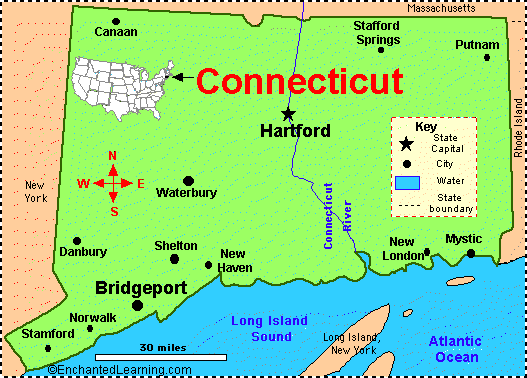
Connecticut and Israel
Trade and Population Statistics
| Exports to Israel (2014) |
$118,680,218 |
| Percentage Change (2013-2014) |
+16.08% |
| Total Exports to Israel (1996-Present) |
$1,958,961,344 |
| Israel's Trade Partner Rank (2014) |
17 |
| Military Contracts with Israel (2015) |
$25,812,009 |
| Jewish Population (2015) |
97,000 |
| Jewish Percentage of Population |
3.6% |
Binational
foundation grants shared by Connecticut and Israel
Grant recipients in
Connecticut from U.S.-Israel binational foundations:
Alcide Corp.
Canberra Industries Inc.
CAS Medical Systems Inc.
Corometrics Medical Inc.
Executone Information Systems
General DataComm
Hydrofera
Kollmorgen Motion Tech.
Lansco Inc.
MacDermid Inc. |
Micromint Inc.
Packet/PC Inc.
Presstek Inc.
Timex Corp.
TranSwitch Corp.
University of Connecticut
University of Connecticut Med School
VA Medical Center
Yale University
Yale Medical School |
Bilateral
Institutions
Connecticut - Israel Exchange Commission- Established in the late 1980's
by Connecticut's Department of Economic and Community Development, the
CONNIX was created with the inherent purpose of promoting and expanding
economic, scientific, educational, technological, commercial, industrial
and cultural cooperation and exchange between Connecticut and Israel.
Then-Governor William O'Neill signed the agreement that officially created
CONNIX. In recent years, unfortunately, CONNIX has no longer received
state funds though State Representative David Baram is hoping to resurrect
CONNIX. Read the agreement that established CONNIX, CLICK
HERE.
Cooperative
Agreements - "Memoranda of Understanding"
September 2005 - Sikorsky Aircraft,
based in Stratford, signed an MOU with the government of Israel to develop
the Armed Blackhawk (ABH) helicopter, also known as the BattleHawk,
for use by the Israeli Air Force. In 2009, Sikorsky announced that the
test phase for the ABH was complete which paves the way to upgrade the
IAF's existing fleet of BlackHawk helicopters currently in use. Read
more about the project, CLICK
HERE.
Connecticut Government Missions to Israel
April 2010 - Congressman
Joe Courtney (D-CT) led a very successful economic trade mission to
Israel that included businesspeople from at least one dozen Connecticut
companies and organizations. The goal of the mission was to promote
long-term economic growth and job creation by growing export opportunities
for small and mid-sized companies by developing a mutually beneficial
relationship with Israel. "This mission to Israel is about creating
long-term economic opportunities and jobs for a more sustainable and
robust Connecticut economy,” stated Courtney. “I want to
help open doors for Connecticut companies who otherwise have no global
reach or resources to bridge the international divide." Anne Evans,
District Director of the US Department of Commerce's Export Assistance
Center in Middletown, added, "Our trade mission to Israel will
serve as the vehicle to proactively open up the Israeli market to our
state’s companies." Read more about the mission at the blog
of the International Trade Administration, CLICK
HERE.
March 2008 - Senator Joe Lieberman
joined Senators John McCain (R-AZ) and Lindsey Graham (R-SC) on an official
congressional visit to Israel to learn more about regional threats in
the Middle East and ways in which the United States and Israel can collaborate
on responses. While in Israel, the trio of senators met with Israeli
Vice Prime Minister and Foreign Minister Tzipi Livni who stressed the
importance of dealing with the rising tide of Islamic extremism. "It
is impossible to achieve peace without dealing with the fundamental
issues of terrorism and extreme Islamism. A change in Gaza is essential,"
said Minister Livni. Read more about this high level meeting, CLICK
HERE.
Partners
For Change
The U.S.-Israel relationship is based on the twin
pillars of shared values and mutual interests. Given this commonality of
interests and beliefs, it should not be surprising that support for Israel
is one of the most pronounced and consistent foreign policy values of the
American people.
It is more difficult to devise programs that capitalize
on the two nations' shared values than their security interests;
nevertheless, such programs do exist. In fact, these SHARED VALUE
INITIATIVES cover a broad range of areas, including the environment,
science and technology, education and health.
As analyst David Pollock noted, Israel is an advanced country with a population that surpassed eight million people in 2013 and a robust, dynamic economy that allowed it to join the Organization for Economic Cooperation and Development (OECD). Between 2005 and 2013, Israel has represented a larger market for U.S. exports than Saudi Arabia. Although Israel's citizenry make up just 3 percent of the total region's population, Israel accounts for 25 percent of American exports in the Middle East.
"It has also been one of the top 20 foreign direct investors in the United States since 2009," Pollock confirms. He adds that "$2.25 billion of the $3 billion in annual U.S. aid to Israel comes back via Israeli purchases of U.S. military equipment - and that is just 5 percent of the total bilateral trade each year."
Today's interdependent global economy requires that
trade policy be developed at the national and state level.
Many states have recognized the opportunity for realizing
significant benefits by seeking to increase trade with Israel. Connecticut is one of 33 states that have cooperative
agreements with Israel.
In 2012, Connecticut exported over $98,393,209.00 worth
of manufacturing goods to Israel. Since 1996, Connecticut exports to
Israel have totaled more than $1,701,217,604.00and Israel now ranks as Connecticut’s
22nd leading trade partner.
Additionally in 2012, Connecticut received more than
$58,687,484.91 in foreign military financing (FMF) for US military aid
to Israel. Some of those companies that have received funding through FMF in 2012 or past years
include: Kahn Industries Inc. in Wethersfield, United Technologies Corporation in East Hartford, and Roller Bearing Company of America in Fairfield.
Israel is certainly a place where potential business
and trade partners can be found. It can also be a source, however, for
innovative programs and ideas for addressing problems facing the citizens
of Connecticut.
Israel has developed a number of pioneering education programs. For example, AICE introduced an innovative Israeli
peer tutoring program to North Carolina that educators adapted for use
in the United States. Now known as Reading Together, the program is
used in 28 states. The program is designed to help students achieve
reading fluency and is mostly used for children in second grade. The
hope is that with its implementation, increasing numbers of students
will perform at grade level or above.
A range of other exciting approaches to social problems
like unemployment, environmental protection and drug abuse have been
successfully implemented in Israel and could be imported for the benefit
of Americans.
The potential for greater cooperation with Israel for
the benefit of Connecticut is limited only by the imagination.
Connecticut Firms
Profit From Business With Israel
As the only country with free trade agreements with both
the United States and the European community, Israel can act as a bridge
for international trade between the United States and Europe. Moreover,
because of the deep pool of talent, particularly in hightechnology areas,
Israel provides excellent investment opportunities. Some of the nation's
largest companies, such as IBM, Microsoft, Motorola and Intel have found
that it is indeed profitable to do business in Israel.
More than 250 Connecticut companies have also discovered
the benefits of trade with Israel. Several own interests in Israeli
companies or have subsidiaries there, including MacDermid, Brink's,
General Electric and Branson Ultrasonics.
For example, in addition to the funds already given
to Connecticut companies through the FMF program, Pratt & Whitney
Military Engines, based out of East Hartford, has been chosen as one
of the principle contractors in a US Congressional deal to send as much
as $15.2 billion worth of F-35 Joint Strike Fighter Aircraft to the
Israeli government. Being chosen as a principle contractor in this deal
is a major achievement for the Connecticut-based firm which will be
required to run multiple trips to Israel involving US government representatives
in order to hammer down the specific technical details and training.
Read more about this deal, CLICK
HERE.
The Connecticut-Israel Exchange Commission, which is
located in the Governor's office in Bridgeport, provides information
about trade opportunities and helps match Israeli and Connecticut companies
that are interested in cooperative ventures.
One good way to break into the Israeli market is through
a joint venture with an Israeli company. Funding for such projects is
available from the Binational
Industrial Research and Development Foundation (BIRD). BIRD funds projects in 36 states and the District of
Columbia and hundreds of companies including AOL, GE, BP Solar, Texas
Instruments and Johnson & Johnson have benefitted from BIRD grants.
The United States and Israel established BIRD in 1977
to fund joint U.S.-Israeli teams in the development and subsequent commercialization
of innovative, nondefense technological products from which both the
Israeli and American company can expect to derive benefits commensurate
with the investments and risks. Most grant recipients are small businesses
involved with software, instrumentation, communications, medical devices
and semiconductors.
Since its inception, BIRD has funded more than 800
joint high-tech R&D projects through conditional grants totaling
more than $210 million. Products developed from these ventures have
generated more than $8 billion in direct and indirect revenues for both
countries and has helped to create an estimated 20,000 American jobs.
Dr. Eli Opper, the former Israeli chair of BIRD, has
said that BIRD is a strong pillar of US-Israel industrial
cooperation and that the extreme success of BIRD has
led Israel to adopt similar models of R&D with other countries.
Several Connecticut companies have benefited from BIRD grants, including Alcide Corp., Executone Information Systems, Lansco,
Micromint, TranSwitch Corp., General DataComm, Timex, Presstek and MacDermid.
Connecticut's BIRD recipients to companies total nearly
$2 million.
In 2011, Hydrofera, based out of Willimantic, was awarded
funding through the BIRD Foundation to team up with
the Israeli-based company ART Healthcare in order to develop a device
to reduce infections in intensive care units. This grant was part of
over $8 million awarded by BIRD to nine new projects
with companies across both the US and Israel in 2011.
One BIRD annual report highlighted
a project between Middleburybased General DataComm Industries, a leading
provider of communications networks, and Orckit, an Israeli company
in the forefront of Highbitrate Digital Subscriber Line (HDSL) technology.
Orckit's technical capabilities and experience designing products to
meet both American and European standards attracted GDC's attention.
The products they are jointly developing will allow worldwide carriers
to improve and expand telecommunication services without major investments
in infrastructure, such as fiberoptic cabling, according to the report.
MacDermid of Waterbury has had several BIRD grants for joint ventures with its Israeli subsidiary. One successful
project was the development of a photoresist, which is used in the semiconductor
industry to help make smaller and finer components. The latest grant
is to produce an improved photoresist for printed circuit boards, the
platform on which computer chips are mounted. Jurgen Diekmann, director
of imaging systems, said the grants are a catalyst for projects because
they reduce the risk of undertaking new and costly ventures.
Dr. Daniel Upp has used the BIRD grant
to TranSwitch Corp. to accelerate the development of a new integrated
circuit chip. This technology will be used by manufacturing firms that
make transmission equipment for telephone companies.
With help from BIRD grants in 2010,
VCortex Ltd. (Kiryat Gat, Israel) and Presstek Inc. (Greenwich) will
combine their capabilities to design an automatic color control for
digital printing, leading to more capable and more productive digital
press.
Scientific
Innovations
Connecticut researchers are making scientific breakthroughs
and developing cutting-edge technologies in joint projects with Israeli
scientists thanks to support from the Binational
Science Foundation (BSF). BSF was established in 1972 to promote scientific relations
and cooperation between scientists from the United States and Israel.
The fund supports collaborative research projects in a wide area of
basic and applied scientific field for peaceful and non-profit purposes.
Since its inception, BSF has awarded some $480 million
through more than 4,000 grants in 45 states and the District of Columbia.
BSF-sponsored studies are highly successful
in achieving their two main goals: strengthening the US-Israel partnership
through science and promoting world-class scientific research for the
benefit of the two countries and all mankind. The BSF grants help extend research resources to achieve milestones that might
not otherwise be attainable; introduce novel approaches and techniques
to lead American researchers in new directions; confirm, clarify and
intensify research projects; and provide unmatched access to Israeli
equipment, facilities and research results that help speed American
scientific advances. BSF has documented no less than
75 new discoveries made possible by its research grants and counts 37
Nobel Prize and 19 Lasker Medical Award laureates among its joint partners.
Scientists in Connecticut have shared with their counterparts
in Israel more than $5.6 million in BSF grants awarded
since 1996 alone. Yale and the University of Connecticut are among the
grant recipients.
Jeffrey Kocsis is a professor of neurology at Yale
Medical School doing research on proteins that are believed to be related
to types of pain associated with secondary nerve injuries. He said that
surgeons find that, for example, after an amputation a patient's pain goes
away temporarily, but then returns later. He is trying to understand the
cause of that pain so that eventually drugs might be developed to alleviate
it.
“I can't emphasize enough how wonderful the BSF program is,” Kocsis said. “It fosters collaboration that would
not otherwise occur and made possible an exchange of visits with my
colleague that has led to a number of publications.”
The Yale Child Studies Center has had extensive
collaboration with counterparts in Israel, according to Robert King. He was
a scholarinresidence at “a wonderful place” in Jerusalem run by
B'nai B'rith Women, called the Residential Treatment Center, which offers
residential care and psychotherapeutic treatment to severely emotionally
disturbed boys.
The project he is working on with a BSF grant looks at traits in adolescents related to physical pain and suicide.
Israel has a much lower suicide rate than the United States, according
to King. Israelis are not as likely to abuse alcohol or suffer from
conduct disorders. They do, however, feel tremendous pressure to be
high achievers and those who think they have failed may be more prone
to suicide. He has also found that Israelis who are more tolerant of
pain are more prone to suicide. “Each year, the army screens every
adolescent in Israel,” King said, “and this provides a rich
source of information that allows us to prospectively study how kids
with certain traits adapt.”
Yale geneticist Kenneth Kidd is trying to identify
a gene for inherited deafness that will make it possible to offer genetic
counseling to treat the condition. The BSF grant has
allowed his colleague to study a large number of genetic markers, which
have been passed on to his lab for further analysis. "The more
hands working on the project, the faster it goes," he said.
Researchers Aner Shalev from the Hebrew
University in Jerusalem along with Efim Zelmanov at Yale
University in New Haven, understood that the sequencing of
certain events is important. Using both Lie algebra and the
Abelian group in their research, Shalev and Zelmanov hope
to discover new findings that can be applied to the fields
of physics, economics, and biology. Lie algebra consists
of a group of elements in which there is a commutator (the
difference between the process of a group of events in one
sequence and then again in the opposite sequence). In other
words, in Lie algebra, the sequence of events changes the
outcome. In an Abelian group, however, the sequence has no
affect on the outcome of events and the commutator is zero.
General benefits to America from BSFsponsored
studies include the extension and elaboration of research to achieve
milestones that might not have been reached otherwise; the introduction
of novel thinking and techniques that led American researchers to move
in new directions and early access to Israeli research results that
sped American scientific advances.
Agriculture
Benefits
In 1978 the United States and Israel jointly created
the Binational Agricultural
Research and Development Fund (BARD)
to help fund programs between US and Israeli scientists for mutually
beneficial, mission-oriented, strategic and applied research into agricultural
problems. Since its inception, BARD has funded more
than 1,000 projects in 45 states and the District of Columbia with a
total investment of more than $250 million. In 2000, an independent
and external economic review of 10 BARD projects conservatively
projected more than $700 million in revenue by the end of 2010, a number
which far outweighs the total investment in all BARD projects over its 33 year existence and helps to continually strengthen
the foundation.
Most BARD projects focus on either increasing agricultural
productivity, plant and animal health or food quality and safety and
have been influential in creating new technologies in drip irrigation,
pesticides, fish farming, livestock, poultry, disease control and farm
equipment. BARD funds projects in 45 states and the
District of Columbia and at present is beginning to administer collaborative
efforts between Australia, Canada and Israel as well. It is difficult
to break down the impact on a state-by-state basis, but overall, BARD-sponsored
research has generated sales of more than $500 million, tax revenues
of more than $100 million and created more than 5,000 American jobs.
Connecticut institutions, including the University of Connecticut and
Yale University have shared grants worth more than $1.2 million since
1979.
Richard Crain, a professor of molecular and cell biology
at the University of Connecticut at Storrs has received grants from
both BARD and BSF. One project involves the investigation
of what regulates the aging process (for example, why leaves lose their
green color) in plants. The longterm application would be to develop
improved methods for storing vegetables to retard the aging process.
A second project looks at plant responses to
environmental changes. Crain wants to understand, for example, why some
plants wilt easily. The study, he said, applies to plant reactions to
conditions such as drought, changing light and variations in salt content.
The grants allow Crain to travel to Israel, which is
important for allowing him to interact and exchange ideas with his colleagues. BARD also allowed him to hire a graduate student to
work in the lab for three years. And, most important, the collaboration
results in prestigious publications.
A project with implications outside Connecticut involves
the study of cow reproduction. Bob Milvae of U Conn is studying structures
in the ovary of cows to try to understand the biochemical messages that
determine whether a calf will develop. Dairy cows only produce milk after
having calves. Ideally, cows would give birth every 12 months, but today
the interval is 14 months and the two-month difference costs the dairy
industry millions of dollars. Milvae hopes his research will help bridge
the gap.
Milvae's research may also have important implications
for humans, such as understanding why women have early, spontaneous
abortions even if an embryo is healthy. "I couldn't do the research
without funding from BARD," Milvae said, adding
that he and his collaborator have different techniques and labs and
therefore benefit from looking at the problem from different perspectives.
An earlier BARD project conducted
by researchers at Yale, Israel's Kimron Veterinary Institute and the
USDA Plum Island Animal Diseases Center in New York, developed a test
for Rift Valley Fever. This test has improved detection of a virus that
infects cattle, sheep and humans in many developing countries.
Other Cooperative
Programs
Central Connecticut State University launched an innovative
learning partnership in the 2010s with leading universities in Israel as part of
its international course curriculum and study-abroad opportunities.
Sister Cities
UJA Partnership
2000 Communities
CONNECTICUT |
ISRAEL |
Bridgeport |
Afula - Ta'anach
- Gilboa |
Danbury |
Afula - Ta'anach - Gilboa |
Greenwich |
Afula - Ta'anach - Gilboa |
Hartford |
Afula - Ta'anach - Gilboa |
Stamford |
Afula - Ta'anach - Gilboa |
Waterbury |
Afula - Ta'anach - Gilboa |
Westport |
Afula - Ta'anach - Gilboa |
State
Contacts:
Hillel
Campus Profiles
Connecticut-Israel Exchange Commission
Dept. of Economic Development, 10 Middle St., 1st Fl.
Bridgeport, CT 06604
Tel. 203-336-8700
Dr. Israel Peleg
Trade Representative for Israel
Department of Economic & Community Development
Connecticut-Israel Exchange Commission
14 Rahavat Ilan
54056 Givat Shmuel
Tel: 03-532-5974
Fax. 03-532-2460
Email: [email protected]
Jewish Federation
1035 Newfield Ave., P.O. Box 3038
Stamford, CT 06905
Tel. 203-321-1373
Jewish Federation
360 Amity Road
Woodbridge, CT 06525
Tel. 203-387-2424
Jewish Federation
333 Bloomfield Avenue
West Hartford, CT 06117
Tel. 860-232-4483
Jewish Federation Association of Connecticut
40 Woodland Street
Hartford, CT 06105
Tel. 860-418-5701
Jewish Federation Of Eastern Connecticut
28 Channing Street
New London, CT 06320-5702
Tel. 860-442-8062
Jewish Federation Greater Danbury
105 Newtown Road
Danbury, CT 06810-4114
Tel. 203-792-6353
Jewish Federation of Eastern Fairfield County
4200 Park Avenue
Bridgeport, CT 06604
Tel. 204-372-6567
|
Jewish Federation of Eastern Fairfield County
4200 Park Avenue
Bridgeport, CT 06604
Tel. 203-372-6567
Jewish Federation Of Greater Hartford
333 Bloomfield Avenue
W Hartford, CT 06117-1544
Tel. 860-232-4483
Jewish Federation Greater New Haven
360 Amity Road
Bethany, CT 06524-3407
Tel. 203-387-2424
Jewish Federation Of Greenwich
600 W Putnam Avenue
Greenwich, CT 06830-6080
Tel. 203-622-1434
Jewish Federation Of Waterbury
100 Williamson Drive
Waterbury, CT 06710-1134
Tel. 203-756-7234
Jewish Federation of Greater Waterbury
73 Main St. South
Woodbury, CT 06798-3404
Tel. 203-263-5121 |
|