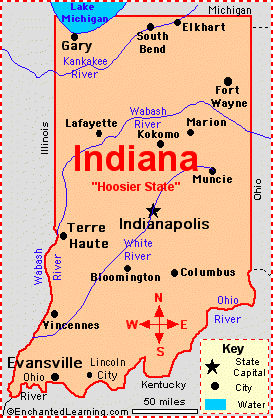
Indiana and Israel
Trade and Population Statistics
| Exports to Israel (2015) |
|
| Percentage Change (2014-2015) |
-21.29% |
| Total Exports to Israel (1996-Present) |
$813,786,967 |
| Israel's Trade Partner Rank (2015) |
38 |
| Military Contracts with Israel (2015) |
$946,762 |
| Jewish Population (2015) |
34,900 |
| Jewish Percentage of Population |
0.72% |
Binational
foundation grants shared by Indiana and Israel
Grant recipients in
Indiana from U.S.-Israel binational foundations:
Indiana State
Indiana University
Indiana University Medical School
Purdue University
Purdue Medical School
Purdue Research Foundation
Notre Dame University
USDA Soil Erosion Lab
Valparaiso University
Bilateral
Institutions
Indiana Economic
Development Corporation Eastern Mediterranean Office - Headed by American oleh to Israel, Sherwin Pomerantz, the IEDC-EM looks
to match companies in Indiana and Israel to develop joint business ventures
and bilateral trade to enhance the economies of both states. Read more
about the IEDC, CLICK
HERE.
Cooperative
Agreements - "Memoranda of Understanding"
None. Help us build this section by emailing AICE with any updates, additions, corrections or commetns. We appreciate your support.
Indiana Government Missions to Israel
December 2014 - Indiana Governor Mike Pence spent his winter holiday with family in Israel during late December 2014 during a 9 day government mission to Israel. During his time there Pence met for three days with Indiana and Israeli business and technology leaders, discussing future increased cooperation between Indiana and Israel. Pence and his entourage were invited to Palestinian Authority President Mahmoud Abbas's annual Christmas dinner at his home, but promptly refused the invitation. In addition to business leaders Pence also held meetings with Prime Minister Netanyahu, stating that "appreciation for the state of Israel and the partnership between the state of Israel and America has never been stronger." This visit was funded by the Zionist organization Christians United for Israel, and the Indiana Economic Development Foundation. To read more about Pence's trip, CLICK HERE.
March 2014 - Senator Joe Donnelly (D-IN) visited Israel with two colleagues, a fellow Democrat and one Republican, and met with Prime Minister Benjamin Netanyahu and President Shimon Peres.
"[The US-Israel relationship] is as strong as it could be ... when we were with [Netanyahu] tonight, there was a very clear understanding on both [sides] that we're standing shoulder to shoulder," Donnelly said. The trio of senators also presented Peres with a Congressional medal for his years supporting and nurturing the US-Israel alliance. To read more, CLICK HERE.
April 2012 - Governor Mitch Daniels visited Israel for eight days on a trip that Indianapolis businessman Mickey Mauer led and that Jewish Federation of Greater Indianapolis members had requested. Gov. Daniels met with Prime Minister Benjamin Netanyahu and several prominent Israeli businessmen and leaders of aerospace companies. He also visited significant cultural sites in Israel.
Mickey Maurer led. The governor participated in the trip after members of the Jewish Federation of Greater Indianapolis asked him to travel to Israel. While there, Gov. Daniels met with Prime Minister Benjamin Netanyahu, leaders of various Israeli
businesses and aerospace companies, and he visited several cultural sites.
July 2008 - Representative Mike Pence visited Israel
and the Palestinian territories as part of a Congressional delegation
to the area. Rep. Pence and his colleagues met with high ranking government
officials, including Israeli Prime Minister Ehud Olmert and Palestinian
Prime Minister Salam Fayyad. As the ranking Republican on the Middle
East and South Asia Subcommittee of the House Committee on Foreign Affairs,
Rep. Pence needed a first-hand look at the situation in Israel and to
discuss the prospects for a renewed peace process with the Palestinian
Authority. Read more about Rep. Pence's trip to the region from his
personal blog, CLICK
HERE.
March 2006 - Mayor Kevin Smith, of Anderson, and a
number of high ranking staff officials travelled to Israel to make contacts
with Israeli businesses with the hope to lure profitable companies to
Anderson, in particular, and Indiana in general. The delegation met
with a slew of Israeli businesspeople across a wide spectrum of fields.
Read more, CLICK
HERE.
Partners
For Change
The U.S.-Israel relationship is based on the twin
pillars of shared values and mutual interests. Given this commonality of
interests and beliefs, it should not be surprising that support for Israel
is one of the most pronounced and consistent foreign policy values of the
American people.
It is more difficult to devise programs that capitalize
on the two nations' shared values than their security interests;
nevertheless, such programs do exist. In fact, these SHARED VALUE
INITIATIVES cover a broad range of areas, including the environment,
science and technology, education and health.
As analyst David Pollock noted, Israel is an advanced country with a population that surpassed eight million people in 2013 and a robust, dynamic economy that allowed it to join the Organization for Economic Cooperation and Development (OECD). Between 2005 and 2013, Israel has represented a larger market for U.S. exports than Saudi Arabia. Although Israel's citizenry make up just 3 percent of the total region's population, Israel accounts for 25 percent of American exports in the Middle East.
"It has also been one of the top 20 foreign direct investors in the United States since 2009," Pollock confirms. He adds that "$2.25 billion of the $3 billion in annual U.S. aid to Israel comes back via Israeli purchases of U.S. military equipment - and that is just 5 percent of the total bilateral trade each year."
Today's interdependent global economy requires that
trade policy be developed at the national and state level.
Many states have recognized the opportunity for realizing
significant benefits by seeking to increase trade with Israel. Indiana is one of 33 states that have cooperative
agreements with Israel.
In 2012, Indiana exported over $50,418,630.00 worth
of manufacturing goods to Israel. Since 1996, Indiana exports to
Israel have totaled more than $611,990,809.00and Israel now ranks as Indiana’s
45th leading trade partner.
Additionally in 2012, Indiana received more than
$25,159,454.25 in foreign military financing (FMF) for US military aid
to Israel. Some of those companies that have received funding through FMF in 2012 or past years
include: CNC Industries, Inc. in Fort Wayne, Indiana Heat Transfer Inc. in Marshall, and AM General Corporation in South Bend.
Israel is certainly a place where potential business
and trade partners can be found. It can also be a source, however, for
innovative programs and ideas for addressing problems facing the citizens
of Indiana.
Israel has developed a number of pioneering education programs. For example, AICE introduced an innovative Israeli
peer tutoring program to North Carolina that educators adapted for use
in the United States. Now known as Reading Together, the program is
used in 28 states. The program is designed to help students achieve
reading fluency and is mostly used for children in second grade. The
hope is that with its implementation, increasing numbers of students
will perform at grade level or above.
A range of other exciting approaches to social problems
like unemployment, environmental protection and drug abuse have been
successfully implemented in Israel and could be imported for the benefit
of Americans.
The potential for greater cooperation with Israel for
the benefit of Indiana is limited only by the imagination.
Indiana Firms
Profit From Business With Israel
As the only country with free trade agreements with
both the United States and the European community, Israel can act as
a bridge for international trade between the United States and Europe.
Moreover, because of the deep pool of talent, particularly in high-technology
areas, Israel provides excellent investment opportunities. Some of the
nation's largest companies, such as IBM, Microsoft, Motorola, Intel
and McDonald's have found that it is indeed profitable to do business
in Israel.
At least 70 Indiana companies have discovered the benefits
of doing business in Israel, including Magnavox, ALCOA, Allied-Signal,
Colgate Palmolive and ITT Aerospace.
Biomet has been doing business in Israel for about
ten years, says Tom Allen, Director of International Sales, Marketing
& Operations. The company sells orthopedic equipment, such as hip
and knee replacements. Allen says it's a good market for the size of
its population (roughly six million) and that it's easier to do business
in Israel than many countries like Japan and France. "The Israelis
always meet their payment terms and that puts them in the top ten,"
says Allen, who sees the country as a growth market for his products
because of its aging population. Given his positive experience, he enthusiastically
recommends that other companies look for business opportunities in Israel.
Edmond Schaefer, Magnavox's Director of International
Marketing, has also found Israel a good place to make money. "Magnavox
has been doing business with Israel for about 20 years," he says.
"We sell defense communications equipment and the Israelis in this
industry are high caliber. You need to be patient and flexible,"
he adds, "but it's definitely a place where a company can make
a profit."
ITT Aerospace is another company with long experience
in Israel. "Israel's military needs make it a good market,"
says President and General Manager Dr. Marvin Sambur, whose company
sold military radios to the Israel Defense Forces. "It's also a
good place to visit; I learned a lot from dealing there. Israel's also
a growing marketplace, which goes beyond the military."
One of the benefits to doing business there, adds Sambur,
is that Israelis make up their minds quickly and then go forward. "The
defense industry is a tough one to crack. It's a long process to establish
yourself in the market." Since Israel uses a lot of the same equipment
as the U.S. Army, which ITT supplies, Sambur looks forward to doing
more business in Israel in the future.
One good way to break into the Israeli market is through
a joint venture with an Israeli company. Funding for such projects is
available from the Binational
Industrial Research and Development Foundation (BIRD). BIRD funds projects in 36 states and the District of
Columbia and hundreds of companies including AOL, GE, BP Solar, Texas
Instruments and Johnson & Johnson have benefitted from BIRD grants.
The United States and Israel established BIRD in 1977
to fund joint U.S.-Israeli teams in the development and subsequent commercialization
of innovative, nondefense technological products from which both the
Israeli and American company can expect to derive benefits commensurate
with the investments and risks. Most grant recipients are small businesses
involved with software, instrumentation, communications, medical devices
and semiconductors.
Since its inception, BIRD has funded more than 800
joint high-tech R&D projects through conditional grants totaling
more than $210 million. Products developed from these ventures have
generated more than $8 billion in direct and indirect revenues for both
countries and has helped to create an estimated 20,000 American jobs.
Dr. Eli Opper, the former Israeli chair of BIRD, has
said that BIRD is a strong pillar of US-Israel industrial
cooperation and that the extreme success of BIRD has
led Israel to adopt similar models of R&D with other countries.
Until now, no Indiana companies have taken advantage
of the opportunity to reduce the risk of new ventures and tap into the
deep pool of Israeli talent through the BIRD program.
Scientific
Innovations
Indiana researchers are making scientific breakthroughs
and developing cutting-edge technologies in joint projects with Israeli
scientists thanks to support from the Binational
Science Foundation (BSF). BSF was established in 1972 to promote scientific relations
and cooperation between scientists from the United States and Israel.
The fund supports collaborative research projects in a wide area of
basic and applied scientific field for peaceful and non-profit purposes.
Since its inception, BSF has awarded some $480 million
through more than 4,000 grants in 45 states and the District of Columbia.
BSF-sponsored studies are highly successful
in achieving their two main goals: strengthening the US-Israel partnership
through science and promoting world-class scientific research for the
benefit of the two countries and all mankind. The BSF grants help extend research resources to achieve milestones that might
not otherwise be attainable; introduce novel approaches and techniques
to lead American researchers in new directions; confirm, clarify and
intensify research projects; and provide unmatched access to Israeli
equipment, facilities and research results that help speed American
scientific advances. BSF has documented no less than
75 new discoveries made possible by its research grants and counts 37
Nobel Prize and 19 Lasker Medical Award laureates among its joint partners.
Purdue, Notre Dame and Indiana University are among
the institutions which have shared more than $3.5 million in BSF grants awarded since 1996 alone.
Purdue's Louis Sherman studies photosynthesis in organisms
called prokaryotes, a type of bacteria that doesn't contain a nucleus.
He is trying to understand chlorophyl binding mechanisms to explain
how photosynthesis occurs under different conditions, a project that
could have important implications for agriculture. He has applied for
a new grant to continue the research to learn more about photosynthesis
in extreme environments, for example, to see how cells maintain themselves
in the desert. Sherman says he and his Hebrew University collaborator
have different but complementary skills. "Dr. Ohant is well-known
for his research related to photosynthesis and has built special equipment
that aided our work. Israelis are very good at studying extreme events
like drought and Sde Boker, where the research is done, is like no other
lab in the world."
Some BSF projects have practical applications,
such as the work of chemical engineer James Carberry at Notre Dame,
whose research on the effects of changing crystallite sizes has important
implications for the chemical, petroleum and food industries.
Other projects, however, involve basic science, and
are meant only to stimulate advances in a particular field. This is
typically the case of grantees in mathematics. Notre Dame's William
Dwyer, for example, works in a branch of mathematics that studies higher-dimensional
shapes and tries to find quantitative ways to describe their forms.
Together with his Hebrew University colleague, Emmanuel Dror-Farjoun,
Dwyer hopes to ultimately reach a comprehensive understanding of higher-dimensional
geometry. Dwyer met his collaborator in graduate school and values the
association. "Emmanuel is energetic, imaginative, inventive, fun
and productive to work with," says Dwyer. "and has helped
push our field further."
Agriculture
Benefits
In 1978 the United States and Israel jointly created the Binational
Agricultural Research and Development Fund (BARD)
to help fund programs between US and Israeli scientists for mutually
beneficial, mission-oriented, strategic and applied research into agricultural
problems. Since its inception, BARD has funded more
than 1,000 projects in 45 states and the District of Columbia with a
total investment of more than $250 million. In 2000, an independent
and external economic review of 10 BARD projects conservatively
projected more than $700 million in revenue by the end of 2010, a number
which far outweighs the total investment in all BARD projects over its 33 year existence and helps to continually strengthen
the foundation.
Most BARD projects focus on either increasing agricultural
productivity, plant and animal health or food quality and safety and
have been influential in creating new technologies in drip irrigation,
pesticides, fish farming, livestock, poultry, disease control and farm
equipment. BARD funds projects in 45 states and the
District of Columbia and at present is beginning to administer collaborative
efforts between Australia, Canada and Israel as well. It is difficult
to break down the impact on a state-by-state basis, but overall, BARD-sponsored
research has generated sales of more than $500 million, tax revenues
of more than $100 million and created more than 5,000 American jobs.
Indiana institutions have shared BARD grants worth
more than $4.45 million since 1979.
In 2008, Purdue University professor of horticulture Natalia Doudareva
received a three year BARD grant to work with Israeli
scientists at the Volcani Center and at Ben Gurion University of the
Negev to research and help produce better tasting fruits such as tomatoes.
In recent years, farmer and growers have sacrificed flavor in their
fruits and vegetables in order to produce ones that are more attractive
to the eye and have a longer shelf life. Professor Doudareva and her
colleagues have found a way to genetically enhance the aroma and taste
of these fruits without harming their look or shelf-life.
Thanks to the support from BARD, the researchers from
Purdue and Israel also believe that these genetically enhanced fruits
and vegetables will also be marked by improved quality. Their achievements
so far have actually been widely praised in print media and television
and they hope this research will lead to improved crop yields and better
produce at your local grocer. Read a summary of the project and its
initial findings, HERE.
Finding new ways to protect Indiana's corn crops and
egg production are two other benefits of joint research projects conducted
under the auspices of BARD.
Bernie Engel is an Agricultural and Biological Engineer
at Purdue who has been trying to develop a sensor that can determine
the quality of fruit so it can be sorted more efficiently. He has been
working with cantaloupes while his Israeli counterpart has worked with
tomatoes. Both are using different types of sensors to detect qualities
like firmness and aroma. "The innovation," he said, "is
the software we've developed using artificial intelligence that puts
all the sensory inputs together to judge quality." The idea is
to have the sorter use the system to insure only the highest quality
fruits and vegetables reach the grocer. Does this mean you'll never
see another piece of rotten fruit in the store again? Not quite, Engel
says, but he hopes once the program is commercialized, it will significantly
improve the quality of produce.
The collaboration was very successful, Engel adds.
"The Israelis are some of the best researchers in the world in
the field of automation for fruit and vegetable sorting." Combining
their skills with his own expertise in using computing technology to
solve agricultural problems, has enabled the team to develop a system
with great potential commercial value.
Purdue University Developmental Physiologist Nick Carpita
has had two BARD grants to study the structure of cell
walls. His most recent project involved research on tobacco and carrot
cells to learn more about how plants tolerate salt. Ultimately, the
findings could help scientists manipulate genes in plants to enable
them to grow normally in a salty environment. The collaboration with
gave Carpita the opportunity to work with Hebrew University's Debbie
Delmer, one of the leading scientists in the field, "the matriarch
of plant biology." He said his colleague's expertise working with
cell walls and seed biology complemented his own proficiency in chemistry.
In another project, researchers at the State University
of Indiana at Terre Haute have discovered a virus that may protect corn,
barley and oats from smut diseases. This research may enable farmers
to kill diseases and pests that threaten the State's corn crops.
BARD research done outside the State
also benefits Indiana. For example, the State's egg industry has benefitted
from BARD projects that produced a vaccine that prevents
infections that cause egg production losses.
Other Cooperative
Programs
Israeli auto parts manufacturer Omen Casting Group announced plans to open it's first U.S. production facility in Richmond, Indiana on January 26, 2016. A production facility that will provide more than 100 new jobs will be renovated and operational by 2019 with a preliminary $16 million investment from Omen. Steering components, oil pumps, and various other aluminum parts for American and German automobiles will be produced in the factory. Indiana Secretary of Commerce Victor Smith travelled to Israel to attend the Cybertech conference in Tel Aviv, and announced the project alongside representatives from Omen. Other Israeli businesses that do business in Indiana include Taditel, Resin Partners, Keter Plastics, ACS Motion Control, and ICL Performance Products.
Help us build this section by emailing AICE with any updates, additions, corrections or commetns. We appreciate your support.
Sister Cities
None. Help us build this section by emailing AICE with any updates, additions, corrections or commetns. We appreciate your support.
UJA Partnership
2000 Communities
INDIANA. . . . . . . . . .. . .. . . .. . .
.. . . .. .. . . . . . . . . . . . . . . . . . ISRAEL |
Indianapolis |
|
|
|
|
|
State
Contacts:
Hillel
Campus Profiles
Sherwin Pomerantz, Israel Director
Indiana Department of Commerce
c/o Atid EDI Ltd.
Bldg. 2, Har Hotzvim
POB 45005, 91450 Jerusalem
Israel
Tel: 011-972-2-571-0199
Fax: 011-972-2-571-0713
E-mail: [email protected]
URL: www.atid-edi.com/indiana.htm
Jewish Federation Greater Indianapolis
615 N Alabama St #-412
Indianapolis, IN 46204-1434
Tel. 317-637-2473
Indianapolis Jewish Community Relations Council
1100 West 42nd St.
Indianapolis, IN 46208
Tel. 317-926-2935
Fax. 317-926-2952
Jewish Federation
2939 Jewett St.
Highland, IN 46322
Tel. 219-972-2250
Michigan City United Jewish Welfare Fund
Temple Sinai, 2800 S. Franklin St.
Michigan City, IN 46360
Tel. 219-874-4477
Jewish Federation
105 Jefferson Center, #804
South Bend, IN 46601
Tel. 219-233-1164
Jewish Federation
105 E Jefferson Blvd #-804
South Bend, IN 46601-1917
Tel. 219-233-1164
Fort Wayne Jewish Federation
227 East Washington Blvd.
Fort Wayne, IN 46802
Tel. 219-422-8566
Fax. 219-422-8567 (f)
Evansville Jewish Community Council
P.O. Box 5026
Evansville, IN 47716
Tel. 812-476-5091
Federated Jewish Charities Hillel
912 W. State. St.
W. Lafayette, IN 47906
Tel. 317-743-1293
|