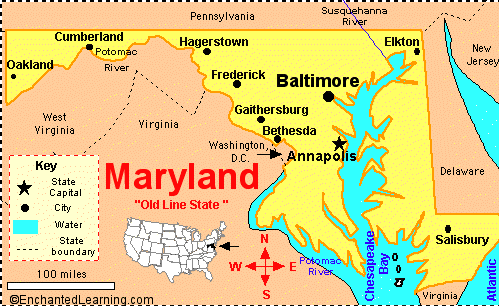
Maryland and Israel
Trade and Population Statistics
| Exports to Israel (2015) |
$145,184,418 |
| Percentage Change (2014-2015) |
+45.19% |
| Total Exports to Israel (1996-Present) |
$983,470,116 |
| Israel's Trade Partner Rank (2015) |
19 |
| Military Contracts with Israel (2015) |
$29,104,199 |
| Jewish Population (2015) |
213,300 |
| Jewish Percentage of Population |
4.7% |
Binational
foundation grants shared by Maryland and Israel
Grant recipients in
Maryland from U.S.-Israel binational foundations:
American
Red Cross
Ariadne Genomics
BP Solar International
CAD Language Systems
Comsat Corp.
Direct Dimensions
Endo Image Corp.
Frederick Cancer Research Center
Goddard Space Center
Johns Hopkins Medical School
Johns Hopkins University
Maryland Biotechnology Institute
MedStar Research Institute
NASA
National Cancer Institute
National Institute of Dental Research
National Institutes of Health
National Institute of Mental Health |
National Institute
of Science & Technology
New Horizons Diagnostics
NOAA
Online Computer Systems
Orgenics International
University of Maryland
University of Maryland Biotechnology Institute
University of Maryland Medical School
USDA Agriculture Research Center
USDA-ARS Florist & Nursery Crops Lab
USDA-ARS Plant Molecular Biology Lab
USDA Beneficial Insects Lab
USDA Horticultural Crop Quality Lab
USDA Molecular Plant Pathology Lab
USDA Plant Molecular Biology Lab
USDA Systematic Entomology Lab
Uniformed Services University
|
Bilateral
Institutions
Maryland-Israel Advisory Board -
While on a trade mission to Israel in April 2013, Maryland Governor Martin O'Malley launched the Maryland-Israel Advisory Board to be charged with developing business opportunities and partnerships between Maryland and Israel. O’Malley and Rabbi Dov Lipman, a former Marylander and member of the Israeli Knesset, will serve as honorary co-chairs. While Maryland and Israel have a long history of partnership, the Maryland/Israel Advisory Board will be a dedicated group looking to open new doors for Maryland and Israeli businesses and community organizations looking to collaborate,” O’Malley said in a statement. Learn more about the Maryland-Israel Advisory Board, CLICK
HERE.
Maryland-Israel Development
Partnership -
While on a trade mission to Israel in April 2013, Maryland Governor Martin O'Malley launched the MIDP to fund joint development efforts with Israeli companies in the cybersecurity and life sciences sectors. The Maryland Department of Business and Economic Development and Israel’s Ministry of Industry will decide which research to fund and Maryland will fund up to half of the research costs for Maryland companies, with a $400,000 cap per project. Learn more about the Maryland-Israel Development Partnership, CLICK
HERE.
Maryland-Israel Development
Center -
MIDC is a non-profit membership organization
that promotes trade and investment between Maryland and Israeli companies.
The mission of the Maryland/Israel Development Center is to foster bilateral
economic development between Israel and Maryland. The MIDC will be an
energetic hub of people and activities engaged in promoting Maryland/Israel
trade and investment. It will assist both Israeli and Maryland businesses
and entrepreneurs in successfully accessing each other’s markets.
Learn more about the Maryland-Israel Development Center, CLICK
HERE.
Maryland-Israel Collaborative
Marine Biotechnology Research and Development Program -
Established
in 2003 under then-Governor Robert Ehrlich, the R&D partnership
puts together the University of Maryland's Biotechnology Institute (UMBI)
with a number of Israeli research institutions through the guidance
of administration of BARD. The program promotes collaborative aquaculture
research that are of mutual benefit to both Maryland and Israel for
various shared aquaculture and marine biology challenges. One of the
program's main priority areas is in finding new methods at controlling
marine diseases in dense aquaculture areas. Learn more, CLICK
HERE.
Cooperative
Agreements - "Memoranda of Understanding"
In April 2013, in conjuction with the formation of the Maryland-Israel Advisory Board, LifeBridge Health of Maryland and The Trendlines Group of Israel signed a Memorandum of Understanding to establish the five-year Maryland/Israel Medical Device Commercialization Initiative. Through the initiative both companies will collaborate in medical device development and commercialization. Learn more, CLICK HERE.
On November 16, 2006, the Office of
the Governor signed a Memorandum of Understanding with the Israeli Ministry
of Industry, Trade and Labor that focues on bilateral cooperation in
private sector industrial research and development. The program supports
joint commercially-focused joint industrial R&D projects between
Israeli and Maryland companies in all technological fields. Learn more
about this private sector MOU, CLICK
HERE.
In 2004, Israel and Maryland entered
into a Memorandum of Understanding to create the Maryland-Israel Development
Fund (MIDF) that supports collaborative technology development and commercialization
conducted in partnership between Maryland and Israeli businesses. The
fund if supported by MIDC along with the Maryland Department of Business
and Economic Development. Its goal is to foster job creation through
the growth of companies selling newly developed technological products.
The $5,000,000 five year fund will make investments up to $300,000 in
Maryland/Israel company teams collaborating on new product development
joint ventures. Learn more about the MIDF, CLICK
HERE.
In November 2003, during his economic
mission to Israel, Governor Robert Ehrlich signed a cooperative agreement
to establish the Maryland-Israel Partnership in Homeland Security. The
agreement makes Maryland the first state to officially recognize the
contribution cutting edge Israeli methods and technologies can make
toward enhancing U.S. homeland security and paves the way for homeland
security and emergency management professionals from both sides to share
“best practices” in fighting terrorism. Read more about
the details of the MOU, CLICK
HERE.
Also in November 2003, Governor Ehrlich
signed a partnership with the Israeli Ministry of Agriculture to establish
the Collaborative Marine Biotechnology R&D Program. Both the governments
of Maryland and Israel agreed to provide $250,000 for the first three
years to help jump-start the program's success. On hand to sign the
agreement was Gov Ehrlich, University of Maryland Biotechnology Institite
President Jennie Hunter-Cevera as well as several other members of the
delegation. Learn more, CLICK
HERE.
In May 1988, the Maryland-Israel Exchange
was signed by Governor William Donald Schaefer. The MIX was designed
to develop and expand ventures in the fields of trade, tourism, science
and technology, communications, agriculture, aquaculture and transportation.
Maryland Government Missions to Israel
September 2016 - Maryland Governor Larry Hogan led a delegation of state legislators, higher education officials, Jewish community leaders, and business executives on a trade mission to Israel during the last two weeks of September 2016. During the weeklong mission, Governor Hogan and his entourage met with government officials and Israeli business executives to try to drum up more Israeli investment in his state. Upon arrival in Israel Hogan spoke with representatives from VAYA Pharma and Enzymotec, who recently relocated their U.S. headquarters to the University of Maryland's BioPark.
April 2013 - Governor Martin O'Malley traveled to Israel and Jordan to discuss trade opportunities, U.S. foreign policy and to create a new research and development partnership between Israel and the State of Maryland. This was O'Malley's third trip to Israel and while there he met with Prime Minister Benjamin Netanyahu, newly elected Knesset member Dov Lipman (originally from Silver Spring, MD) and business leaders. While in Israel, O'Malley also announced that four Israeli high-tech firms plan to soon open offices or add staff in Maryland. Those firms are: Shekel Scales, Askimo, Roboteam and Hybrid Security.
January 2012 - Senator Barbara Mikulski
(D) traveled to Israel with Senators Daniel Inouye (D-HI) and Thad Cochran
(R-MS).
August 2011 - Congressman Steny Hoyer
(D) led the Democratic delegation of 26 congressmen on a tour of Israel
and the Palestinian Authority. During the trip, Hoyer reaffirmed America's
committment to securing Israel with financial assistance and reiterated
that the current economic crisis in the U.S. will not affect the level
of Israel's aid. To read more about their mission, CLICK
HERE.
May 2010 - Delegate Anthony O’Donnell
(R-District 29C-Solomons), the Maryland House Minority Leader, joined
Maryland's Lt. Governor Brown and a number of other Maryland-based business
leaders on a trade and business-cooperation development mission. While
on the mission, the delegation will visit several Israeli businesses
considering opening offices in Maryland and participate in a professional
exchange with Israeli professionals. Read more about this mission to
Israel, CLICK
HERE.
May 2008 - Governor Martin O'Malley
led a delegation on a high-level Biotech and economic development mission.
The Governor met with representatives of the Teva Pharmaceuticals company
and also announced that a leading Israeli drug development company,
BioLineRx, opened a US office based in Maryland. Additionally, Gov.
O'Malley announced that ClassifEye, Ltd, an Israeli identity authentication
solutions company, is establishing its US headquarters in Montgomery
County. To view pictures and read press releases from the mission to
Israel, CLICK
HERE.
August 2007 - House Majority Leader
Steny Hoyer led a group of 19 Congress members, mostly freshmen Democrats)
on a week long trip to Israel sponsored by the America Israel Education
Federation. Rep. Hoyer personally invited Rep. Keith Ellison of Minnesota,
the first Muslim-American elected to Congress, to join the trip, which
Rep. Ellison did. While in Israel the group met with Israeli Prime Minister
Ehud Olmert as well as Palestinian President Mahmoud Abbas. The delegation
also viewed the Israeli border with Lebanon to get a personal understanding
of the proximity of Hezbollah strongholds to northern Israeli towns
and cities.
November 2003 - Governor Robert Ehrlich
led a trade and business development mission together with more than
two dozen state officials and corporate executives. Gov. Ehrlich's mission
focused on selling Maryland to various Israeli companies in order to
attract their investment in Maryland-based firms and companies. "We're
here to make the hard sell," the governor told a group of Israeli
business executives who have decided to invest in Maryland or have shown
an interest. "We're very enthusiastic, and we don't take no for
an answer." Read more about Gov. Ehrlich's trip in a news article, CLICK
HERE.
Partners
For Change
The U.S.-Israel relationship is based on the twin
pillars of shared values and mutual interests. Given this commonality of
interests and beliefs, it should not be surprising that support for Israel
is one of the most pronounced and consistent foreign policy values of the
American people.
It is more difficult to devise programs that capitalize
on the two nations' shared values than their security interests;
nevertheless, such programs do exist. In fact, these SHARED VALUE
INITIATIVES cover a broad range of areas, including the environment,
science and technology, education and health.
As analyst David Pollock noted, Israel is an advanced country with a population that surpassed eight million people in 2013 and a robust, dynamic economy that allowed it to join the Organization for Economic Cooperation and Development (OECD). Between 2005 and 2013, Israel has represented a larger market for U.S. exports than Saudi Arabia. Although Israel's citizenry make up just 3 percent of the total region's population, Israel accounts for 25 percent of American exports in the Middle East.
"It has also been one of the top 20 foreign direct investors in the United States since 2009," Pollock confirms. He adds that "$2.25 billion of the $3 billion in annual U.S. aid to Israel comes back via Israeli purchases of U.S. military equipment - and that is just 5 percent of the total bilateral trade each year."
Today's interdependent global economy requires that
trade policy be developed at the national and state level.
Many states have recognized the opportunity for realizing
significant benefits by seeking to increase trade with Israel. Maryland is one of 33 states that have cooperative
agreements with Israel.
In 2012, Maryland exported over$ 51,443,074.00 worth
of manufacturing goods to Israel. Since 1996, Maryland exports to
Israel have totaled more than $$766,811,958.00 and Israel now ranks as Maryland’s 31st leading trade partner.
Additionally in 2012, Maryland received more than $33,428,687.18 in foreign military financing (FMF) for US military aid
to Israel. Some of those companies that have received funding through FMF in 2012 or past years
include: Advanced Defense Technologies in Baltimore, Custom Cable Solutions, Inc. in Salisbury, and DRS C3 & Aviation Company in Gaithersburg.
Israel is certainly a place where potential business
and trade partners can be found. It can also be a source, however, for
innovative programs and ideas for addressing problems facing the citizens
of Maryland.
Israel has developed a number of pioneering education programs. For example, AICE introduced an innovative Israeli
peer tutoring program to North Carolina that educators adapted for use
in the United States. Now known as Reading Together, the program is
used in 28 states. The program is designed to help students achieve
reading fluency and is mostly used for children in second grade. The
hope is that with its implementation, increasing numbers of students
will perform at grade level or above.
A range of other exciting approaches to social problems
like unemployment, environmental protection and drug abuse have been
successfully implemented in Israel and could be imported for the benefit
of Americans.
The potential for greater cooperation with Israel for
the benefit of Maryland is limited only by the imagination.
Maryland Firms
Profit From Business With Israel
Because of Israel's unique status as the only country
with free trade agreements with both the United States and the European
community, it can act as a bridge for international trade between the
United States and Europe. Moreover, because of the deep pool of talent,
particularly in high-technology areas, Israel provides excellent investment
opportunities. Some of the nation's largest companies, such as IBM,
Microsoft and Intel have found that it is indeed profitable to do business
in Israel.
More than 80 Maryland firms, including Motorola, Black
& Decker and Westinghouse, have made similar discoveries.
One good way to break into the Israeli market is through
a joint venture with an Israeli company. Funding for such projects is
available from the Binational
Industrial Research and Development Foundation (BIRD). BIRD funds projects in 36 states and the District of
Columbia and hundreds of companies including AOL, GE, BP Solar, Texas
Instruments and Johnson & Johnson have benefitted from BIRD grants.
The United States and Israel established BIRD in 1977
to fund joint U.S.-Israeli teams in the development and subsequent commercialization
of innovative, nondefense technological products from which both the
Israeli and American company can expect to derive benefits commensurate
with the investments and risks. Most grant recipients are small businesses
involved with software, instrumentation, communications, medical devices
and semiconductors.
Since its inception, BIRD has funded more than 800
joint high-tech R&D projects through conditional grants totaling
more than $210 million. Products developed from these ventures have
generated more than $8 billion in direct and indirect revenues for both
countries and has helped to create an estimated 20,000 American jobs.
Dr. Eli Opper, the former Israeli chair of BIRD, has
said that BIRD is a strong pillar of US-Israel industrial
cooperation and that the extreme success of BIRD has
led Israel to adopt similar models of R&D with other countries.
Several Maryland companies have benefited from BIRD grants, including Comsat, New Horizons Diagnostics and Online Computer
Systems. Grants shared by Maryland companies have totaled nearly $2.5
million.
In 2011, two new Maryland companies gained sponsorship
for collaborative projects with Israeli companies through the BIRD Foundation with help from the Maryland-Israel Development Center. Ariadne
Genomics, from Rockville, will work with Israeli-based BioMarCare Technologies
to develop a companion diagnostic test for metastatic colorectal cancer.
In Owings Mills, Direct Dimensions will be teaming with Israeli company
Mantis Vision to develop a 3D imaging system for facilities' measurements.
"The American and Israeli companies will benefit from these grants,"
explained MIDC executive director Barry Bogage, "because it leverages
their own R&D budgets and brings a new partner into their activities
that complement their own technological skills. For Maryland companies,
Israel offers world-class high-tech talents, which will help Maryland
companies create new products to sell in the global marketplace."
For example, in 2008 BIRD gave a grant
to the Baltimore company Sensics, Inc to develop an innovative, head
mounted virtual-reality display with an Israeli partner. The joint initiative
will create a new lightweight head-mounted display that delivers high-performance
and substanstial ease of integration and ease of use. The end goal is
to make head-mounted displays easier to own, easier to intergrate, and
easier to use. Yuval Boger, CEO of Sensics, said that "the BIRD grant will give Sensics the opportunity to work with another technology
company halfway around the world, taking full advantage of each firm's
intellectual property, R&D, manufacturing and marketing capabilities."
Maryland Governor Martin O'Malley also very much supported the partnership.
He said, "We celebrate Sensic's recognition as one of Maryland's
most innovative technology firms with whom an Israeli company can partner.
We support this prestigious BIRD grant to deliver new
products to drive the 21st century economy."1
Also in 2008 BIRD sponsored a joint
project between the Israeli company SolarEdge and Maryland-based BP
Solar International that investigated the creation of a module intergrated
power harvesting unit.
Other business ventures have been the result of trade
missions sponsored by the Maryland/Israel Development Center. As a result
of one, Morton Management, Inc. of Silver Spring developed a new relationship
with Y.A.D. Computers. The Center also played a role in putting together
another Silver Spring company, COMSIS Corp., with Eyal Dani Ltd. of
Israel to market a unique in-vehicle automated data collection device
for the elderly and handicapped transportation market. It also helped
Lee L. Dopkin/Standard Plumbing Supply of Baltimore arrange to sell
plumbing fixtures designed and manufactured by Israel's Hamat Fittings
Ltd.
Maryland businesses invest about $70 million a year
in Israel, and 18 Israeli companies have their offices in the state.
In November 2003, Gov. Robert Ehrlich Jr. announced that Oblicore, an
Israeli business software development company planned to expand its
U.S. operations by opening a headquarters in Columbia, creating dozens
of new jobs in the state. Another Israeli company, Medispec, which has
developed a new technique for using shock waves to break up kidney stones,
planned to open an office in Germantown.
Governor Ehrlich
and Israel’s Deputy Prime Minister
and Minister of Industry, Trade and Labor
Ehud Olmert discussed establishing Israel’s
first international R&D fund at the sub-national
level during Governor Ehrlich’s trade
mission to Israel. Israel has international
R&D funds at the national level with
20 countries including the United States.
In July 2005, the Maryland/Israel Development
Fund (MIDF) was established to foster job
creation through the growth of companies
selling technological products developed
jointly by Maryland/Israel company teams.
The MIDF is a joint project of the Maryland/Israel
Development Center (MIDC), Maryland’s
Department of Business and Economic Development
(DBED), and the Office of the Chief Scientist
(OCS) of Israel’s Ministry of Industry
and Trade. The $5,000,000 five year fund
will make investments between $100,000 and
$300,000 in Maryland/Israel company teams
collaborating on new product development
joint ventures.
The program is valuable for companies seeking
to leverage their technical and marketing
talent by partnering with a complementary
business. It will also help companies expand
into international markets. Investments may
range from $100,000 to $300,000, half from
DBED for the Maryland company and half from
MOIT for the Israeli firm. The Maryland/Israel
Development Fund has limited financial resources.
Investment decisions will be made on a competitive
basis. The funds can only be used for the
R&D expenses of the project. Company
matching funds are required, equal to a minimum
of fifty percent of total project costs.
For products successful in the market, investments
will be repaid with interest.
During a November 2005 trade mission, Lt. Governor
Michael Steele announced the formation of the Maryland/Israel Incubator
Partnership under which incubators in each country will welcome each
other's companies and provide up to six months free office space. The
Emerging Technology Center in Baltimore and the Misgav Technology Center
in the Galilee are the first incubators to participate in the program;
four additonal Maryland and Israeli incubators will soon join the program.
At its December 2013 meeting, BIRD approved 11 new projects for 2014 ranging from pet hospital technology to nuclear pharmacy management innovations.
Scientific
Innovations
Maryland researchers are making scientific breakthroughs
and developing cutting-edge technologies in joint projects with Israeli
scientists thanks to support from the Binational
Science Foundation (BSF). BSF was established in 1972 to promote scientific relations
and cooperation between scientists from the United States and Israel.
The fund supports collaborative research projects in a wide area of
basic and applied scientific field for peaceful and non-profit purposes.
Since its inception, BSF has awarded some $480 million
through more than 4,000 grants in 45 states and the District of Columbia.
BSF-sponsored studies are highly successful
in achieving their two main goals: strengthening the US-Israel partnership
through science and promoting world-class scientific research for the
benefit of the two countries and all mankind. The BSF grants help extend research resources to achieve milestones that might
not otherwise be attainable; introduce novel approaches and techniques
to lead American researchers in new directions; confirm, clarify and
intensify research projects; and provide unmatched access to Israeli
equipment, facilities and research results that help speed American
scientific advances. BSF has documented no less than
75 new discoveries made possible by its research grants and counts 37
Nobel Prize and 19 Lasker Medical Award laureates among its joint partners.
Maryland institutions that have benefited from the
program include the Fredrick Cancer Research Center, Johns Hopkins,
the University of Maryland, the National Institutes of Health, the National
Institute for Mental Health and the National Institute for Standards
and Technology. Researchers have been awarded grants in life sciences,
physics, chemistry and mathematics to the tune of almost $16 million
since 1996 alone.
In 2011, with continued financial support from BSF,
Dr. Henry Brem, the Chair of the Department of Neurosurgery at Johns
Hopkins, together with Professor Joseph Kost, Head of the Department
of Chemical Engineering at Ben Gurion University in Israel, are developing
a new non-invasive approach against brain cancer by combining gene therapy
and High-Intensity Focused Ultrasound (HIFU). Brain tumors are the leading
cause of cancer-related deaths in patients below the age of 35 and unfortunately
the prognosis for brain tumors treated by existing conventional therapy
is extremely poor. This BSF-sponsored bilateral research
is therefore incredibly important in helping to eventually cure brain
cancer and give life to thousands of patients who suffer from tumors.
In 2009, Dr. Gilad Chen, a professor of psychology
at the University of Maryland, received a four year BSF grant to work with Professor Mina Westman of Tel Aviv University on
an investigation of the work-family interface on international business
assignments. While the research was only in the developmental stages
at the end of calendar year 2010, Dr. Chen shared with AICE the main
goals and hopes for how his research will be used in the real world.
"The main goal of our research is to learn about factors that enable
expatriate managers and their spouses to perform effectively both at
work and at home, during international assignments," said Dr. Chen.
"That is, we want to understand better why some managers, when
sent abroad, perform more effectively than others at work, and also
how expatriate managers are able to balance between work and non-work
demands during such assignments."
This collaborative, BSF funded research will likely
enable companies to prepare and manage expatriates more effectively,
but also provide expatriates with guidance as to how they can perform
their assignment well while maintain g effective functioning in their
personal life, as well. Dr. Chen was pleasantly surprised with the ease
in which applying and receiving funds through the BSF program was carried out.
Dr. Laure Aurelian, a virologist in the Department of
Pharmacology at the University of Maryland, is interested in research
related to skin cells that appear to protect the body from infection and
cancer. Working with a collaborator at the Hebrew University in Jerusalem,
Dr. Aurelian hopes to learn how to stimulate responses from dendritic cells
to prevent disease.
Cooperation is valuable on a number of levels, according to
Dr. Aurelian. One is that her Israeli colleague is one of the few people
in the world interested in the type of cell she is studying. She also
has a personal attachment, having grown up in Israel. “I also genuinely
believe Israel has a powerful cadre of intellectuals who have trouble
contributing because of financial constraints.” Dr. Aurelian believes
she and her collaborator have made greater progress together than they
could have alone, and that their work has stimulated younger researchers
to conduct similar studies.
For 15 years, the BSF supported cooperation
between Prof. Ilana Gozes (Tel Aviv University) and Dr. Douglas Brenneman,
of the National Institute for Health in Bethesda, who jointly studied
brain-specific molecules that are related to loss of memory, decreased
learning ability and inhibition of sexual function. These studies resulted
in the synthesis of novel neuropeptides-based drugs, including for cancer
therapy, the treatment of Alzheimer’s Disease, and other neurodegenerative
conditions. Allon Therapeutics, a start-up company based on these discoveries,
is now performing clinical studies on the first of these potential new
drugs.
By studying protein molecules in fruit flies, Craig
Montell of Johns Hopkins Medical School, and his Israeli partner hope to
learn more about human vision. Dr. Montell has characterized a previously
unknown protein that is important in visual transection.
A biochemist at the Center for Advanced Research in
Biotechnology at the University of Maryland has the opportunity to study
organisms unique to the Dead Sea thanks to his BSF grant. Dr. John Moult is interested in the properties of protein molecules,
the understanding of which is crucial to the future development of medicines.
Moult is looking at organisms that survive in high salt conditions and
testing a computer model that helps explain differences in organisms.
Researchers Joseph Kost from Ben-Gurion University
in Be'er Sheva, Robert Langer from the Massachusetts Institute of Technology
in Cambridge, and Henry Brem from Johns Hopkins University in Baltimore
are all researching this project together. Using a group of molecules
that combines to form a polymer, a timed release of a drug was developed.
Langer and Brem saw the possibility of a polymer as a "remote control"
device for the controlled release of drugs. The same idea has been developed
for the use of women's birth control and brain cancer treatment.
Professor Ilana Gozes at Tel Aviv University, along
with Douglas E. Brenneman at the National Institutes of Health in Bethesda
used a BSF grant to research the effects of a neuropeptide
called VIP (Vasoactive Intestinal Peptide) found in neurons on different
areas of the brain. Neuropeptides transmit information related to many
body functions, including: learning, memory and aging, sexual function
and brain development. They are linked to conditions such as gastric
diseases, diabetes, osteoporosis and arthritis.
The general benefits to the United States from BSF-sponsored
studies include the extension and elaboration of research to achieve
milestones that might not have been reached otherwise; the introduction
of novel thinking and techniques that led American researchers to move
in new directions; confirmation, clarification and intensification of
research projects; access to Israeli equipment and facilities unavailable
elsewhere and early access to Israeli research results that sped American
scientific advances.
BSF documented no less than 75 new
discoveries that probably would not have been possible without foundation-supported
collaboration. These advances included the development of new methods
and techniques, the discovery of new phenomena and major theoretical
breakthroughs.
Agriculture
Benefits
In 1978 the United States and Israel jointly created the Binational
Agricultural Research and Development Fund (BARD)
to help fund programs between US and Israeli scientists for mutually
beneficial, mission-oriented, strategic and applied research into agricultural
problems. Since its inception, BARD has funded more
than 1,000 projects in 45 states and the District of Columbia with a
total investment of more than $250 million. In 2000, an independent
and external economic review of 10 BARD projects conservatively
projected more than $700 million in revenue by the end of 2010, a number
which far outweighs the total investment in all BARD projects over its 33 year existence and helps to continually strengthen
the foundation.
Most BARD projects focus on either increasing agricultural
productivity, plant and animal health or food quality and safety and
have been influential in creating new technologies in drip irrigation,
pesticides, fish farming, livestock, poultry, disease control and farm
equipment. BARD funds projects in 45 states and the
District of Columbia and at present is beginning to administer collaborative
efforts between Australia, Canada and Israel as well. It is difficult
to break down the impact on a state-by-state basis, but overall, BARD-sponsored
research has generated sales of more than $500 million, tax revenues
of more than $100 million and created more than 5,000 American jobs.
Two of the major beneficiaries of BARD grants have been the University of Maryland and the U.S. Department
of Agriculture's Agricultural Research Service (ARS) in Beltsville.
Overall, Maryland has shared more than $2 million worth of grants since
1979.
Israel is such a small country, the whole state can
sometimes be a laboratory. Also, unique institutions like kibbutzim allow
for controlled experiments. Richard Just of the University of Maryland, for
example, was able to develop a data set from Israeli moshavim (a type of
agricultural cooperative) to create econometric models for estimating
efficient agricultural production. The model has been used to make
estimates for growing tomatoes, peppers, onions and other crops.
John McMurty of ARS worked with the Israeli Agricultural
Research Organization to develop techniques to stimulate growth in broiler
chickens and turkeys. The approach they developed increases feed efficiency
and reduces fat in the birds. “The result is the farmer saves money on
feed and the consumer gets a leaner bird,” he said.
Researchers at the U.S. Army Medical Research Institute
of Infectious Diseases at Fort Detrick, Israel's Kimron Veterinary
Institute and the University of Alabama developed a vaccine that protects
pregnant sheep from Rift Valley Fever. The vaccine can help protect animals
in Africa, where RVF is common, as well as cattle in the United States.
Working with Hebrew University scientists who pioneered
solarization techniques that protect and boost yields in a variety of
fruits, nuts and vegetables, Deborah Fravel of the ARS is looking for ways
to cover crops for shorter periods and with less fumigants. Fravel enjoys
the collaboration and benefits from her counterpart's years of experience.
“He sees things I haven't,” she says, “and that makes me think.”
Another ARS researcher, Roger Lawson, is one of the
few American scientists doing research on ornamental flowers. He received
two BARD grants to work with the Volcani Institute
to develop a better understanding of viruses in gladiolas and lilies.
The floral industry in the United States, Lawson says, is about $9 billion
and gladiolas is approximately fifth on the list of flowers sold. In
Florida alone, gladiolas are a $14 million industry. The research helped
make it possible to develop more sensitive tests to detect viruses in
the flowers. Because ornamental flowers are a big industry in Israel
and scientists there share his interest, Lawson found the collaboration
a natural.
In 2003, the University of Maryland Biotechnology Institute
(UMBI) and BARD established a framework for conducting
collaborative aquaculture research between UMBI and Israeli scientists
– the UMBI/BARD Program.
A year later, it was announced that the collaboration will study and
develop new environmentally sustainable and economically feasible aquaculture
technologies and explore new aveneues for the production of marine natural
compounds with pharmaceutical potential. The program was initiated by
the Maryland/Israel Development Center and the Israeli Ministry of Agriculture.
Each government originally agreed to provide $250,000 annually for three
years to fund the project, which will be administered by UMBI and BARD.
During his November 2005 visit to Israel, Lt. Governor Michael Steele
announced the program would be funded for another three years.
Other Cooperative
Programs
The Goddard Space Center in Greenbelt and Ben Gurion
have worked on several joint projects related to Satellite-ranging systems
and the study of atmospheric and surface properrties in the desert.
In 1998, Elron Electronic Industries, a holding company
for Israeli high-tech firms, signed a Memorandum of Understanding with
Maryland to collaborate on the study of emerging Internet technologies for
conducting business. Israel will now be a partner in the Institute for
Global Electronic Commerce at the University of Maryland, Baltimore County.
Also in 1998, the University of Maryland School of
Nursing and Hadassah announced a partnership to develop and offer a
clinical masters degree program in nursing at the Henrietta Szold
Hadassah-Hebrew University School of Nursing in Jerusalem. This will be the
first masters degree program in nursing offered in Israel.
In 1999, the University of Maryland in Baltimore created
the Maryland/Israel Visiting Fellows Program in Biotechnology. The program
is designed to build and encourage ties between the bioscience communities
of Maryland and Israel. Fellowships will be offered to qualified Israelis
at the M.D. and Ph.D. levels to conduct collaborative research at Maryland
biotech research institutions.
In 2000, the University of Maryland business school is
offering a course, High Technology Entrepreneurship in collaboration with
Israel's Technion.
The University of Baltimore Law School is collaborating
with the University of Haifa in offering a summer study abroad program
in 2000 with courses offered comparing the U.S., Israeli and other legal
systems.
The United
States-Israel Educational Foundation (USIEF) and the Maryland/Israel
Development Center (MIDC) offer a joint grant to a postdoctoral scholar
in the natural sciences who is about to begin a program of research
at an accredited university, or at a public or private, nonprofit research
institute in the State of Maryland. The program grant provides $20,000
in partial support of the recipient's first year of activity Maryland.
In 2003, a new program was initiated between the University of Maryland Biotechnology Institute
(UMBI) and the US-Israel Binational
Agricultural Research and Development fund (BARD) for joint research.*
In May 2011, The University of Maryland's Dingman Center
for Entrepreneurship collaborated with the Technion Entrepreneurship
Center, The Technion T3, and the Technion Seed Incubator to create a 10-week
fellowship program for MBA students to work on commercializing technology
at the Technion. Teams of U.S. students worked with Israeli students
to develop feasibility studies and commercialization plans for Technion
owned intellectual property. Throughout the fellowship, students were
guided by a panel of entrepreneurs, researchers and venture capitalists.
In addition, students had the opportunity to travel to Tel Aviv and
Jerusalem and hear in-depth information about Israeli industry through
a lunchtime speaker series called the eClub.
In 2014, the University of Maryland began an Israel Studies course that paired local students with peers at Tel Aviv University. This course is the results of University President Wallace Loh's Israel visist in April 2013 where he signed academic partnerships with a few Israeli universities and colleges. Maryland, students can learn with other students in Tel Aviv through video-conferencing software in their Israel studies classes. Gildenhorn Institute for Israel Studies and visiting Israeli professor Paul Scham said: "For someone who teaches about Israel, the sense of connection is important in ways we don't see, we don't realize."
Sister Cities
UJA Partnership
2000 Communities
State
Contacts:
Hillel
Campus Profiles
Baltimore Jewish Council
2701 North Charles St., #510
Baltimore, MD 21218
Tel. 410-542-4850 |
JCC of Greater Washington
6125 Montrose Rd.
Rockville, MD 20852
Tel. 301-881-0100 |
Jewish National Fund (JNF)
4 Reservoir Circle, #104
Baltimore, MD 21208
Tel. 410-486-3317 |
Baltimore Zionist District
3723 Old Court Rd., #200
Baltimore, MD 21208
Tel. 410-602-1200 |
Jewish Federation of Howard County
5885 Robert Oliver Pl
Columbia, MD 21045-3734
Tel. 410-730-4976 |
Maryland/Israel Development Center
217 East Redwood St., #1300
Baltimore, MD 21202
Tel. 410-767-0681
Fax. 410-333-4302
Web. http://marylandisrael.org/ |
Board of Jewish Education
11710 Hunters Lane
Rockville, MD 20852
Tel. 301-984-4455
Fax. 301-230-0267 |
The Jewish Historical Society of Maryland
15 Lloyd St.
Baltimore, MD 21202 |
Maryland Office of Economic Development
Trendlines International Ltd.
Moshav Shorashim, Israel
Tel. 04-958-3323
Fax. 04-958-3325 |
CRC
6101 Montrose Rd., #205
Rockville, MD 20852
Tel. 301-770-0881
Fax. 301-770-7553 |
Jewish National Fund (JNF)
8607 Second Ave., Suite 404A
Silver Spring, MD 20910
Tel. 301-589-8565 |
UJA Federation of Greater Washington
6101 Montrose Rd.
Rockville, MD 20852
Tel. 301-230-7200 |
|