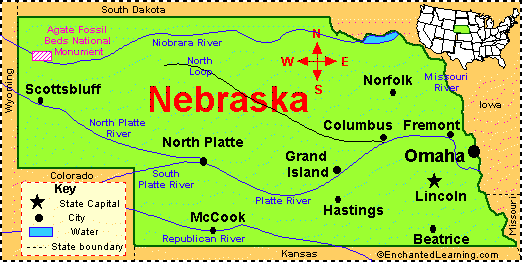
Nebraska and Israel
Trade and Population Statistics
| Exports to Israel (2014) |
$35,621,907 |
| Percentage Change (2013-2014) |
+29.18% |
| Total Exports to Israel (1996-Present) |
$345,913,199 |
| Israel's Trade Partner Rank (2014) |
24 |
| Military Contracts with Israel (2015) |
$44,500 |
| Jewish Population (2015) |
16,800 |
| Jewish Percentage of Population |
1.22% |
Binational
foundation grants shared by Nebraska and Israel
Grant recipients in
Nebraska from U.S.-Israel binational foundations:
Creighton University
Farrall Instruments, Inc.
University of Nebraska
Bilateral
Institutions
None. Please help us build and maintain the Montana state page. Email AICE with any additions, modifications or comments.
Cooperative
Agreements - "Memoranda of Understanding"
In 1993, Gov. Ben Nelson signed a
Memorandum of Understanding to promote trade and exchanges related to
agriculture.
Nebraska Government Missions to Israel
January 2013 - Senator Deb Fischer, a member of the Senate Armed Services Committee, travelled to Israel and Afghanistan with fellow senators on an official visit to meet with political and military leaders and learn more about the situation in the Middle East. In Israel, the group also met with Israeli Prime Minister Benjamin Netanyahu. "That is not just a concern for the country of Israel, that is a concern for the United States of America as well," Fischer says. "And, the prime minister stressed that that what happens in that region of the world has a direct effect on citizens in the United States."
July 2008 - In a buildup to the 2008
presidential elections, Senator Chuck Hagel joined Senator Barack Obama
(D-IL) on an official visit to Israel as part of a whirlwind tour in
which the oval office-hopeful visited seven different countries. In
Israel, Senators Hagel and Obama stressed how much they want to work
towards solving the Israeli-Palestinian conflict and used their short
time in country to visit the southern Israeli city of Sderot which has
been under constant rocket attack from Hamas in Gaza since the Israeli
withdrawal in 2005. Read more, CLICK
HERE.
Partners
For Change
The U.S.-Israel relationship is based on the twin
pillars of shared values and mutual interests. Given this commonality of
interests and beliefs, it should not be surprising that support for Israel
is one of the most pronounced and consistent foreign policy values of the
American people.
It is more difficult to devise programs that capitalize
on the two nations' shared values than their security interests;
nevertheless, such programs do exist. In fact, these SHARED VALUE
INITIATIVES cover a broad range of areas, including the environment,
science and technology, education and health.
As analyst David Pollock noted, Israel is an advanced country with a population that surpassed eight million people in 2013 and a robust, dynamic economy that allowed it to join the Organization for Economic Cooperation and Development (OECD). Between 2005 and 2013, Israel has represented a larger market for U.S. exports than Saudi Arabia. Although Israel's citizenry make up just 3 percent of the total region's population, Israel accounts for 25 percent of American exports in the Middle East.
"It has also been one of the top 20 foreign direct investors in the United States since 2009," Pollock confirms. He adds that "$2.25 billion of the $3 billion in annual U.S. aid to Israel comes back via Israeli purchases of U.S. military equipment - and that is just 5 percent of the total bilateral trade each year."
Today's interdependent global economy requires that
trade policy be developed at the national and state level.
Many states have recognized the opportunity for realizing
significant benefits by seeking to increase trade with Israel. Nebraska is one of 33 states that have cooperative
agreements with Israel.
In 2012, Nebraska exported over $33,785,000 worth
of manufacturing goods to Israel. Since 1996, Nebraska exports to
Israel have totaled more than $285,234,444.00 and Israel now ranks as Nebraska’s
36th leading trade partner.
Additionally in 2012, Nebraska received more than
$158,785.87 in foreign military financing (FMF) for US military aid
to Israel. Some of those companies that have received funding through FMF in 2012 or past years
include: Allmand Bros., Inc. in Holdrege, L-3 Comminications Corp. in Londonderry and Milpower Source, Inc. in Belmont.
Israel is certainly a place where potential business
and trade partners can be found. It can also be a source, however, for
innovative programs and ideas for addressing problems facing the citizens
of Nebraska.
Israel has developed a number of pioneering education programs. For example, AICE introduced an innovative Israeli
peer tutoring program to North Carolina that educators adapted for use
in the United States. Now known as Reading Together, the program is
used in 28 states. The program is designed to help students achieve
reading fluency and is mostly used for children in second grade. The
hope is that with its implementation, increasing numbers of students
will perform at grade level or above.
A range of other exciting approaches to social problems
like unemployment, environmental protection and drug abuse have been
successfully implemented in Israel and could be imported for the benefit
of Americans.
The potential for greater cooperation with Israel for
the benefit of Nebraska is limited only by the imagination.
Nebraska Firms
Profit From Business With Israel
As the only country with free trade agreements with both
the United States and the European community, Israel can act as a bridge
for international trade between the United States and Europe. Moreover,
because of the deep pool of talent, particularly in high-technology areas,
Israel provides excellent investment opportunities. Some of the nation's
largest companies, such as IBM, Microsoft, Motorola, Intel and McDonald's
have found that it is indeed profitable to do business in Israel.
More than 30 Nebraska companies have
discovered the benefits of doing business in Israel,
including Dale Electronics/Vishay and J.A. Woolam Company
Inc.
Dale Electronics became a subsidiary of Vishay
Intertechnology in 1985, thus strengthening Vishay's business in Israel.
Vishay has been doing business in Israel since 1969. Vishay is one of the
world's largest manufacturers of passive electronic components and discrete
semiconductors, with plants in 14 countries, including Israel. Their sales
reach nearly $2 billion per year. Vishay components can be found in almost
all electronic equipment, such as telephones, computers, cars, video and
audio equipment, medical equipment and satellites produced by U.S. or
European manufacturers.
Vishay has four plants in
Israel, which produce 160 million components
daily, of which 99 percent are exported to
Europe, the U.S. and Asia. "Vishay Israel
manufacturing operations draw upon unique
human and economic resources; a reservoir
of competent, loyal, scientific and technical
personnel with a strong work ethic...Waves
of immigration from the former Soviet Union
have brought Vishay Israel a wealth of talented
scientists, engineers, and electronics technicians,"
according to Glyndwr Smith, Assistant to the
CEO and Senior Vice President of Vishay. Its
Dimona plant is one of the few plants in the
world able to manufacture tantalum capacitors
that require a difficult 52-step process.
"Some of Vishay’s most sophisticated products are
produced in Israel. Every Vishay Israel factory, every product line, meets
the world’s most stringent standards," adds Smith. Over thirty
years, Vishay's success in Israel has grown exponentially in the passive
component industry, with sales surging from less than $1 million to $330
million dollars.
J.A. Woolam Co. is another Nebraska company that has had
success in Israel. Marketing manager James Hilfiger says, "I really
enjoyed the diversity of research that I have been involved in, and our
customers have been involved with, in such a small country. You can see
that they are pioneering in many areas including chemistry, biotechnology
and in semiconductors." J.A. Woolam Company has sold the Israel
Foreign Ministry ellipsometers used to measure their films and coatings
(can be found on sunglasses, laser optics and in computer disks).
One good way to break into the Israeli market is through
a joint venture with an Israeli company. Funding for such projects is
available from the Binational
Industrial Research and Development Foundation (BIRD). BIRD funds projects in 36 states and the District of
Columbia and hundreds of companies including AOL, GE, BP Solar, Texas
Instruments and Johnson & Johnson have benefitted from BIRD grants.
The United States and Israel established BIRD in 1977
to fund joint U.S.-Israeli teams in the development and subsequent commercialization
of innovative, nondefense technological products from which both the
Israeli and American company can expect to derive benefits commensurate
with the investments and risks. Most grant recipients are small businesses
involved with software, instrumentation, communications, medical devices
and semiconductors.
Since its inception, BIRD has funded more than 800
joint high-tech R&D projects through conditional grants totaling
more than $210 million. Products developed from these ventures have
generated more than $8 billion in direct and indirect revenues for both
countries and has helped to create an estimated 20,000 American jobs.
Dr. Eli Opper, the former Israeli chair of BIRD, has
said that BIRD is a strong pillar of US-Israel industrial
cooperation and that the extreme success of BIRD has
led Israel to adopt similar models of R&D with other countries.
Nebraska companies have benefited from more than $300,000
in BIRD grants over the last three decades.
Scientific
Innovations
Nebraska researchers are making scientific breakthroughs
and developing cutting-edge technologies in joint projects with Israeli
scientists thanks to support from the Binational
Science Foundation (BSF). BSF was established in 1972 to promote scientific relations
and cooperation between scientists from the United States and Israel.
The fund supports collaborative research projects in a wide area of
basic and applied scientific field for peaceful and non-profit purposes.
Since its inception, BSF has awarded some $480 million
through more than 4,000 grants in 45 states and the District of Columbia.
BSF-sponsored studies are highly successful
in achieving their two main goals: strengthening the US-Israel partnership
through science and promoting world-class scientific research for the
benefit of the two countries and all mankind. The BSF grants help extend research resources to achieve milestones that might
not otherwise be attainable; introduce novel approaches and techniques
to lead American researchers in new directions; confirm, clarify and
intensify research projects; and provide unmatched access to Israeli
equipment, facilities and research results that help speed American
scientific advances. BSF has documented no less than
75 new discoveries made possible by its research grants and counts 37
Nobel Prize and 19 Lasker Medical Award laureates among its joint partners.
The University of Nebraska is among Nebraska institutions
that have shared with their counterparts in Israel nearly $200,000 in BSF grants awarded since 1996 alone.
University of Nebraska scientist Donald C. Rundquist and
his colleagues are studying how to use a remote sensing system to monitor
some aspects of water quality, such as its color. He and his Israeli
colleagues have worked independently and then compared data sets,
approaches and instruments. Together they have produced a number of
publications. Working with Israelis has provided "training
opportunities" and has "lead to some interesting
developments," according to Rundquist. One of these developments is
that one of the Israeli scientists, Dr. Gittelson, from Ben Gurion
University, has moved to the U.S. to become a full professor.
Dr. Rundquist's research with the Israelis has been
"a catalyst to seek further work in connections with Israelis."
Their research is also addressing the issue of algal bloom in sea and
fresh water. These blooms overstimulate the algae in the water, a problem
shared by both countries. The overstimulations cause ecological problems
for the lake and also for humans, putting toxins in the water, removing
oxygen and killing fish.
Agriculture
Benefits
In 1978 the United States and Israel jointly created
the Binational Agricultural
Research and Development Fund (BARD)
to help fund programs between US and Israeli scientists for mutually
beneficial, mission-oriented, strategic and applied research into agricultural
problems. Since its inception, BARD has funded more
than 1,000 projects in 45 states and the District of Columbia with a
total investment of more than $250 million. In 2000, an independent
and external economic review of 10 BARD projects conservatively
projected more than $700 million in revenue by the end of 2010, a number
which far outweighs the total investment in all BARD projects over its 33 year existence and helps to continually strengthen
the foundation.
Most BARD projects focus on either increasing agricultural
productivity, plant and animal health or food quality and safety and
have been influential in creating new technologies in drip irrigation,
pesticides, fish farming, livestock, poultry, disease control and farm
equipment. BARD funds projects in 45 states and the
District of Columbia and at present is beginning to administer collaborative
efforts between Australia, Canada and Israel as well. It is difficult
to break down the impact on a state-by-state basis, but overall, BARD-sponsored
research has generated sales of more than $500 million, tax revenues
of more than $100 million and created more than 5,000 American jobs.
Nebraska institutions have shared BARD grants worth more than $1.3 million since 1979.
In 2006, Professors Thomas Clemente and James Alfano
collaborated with Isaac Barash of Tel Aviv University for an exploratory
one year BARD grant for which they are currently seeking
further funding. Though the grant was only for one year, Professor Alfano
admits that the funds secured through BARD helped for
their research into plant pathology and immunity. From their BARD-supported
research, Professors Clemente and Alfano made initally discoveries that
certain bacterial proteins, injected into plant cells by bacterial pathogens,
actually reduce and suppress a plants innate immunity to disease. Their
preliminary findings are now the basis for a secondary application for
further BARD funding.
Though he has had limited interaction with the BARD program outside of this grant, Professor Clemente understands the immense
important of the program. "Given the rapid rise in commodity prices
over the last few years, from soybeans to cotton," he says, "should
provide sufficient rationale for the continuation of such critical programs
such as BARD that help facilitate collaborative efforts
between our two countries with the long-term goal to develop technologies
to ensure a plentiful, safe and sustainable food supply."
Former University of Nebraska plant pathologist Martin
Dickman received five BARD grants while in Nebraska
to support his researching of plant diseases. With the help of BARD
support, Professor Dickman used a genetic approach to learn about fungal
diseases in crop plants and exploted designing a strategy to interfere
with the features that enable fungus to cause disease. BARD support allowed him to publish a number of research papers and even
a book on the subject.
Professor Dickman was very appreciative of the efforts BARD made to make his collaboration the best possible.
He felt there was a "synergy between him and the Israeli partner;
they have complementary expertise and could tackle the problems together.
We worked well together and are in constant communication. We have become
good friends and take every chance to get together."
At the University of Nebraska, U.S. Department of
Agriculture and Israeli scientists have been studying different strains of
wheat grown in the Negev by Bedouins under drought conditions. Some of
these wheat strains have developed a larger root system to protect
themselves from droughts; these strains also have a higher grain protein
content than commercial wheat.
BARD research done outside the state
also benefits Nebraska. For example, BARD research
on improving water quality, water availability and the efficiency of
water use will be extremely useful for irrigation for Nebraska's farmers.
Sorghum farmers will benefit from research on pesticide breakdown using
sunlight. Nebraska's corn industry will profit from discoveries that
will protect corn from certain types of diseases. Nebraska wheat-growers
will benefit from research on optimizing the storage of winter wheat.
Other Cooperative
Programs
Help us build this section. Email AICE with
any updates, additions, corrections or comments. We appreciate your
support!
Sister Cities
Help us build this section. Email AICE with
any updates, additions, corrections or comments. We appreciate your
support!
UJA Partnership
2000 Communities
State
Contacts:
Hillel
Campus Profiles
Dept. of Agriculture
301 Centennial Mall South, P.O. Box 94947
Lincoln, NE 68509-4947
Tel. 402-471-4876
Fax. 402-471-2759
Jewish Federation Of Omaha
323 S 132nd St
Omaha, NE 68154-2106
Tel. 402-330-4272
Web. http://www.jewishomaha.org/
Lincoln Jewish Welfare Federation
P.O. Box 67218
Lincoln, NE 68506
Tel. 402-477-4113
|