|
Jericho is believed to be one of, if not the oldest
cities in the world.
It was also the first city captured by the Israelites upon entering the land of Canaan
following their 40 years of wandering in the desert after the exodus from Egypt.
Ironically, Jericho (along with the Gaza Strip) was the first territory
given to the Palestinians by Israel as part of the Oslo peace
agreement in 1994. Before the outbreak of the Palestinian War in 2000, the Palestinian
Authority had been developing the town in hopes of making it a major tourist
attraction, most notably erecting a large casino and hotel at the outskirts of the city.
History
Jericho sits between Mt. Nebo in the east, the Central
Mountains to the west and the Dead
Sea to the south. In addition to these natural fortifications, Jericho
also benefited from natural irrigation afforded by the Jordan River
approximately four miles to the west, and from underground tributaries from
the Central Mountains which fed her famous oasis. This irrigation resulted
in teeming plant life and helped to transform Jericho into a flowing sea of
green in an otherwise barren desert. Besides being old, Jericho is also one
of the lowest cities in the world, about 800 feet (244 m) below sea level.
Jericho's natural resources, beauty, and natural
defenses caused her to become the ideal locale for trade. These attributes
also made her the source of envy and a coveted possession for invaders of
ancient Palestine. Given that Jericho is located in roughly central
Palestine, access to her neighboring city-states was a major key to
Jericho's importance to invaders and to traders alike. Jericho's location
was ideal for the establishing of trade routes and for communication
exchange.
According to Jewish tradition, after the Israelites'
40-year sojourn in the desert, Joshua decides the first city in Canaan he
will conquer is Jericho. God tells him that he will be victorious and
instructs Joshua to have his troops march around the walls of the city once
a day for six days. The force is to be led by seven priests walking beside
the Ark of the Covenant containing the Ten
Commandments and blowing rams' horns (shofarot). On the seventh
day, the troops are supposed to circle the city seven more times, then the
priests are ordered to blow their horns and the soldiers to shout, and the
walls of the city, God tells Joshua, will tumble down. This is precisely
what happens according to the Bible (Joshua
6).
Jericho later fell to the Babylonians, but was rebuilt
when the Jews were allowed to return from their exile. The city continued
to be a resort during the rule of the succeeding empires. For Christians,
Jericho took on importance because of its association with John the
Baptist, who was said to have been baptized by the banks of the Jordan on
the eastern boundary of the city (Matthew
3:13-15), and the story of the temptation of Christ (Matthew
4:1-4).
The Romans destroyed the old city in the first century, but it was rebuilt in its
present location by the Byzantines.
The city briefly returned to glory when Caliph Hisham Ibn Abd el-Malik
built his winter palace in Jericho in 743, but an earthquake destroyed
virtually the entire city just four years later. The city later fell to the Crusaders and then was
recaptured by Saladin. Jericho was largely ignored and deserted for
centuries afterward.
The UN
partition decision allocated the area to the Arab state, but, after the 1948 war, it was
controlled by Jordan. Many Arabs who left other parts of Palestine moved to
the area and a number of UN refugee camps were set up. A Palestinian
nationalist named Musa Alami founded an agricultural school to train
refugees in 1951, which is still in operation. The territory was
subsequently captured by Israel in the Six-Day
War.
Sites
The main attraction in Jericho is the Tel e-Sultan, the
site of ancient Jericho. In reality, little remains beyond a few piles of
rocks that archaeologists now tell us were once parts of towers, staircases
and other structures that date back at least 7,000 years. The oldest stairs
and wall in the world are on the site. The layers of 23 ancient
civilizations were uncovered here and may be as much as 9,000 years old.
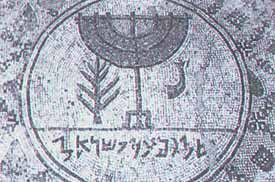
Mosaic from the Shalom Al Yisrael Synagogue (WZO)
 |
Nearby is the Spring of Elisha, or Sultan's Spring,
where the prophet sweetened the water (II
Kings 2). This is the source of water for the oasis. During the
construction of a private home north of the spring, builders discovered the
mosaic floor of an ancient synagogue decorated with Jewish symbols, such as a menorah and ram's horn. A Hebrew inscription reads, "Peace to
Israel." This is the Shalom Al Yisrael Synagogue. A second, older
synagogue, which is believed to have been built in the 5th or 6th century,
was also discovered by accident. The Na'aran Synagogue was found after the Ottoman
Turks shelled a British army unit camped on the spot. It too has a
mosaic floor, this one with the Zodiac, the story of Daniel in the Lion's
Den and pictures of sacred objects from the Temple.
Directly across from the Tel is a huge tourist complex
with shops and a restaurant where every tour bus stops. A new hotel is
being constructed as well. Another new addition since the Palestinian
takeover is a modern cable car that whisks visitors to the Mount of
Temptation. A 19th-century Greek Orthodox monastery sits on the cliff. This
is where Satan offered Jesus the kingdoms of the world in exchange for his
homage. Inside the monastery is a cave where Jesus is believed to have
stayed during the 40 days he spent in the wilderness fasting after his
baptism. At the foot of the mountain are the remains of the sugar mills
built by the Crusaders in the 11th century.
Less than two miles from Old Jericho is Caliph Hisham's
Palace. The building dates to the 7th century during the Umayyad period of
the Muslim Empire. It
was apparently designed as a winter resort from the Caliph, but was
destroyed by an earthquake before he had a chance to use it. Parts of the
building were preserved and some of the artifacts were removed and are on
display at the Rockefeller Museum in Jerusalem.
Jericho biggest tourist attraction at one point was Oasis casino - built in 1995 following the peace agreement signed between the Palestinians and Israelis- which was the only legal gambling establishment in the region, and a
magnet for Israelis. In 1999, it made a profit of $54 million from the close to 2,900 people who visited the casino daily - 99% of them Israelis. In 2000, though, after the outbreak of violence during the Palestinian War, the casino was shut down. The juxtaposition of the casino, located directly across the street from a Palestinian refugee camp, was not lost on Palestinian terrorists who began using its high roof to shoot at nearby Israeli targets. Today the casino remains closed, despite an attempt by an Israeli businessman to reopen it back in 2005.
About four miles east of Jericho (six km.) is the
Allenby Bridge, one of the two crossing points into Jordan. The bridge is
named after the famous general who led British troops during World War I
and helped conquer much of the Middle East, including Palestine.
Previous
Next
|