View from atop Masada
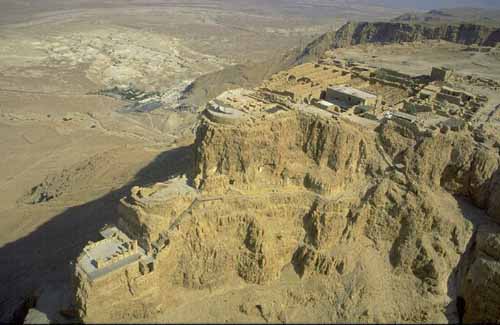 |
Masada (Hebrew "fortress") is a flat plateau measuring roughly 1,000 by 2,000
feet, situated atop an isolated rock cliff at the western end of the Judean
Desert. At the eastern end, the rock falls in a sheer drop of nearly 1,500
feet to the Dead Sea (the lowest point on earth, some 1,300 feet -- 400
meters -- below sea level) and, on the western side, it stands about 300
feet above the surrounding terrain.
It is traditional to climb Masada in the early morning, before the desert gets too hot, to watch the sunrise
over the Dead Sea from the fortress. You can either hike up the snake path
(about a 45-minute walk) or take a short cable car ride to the summit.
Either way, you will enjoy one of the world’s most spectacular sights and
experience the dawning of a new day like you have never seen before.
History
The only written source about Masada is Josephus Flavius’ book, The Jewish War. He wrote that Herod
the Great built the fortress of Masada between 37 and 31 BCE as a refuge. The water supply came from a network of
large, rock-hewn cisterns on the northwestern side of the hill. They filled
during the winter with rainwater flowing in streams from the mountain on
this side. Cisterns on the summit supplied the immediate needs of the
residents of Masada and could
be relied upon in time of siege.
On the northern edge of the steep cliff, with a splendid
view, stood the elegant, intimate, private palace-villa of the king. It was
separated from the fortress by a wall, affording total privacy and
security. Along the western casemate wall, Herod built a palace, the
largest building on Masada,
covering approximately one acre.
At the beginning of the Great
Revolt of the Jews against the Romans in 66 CE, 75 years after Herod’s death, a group of Jewish rebels overcame
the Roman garrison of Masada.
After the fall of Jerusalem, and
the destruction of the Second
Temple (70 CE), they were joined by zealots and their families who had
fled from Jerusalem.
This small band of 960 Jews held out against the
mightiest army in the world for three years. The Romans,
however, were not about to let even this handful of rebels, which had
played a key role in starting the revolt, get the best of them. In 73 CE,
the Roman governor Flavius Silva marched against Masada with the Tenth Legion and 10,000 Jewish slaves.
With the strategic advantage of the high ground, the
defenders could easily target their attackers, but the Romans were persistent. They constructed a rampart of thousands of tons of stones
and beaten earth against the western approaches of the fortress and, in 74
CE, moved a battering ram up the ramp and breached the wall of the
fortress.
Once it became apparent that the Tenth Legion's
battering rams and catapults would soon succeed in breaching Masada’s’s
walls, Elazar ben Yair, the Zealots’ leader, decided that all the Jewish
defenders — men, women and children — should burn the fortress and
commit suicide. According to Josephus, two women and five children managed
to hide themselves during the mass suicide, and it was from one of these
women that he heard an account of Elazar ben Yair's final
speech in which he said the Zealot’s "preferred death before
slavery."
Israel Fact
During the
excavations, Yadin found 25 skeletons of men, women, and children. In
1969, they were buried at Masada with full military honors. |
The heroic story of Masada and its dramatic end attracted many explorers to the Judean desert in
attempts to locate the remains of the fortress. The site was identified in
1842, but intensive excavations took place only in 1963-65 under the
leadership of Yigael Yadin. The
Israeli army and thousands of volunteers from 128 countries assisted in the
project.
The archaeologists found Herod’s residential and
western palaces, a storehouse complex, bathhouse, two mikvaot (ritual baths), artifacts such as coins and pots and a synagogue (the
oldest in Israel) used by Masada’s defenders.
For many years, new members of the Israeli Defense
Forces would be sworn in at Masada and promise that Masada would not fall
again. The practice was abandoned in 1986, Rabbi
Lawrence Hoffman says, because "its underlying message of heroes
who commit suicide no longer captured the imagination of a Jewish state
which emphasized life, not death, and victory rather than defeat."
Nevertheless, Masada remains the symbol of the determination of a people to
be free in its own land.
Previous
Next
|