Montanhas, Portugal
Some centuries ago, this
rugged mountainous area of Portugal was the region where many Jewish communities
chose to settle and continue their ancestral
traditions and forms of worship.
- Braganca
- Torre de Moncorvo
- Freixo de Espada-�-Cinta
- Vila Nova de Foz Coa
- Trancoso
- Guarda
- Belmonte
- Lamengo
- Other Places of Interest
Braganca
This city had an officially
designated Jewish quarter in the 15th century,
although no remains of this are visible today.
Still standing are the old 12th century walls
and the square Gothic keep framed by the cylindrical
towers of' the castle. One of the most interesting
buildings in the city is the Domus Municipalis (12th century) ), which was the mediaeval
town hall. In addition to the city's several
churches, with their rich Baroque wood carvings,
a visit is also recommended to the Museu
do Abade de Bacal with its interesting
collections of epigraphic and ethnographic
exhibits and its magnificent examples of Portuguese
decorative art.
Torre
de Moncorvo
The town has many manor houses
with beautiful and decorative facades emblazoned
with the coats of arrns of their founding
families. In the 16th century Torre de Moncorvo
was, thriving commercial town, largely thanks
to the great efforts of its colony of New
Christians. The Jewish community that had
lived here before the order was given for
their expulsion (1496) was certainly important,
for in the 15th century the rabbi of the Synagogue
of Moncorvo was considered responsible for
the welfare of all the Jews settled in the
region. Amongst the town's Christian religious
architecture, there are two important examples
remaining of its artistic heritage: the parish
church (built in the Mannerist style) and
the Capela da Misericordia with its
Renaissance porch and its beautiful Portuguese
Renaissance Pulpit, carved Out of one single
block of granite Amongst the town's civil
architecture, the Visitor's attention is drawn
to a number of 16th century windows around
the town.
Freixo
de Espada-à-Cinta
Situated in the easternmost
region of the Douro valley, the dominant feature
of this town is an old 14th century tower.
Its construction was ordered by Dom Dinis
(who reigned from 1279 to 1325). The nucleus
of houses stretching out along narrow streets
from the 16th century parish church is one
of the most valuable architectural features
remaining from that period. It was home to
an important community of New Christians,
who, in the period of the Discoveries, were
to set forth from here as traders to the four
corners of the world.
Vila
Nova de Foz Coa
The present-day urban centre
of Vila Nova de Foz Coa is mediaeval in its
formation, although the surrounding area has
a great profusion of rock carvings from the
Palaeolithic age, remaining as clear evidence
of a settlement that was already intense and
permanent in prehistoric times and is today
classified by UNESCO as World Heritage. It
was in the town of Foz Coa that from the 14th
century onwards a dynamic Jewish community
was to form, composed mainly of craftsmen.
In the following century, this community was
to grow even with the expulsion of the Jews from Spain.
They settled mainly in the quarter around
the Castle, and today, amongst the region's
most popular local crafts, there is still
a tradition of manufacturing articles from
iron, brass and other metals, a craft which
is essentially of Jewish origin. The Praca
do Municipio is the historical centre of this
town, where the most notable building is a
16th century church, with an imposing Manueline
doorway and a curious tower with three separate
belfries, as well as the 16th century pillory
and the 19th century Town Hall.
Trancoso
An old mediaeval town, Trancoso
was a defensive military fortress, heavily
fought over between the Moors and the first
king of Portugal,
Dom Afonso Henriques. From those times the
castle with its walled enclosure, the various
gates leading into the town and an interesting
donjon Visiting Trancoso is like going back
into the mediaeval past, evoking memories
of the Jewish merchant that first settled
here in the 12th century. The Jewish community
grew even larger in the 14th and 15th centuries
with the influx of Jews from Aragon and Castile.
The facade of the Casa do Gate Negro (the former Rabbi's house) is decorated with
emblems that have been interpreted as representations
of the Lion of Judah and the Gates
of Jerusalem. The house itself used to
belong to a wealthy member of this community,
and it was probably also used as the synagogue.
In the high street (Rua Dr Fernandes Vaz popularly known as the Corredoura at
the entrance to the town, were to be found
most of the houses where the Jews lived.
Guarda
The city walls, the keep,
the Torre dos Ferreiros (the Blacksmith's
Tower) and the old Jewish quarter are reminders
of the period of great splendor enjoyed by
the city of Guarda in the middle ages. Jews
first began to settle here in the middle of'
the 13th century in the area next to the wall,
close to the Porta d'el Rei and the
high street (Corredoura). A large gate
at the spot known as Quatro Quinas marked the limits of the quarter. Its inhabitants
were mainly traders and craftsmen. The leather
workers who had fled from Salamanca in Castile
introduced their skills into the regional
handicraft, which are still maintained to
this day. Local folklore still fondly remembers
a 14th century Jew called Mendo or Menendes,
the father of Ines Peres, by whom the Master
of Avis, the future king Dom Joao I, had a
bastard son. Legend has it that the father
of Ines, distraught at his daughter's illicit
union, swore that he would never shave again,
so that he later became known as "Barbadao"
(Bushy Beard). Close to the main Jewish quarter,
in the immediate vicinity of the present-day Rua Dom Sancho I, there still exists
the famous Casa do Barbadao. In the
city's Gothic cathedral, there is a magnificent
retable by the sculptor Jean de Rouen.
Belmonte
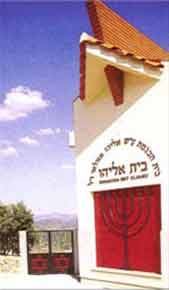 Belmonte
Synagogue
Belmonte
Synagogue |
The groups of Jews who settled
here were to see their numbers substantially
increased in the 15th century by the streams
of Jewish migrants fleeing from Castile. It
was consequently in this town that the most
important nucleus of marranos was to be found in Portugal,
having continued their lives almost completely
undisturbed until the present day. In 1993,
the community welcomed a rabbi and began the building of the "Bet Eliahu"
Synagogue, which is now open for worship.
The Jews' houses were situated in the Bairro
de Marrocos, outside the castle walls
at the easternmost end of the town, where
it is still possible to find houses with crosses
engraved in the stone, close to the doors,
a mark which identified the houses as being
inhabited by New Christians. Belmonte is a
town that is full of history and has managed
to preserve its mediaeval atmosphere just
as well as the Jews managed in secret to preserve
their prayers, traditions and customs. Amongst
its more interesting sights are the 13th century
castle, the Romanesque-Gothic parish church,
and the pantheon of the Cabral family, the
local nobility to which Pedro Alvares Cabral,
the discoverer of Brazil,
belonged, who was born here in the 15th century.
Further information can be obatained about
tile history of the Jewish community at the
local tourist office.
Lamego
A Roman city and an important
centre under the Visigoths (7th century).
Lamego is the city where the first cortes (parliament) of Portugal were summoned by Dom Afonso Henriques. At
the top of a tree-lined hill is the pilgrimage
church of Nossa Senhora dos Remedios from which a monumental Baroque staircase
of 686 steps leads down to the city below.
The historical centre of Lamego preserves
much of its 16th century mediaeval atmosphere,
and it is also worth paying a visit to the
13th century castle. The facade of the magnificent
cathedral, which is mediaeval in origin, was
rebuilt in the 16th century bringing together
elements of Manueline architecture and motifs
that were already part of the Renaissance.
In 1436, the Jews who lived in Lamego could
be proud of living in totally open Jewish
quarters, enjoying permanent social contacts
with the Christian population. The Jewish
quarter of Pedra was located close to the Campo do Tavolado and the Old Jewish
quarter (Judiaria Velha) close to the
church of Santa Maria. The regional museum
of Lamego has an important collection of Flemish
tapestries from the 16th century
Other
places of interest
The river Douro, which has
its source in Spain and flows into the Atlantic at the city of Porto,
has been largely responsible for determining
the region's landscape. On the banks of the
river grows a vine that is unique in the world
and produces famous Port Wine, which is stored
and aged in the wine cellars of Vila Nova
de Gaia. Today the river is easily navigated
in organized cruises that make it possible
to visit the estates where the wine is produced,
as well as a vast region with an important
cultural heritage and several memories that
are evocative of its former Jewish communities.
The local cuisine boasts a speciality which
is attributed to the marrano (Jewish) art of cookery alheiras, a
type of sausage similar in shape to those
that were part of Christian cuisine, but which
was stuffed with chicken and flour instead
of pork meat and fat. In this way, the crypto-Jews
escaped being identified by the Inquisition because of their different eating habits.
Places that are also worth
a visit in this region are: Chaves, Miranda
do Douro, Murca Regua Vila Flor, Vila Real
and Viseu, where until 1468 there was
a Jewish quarter in the immediate vicinity
of the Rua Direita. This latter city
has a cathedral of Romanesque origin, as well
as the impressive Grao Museum, dedicated fundamentally
to exhibiting the painting of the 16th century
artist of the same name (Vasco Fernandes),
but also containing an important collection
of 19th and 20th cenutry Portuguese painting.
In the Municipal Archaeological Museum in
Gouveia, there is a well preserved Hebraic
inscription. In Covilha five of the ten extremities
of the old wall marked the points of connection
between tire Christian part of the city and
the Jewish quarter, whose inhabitants devoted
themselves to the woollen trade and the art
of weaving, activities which are still important
in the region today. In Castelo Branco, the
home of Amato Lusitano (the Portuguese poet
who achieved great fame as a doctor in 16th
century Europe), the Jews inhabited the most
important trading area in the city. It is
interesting in this city to visit the Museum
of Francisco Tavares Proenca Junior with its
unique collection of ancient bedspreads, embroidered
with different coloured silks. These are typical
products of the region, which still maintains
the tradition of this craft even today. It
is also said that the crypto-Jews used to
"send each other messages" through
these bedspreads, making use of tire different
themes that they introduced into their embroidery,
such as the "Tree of- Life or "Paradise."
Sources: Journey to Jewish Portugal courtesy
of the Portuguese
National Tourist Office; Belmonte synagogue photo by Joao Paulo. |