Venice, Italy
Venice is considered one of the world’s most
beautiful and romantic cities. Its canals and streets remain the same
as they were hundreds of years ago. For Jews, however, Venice is also
a place with a dark history; it is where the world’s first ghetto
was instituted and the quality of Jewish life often shifted with the
whims of the ruling power.
- Early History
- The Ghetto
- Emancipation Onward
- Venice Today
- Jewish Tourist Sites
Early
History
While Jews did not settle in Venice until the 13th century, many Jewish merchants and moneylenders visited and worked in
the city beginning with the 10th century. Jews were
mentioned in documents in 945 and 992 forbidding Venetian captains
from accepting Jews onboard their ships. In 1252, Jews were not
allowed to settle in the main part of the city, so they settled on
the island of Spinaulunga (also spelled Spinalonga) which later became Giudecca.
In
1290, Jewish merchants and moneylenders were allowed to work in
Venice, but were forced to pay a special tax of five percent on all
their import and export transactions. The Jewish moneylenders
received permission to settle in the city in 1385. They were given a
piece of land to be used as a Jewish cemetery in 1386.
The Senate decided to expel the Jews from the city
in 1394 due to fears of Jewish encroachment in certain economic
spheres. They were allowed to work in the city for limited two-week
intervals. Those who were not moneylenders were allowed to remain in
the city, albeit with certain restrictions. Jews were forced to wear
various markings on their clothing to identify themselves as Jews. In
1394 they had to wear a yellow badge, it was changed to a yellow hat
in 1496 and to a red hat in 1500. Other anti-Jewish laws including
the prohibition against owning land (enacted in 1423) and from
building a synagogue (enacted in
1426). On occasion, Jews were forced to attend Christian services or
become baptized. Anti-Jewish feelings were prevalent and three Jews
died in a blood libel in 1480
and more died after another libel in 1506.
Despite the harsh economic hardships, Jewish
culture was allowed to develop to a certain degree. Daniel Bomber,
known as Aldo Manuzio (1449-1515), the first Italian printer, used
Hebrew fonts in his publications. This marked an increased
open-mindedness toward Jewish culture among Venetian and Italian
intellectuals.
Venice received an influx of immigrants from Spain and Portugal following the expulsion in 1492. Isaac Abravanel was one of the well-known Sephardic
immigrants who came during this period.
The
Ghetto
In 1516, the doges, Venice’s ruling council,
debated whether Jews should be allowed to remain in the city. They
decided to let the Jews remain, but their residence would be confined
to Ghetto Nuova, a small, dirty island; it became the world’s first
ghetto. The word “ghetto” is from the Italian getto meaning “casting” or Venetian geto meaning
“foundry.”
Jews of Italian and German origin moved into this
ghetto. The latter came to Venice because of persecution in their
communities, while the former came from Rome and from the South, where they faced anti-Semitism.
Jews
from the Levant, who practiced Sephardic traditions, moved into
Ghetto Vecchio in 1541. The Spanish and Portuguese Jews also came to
Venice in the late 16th century and were the strongest and
wealthiest community in the ghetto. Many of the Spanish and Portuguese
Jews were Marranos and became “Jewish” again once moving to
Venice. The Spanish/Portuguese and Levantines lived in the Ghetto
Vecchio.
The German, Italian and Levantine communities were
independent, yet lived side by side to one another. A hierarchy
existed among them, in which the Sephardic (Spanish and Portuguese)/Levantine
Jews were at the top of the scale, Germans in the middle and Italians
at the lowest rung.
Further
restrictions were placed on Jews living in the ghetto. They were only
allowed to leave during the day and were locked inside at night. Jews
were only permitted to work at pawn shops, act as money lenders, work
the Hebrew printing press, trade in textiles or practice medicine.
Detailed banking laws kept their interest rates low and made life
difficult for many of the poor pawnbrokers and moneylenders.
 A "milah" at the end of the 18th Century. Museum of
Jewish Art (Venice)
A "milah" at the end of the 18th Century. Museum of
Jewish Art (Venice) |
Once they left the ghetto they still had to wear
distinguishing clothing, such as a yellow circle or scarf. Jews were
faced with high taxes and the Talmud was burned in 1553, due to
arguments between two Venetian printing companies. Hebrew books were
not allowed to printed for the next thirteen years, however, the
Jewish printing press and publishing companies continued to thrive
until the early 19th century.
One period that was particularly difficult for
Venetian Jews was during the 1570's, after the Battle of Lepanto in
1571. The Jews were blamed for the war and expulsion threats were
made. The German and Italian Jews survived the war by making
financial concessions. They decreased their interest rate to five
percent per annum, the price they had to pay for stable residence in
the ghetto. This was a major setback, however, the Jews were able to
recover.
Despite
the poor living conditions, Jewish community life continued to grow
inside the ghetto. Life centered around Jewish ritual and customs and
the celebration of the Sabbath. The Ashkenazic Jews built two
synagogues on the top floors of the ghetto building, the Scola Grande
Tedesca in 1528-29 and the Scola Canton in 1531. The Levantine Jews,
who had more money, built an extravagant synagogue in 1575 and it was
housed in its own building in Ghetto Vecchio. The Spanish Jews built
a synagogue in 1584. Jews were also able to build their own free
school, the only one in Venice. Christians came to the ghetto to
visit Jewish banks, doctors or shop for spices, jewelry and fabrics.
The 17th century was the period of the
ghetto’s golden age; Jewish commerce and scholarship flourished.
Jews controlled much of Venice’s foreign trade by the mid-1600s.
The Sephardic groups gained influence and wealth in the Venetian
economy. The residents of the Ghetto Nuovo also began to have greater
economic stability and began participating in maritime trade, which
had before only been allowed for those in Ghetto Vecchio.
The commercial activity of the ghetto was halted
during the plague that spread throughout Europe in 1630-31 and hit
the Jewish community of Venice in the summer of 1630. An estimated
450 Jews lost their lives to the plague and many merchants left the
city. The end of the plague was marked by public ceremonies and
fasts. The Jewish community recovered and they opened a new prayer
and study halls. The ghetto’s boundary were extended and the
Nuovissimo ghetto was opened to house wealthy Jewish residents.
In
this period, Venice was home to many famous physicians who later
served the Queen of France, the royal Court in Spain and figures such
as Pope Paul III. Famous personalities included, Rabbi Simone Luzzato,
who served as Venice’s rabbi for 50 years. Luzzato published the Discorso
circa il stato defl’Hebrei (Discourse on the State of the
Jews), which examined the social and political conditions of Jews in
a non-Jewish environment.
Another famous personality was Rabbi Leon da
Modena. Modena’s writings include poetry, several dictionaries,
commentaries on the Bible, the Sur Meda and a tractate against
gambling, which was written at age thirteen.
A third famous personality was Sara Coppio Sullam,
who was the ghetto’s leading poets, she held a salon that drew many
educated men and aristocrats.
Venice
was the center for Jewish knowledge and learning for many Sephardic
Jews. Venetian Sephardic scholars traveled from Venice to start new
communities in London and Amsterdam. Venice also served as a center
for Kabbalah in the early 18th century. One of the community’s most influential Kabbalists was
Rabbi Mosheh Zacuto, who was active from 1645-1673.
The
economic conditions for Jews deteriorated at the end of the 17th century. Anti-Jewish feelings were prevalent in the 18th century and limitations were placed on Jewish economic activity. The
Jewish population decreased from 4,800 in 1655 to 1,700 in 1766
because many prominent families left for Leghorn or other port
cities. Taxes were extremely stiff and Jewish ship owners and
merchants lost their shops between 1714-1718. Finally in 1737, the
Jewish community had to declare bankruptcy.
In February 2016 Venice marked the 500th anniversary of the establishment of the world's first Jewish Ghetto, kicking off a year-long commemoration including keynote speakers, concerts, exhibitions on Jewish life in Venice, workshops, art installations, conferences, and more. The celebration will also include the first ever performance to take place in the ghetto of William Shakespeare's “the Merchant of Venice,” featuring U.S. Supreme Court Justice Ruth Bader Ginsburg presiding over the mock trial within the play.
Emancipation
Onward
Everything changed in 1797 when Napoleon’s
troops reached Venice and tore open the ghetto gates. Swept up in the
fervor, many Jews volunteered for Napoleon’s army. Venice became
part of the Hapsburg empire in 1798 and some of the restrictions were
reintroduced, however, the ghetto was not officially reestablished.
Many Jews chose to continue to live in the ghetto, but the wealthy
Jews left to live in other parts of the city.
In
1848-49, there was a short-lived Venetian Republic run by Daniele
Manin, who had Jewish origins. After Italy’s unification, in 1866,
Venetian Jewry achieved an equal status. One famous Venetian Jew,
Luigi Luzzati, began his career in politics organizing an aid society
for gondoliers. He continued to serve in the Italian Parliament for
50 years and was elected Italy’s first Jewish Prime Minister in
1910.
Following World War I, many Jews left the city
because of rising tensions. Jews did not face restrictions in the
early years of Mussolini’s rule, but the situation changed in the
1930's because of Italy’s relationship with Germany. About 1,200
Jews were living in Venice when German troops occupied the city in
1943. Between November 9, 1943 and August 17,1944, 205 people were
deported to extermination camps,
including Chief Rabbi Adolfo Ottolenghi. At the end of World War II,
1,500 Jews were living in Venice and the number gradually decreased
over the years. By 1965, 844 Jews remained in Venice.
Venice
Today
Today Venice has a Jewish population of about 500
peoples, only 30 of them live in the former ghetto. The ghetto houses
all of the city’s major Jewish institutions. The community is
officially Orthodox. Jews are
prominent in business and as doctors, but no longer are involved in
the banking industry.
Venice
is the only Italian city where one can find an intact ghetto that has
remained unchanged since its founding. The site is so prominent in
the city’s history that there is a water taxi stop that lists the
ghetto (in Italian and Hebrew) as one of the nearby sites and,
at night, a neon sign with Hebrew letters is turned on above the
dock.
Venice has five synagogues, a Jewish bookstore, a
Jewish publishing house, a social center, a rest home, a museum, a
yeshiva and a kosher restaurant.
Jewish Tourist Sites
Campo del Ghetto Nuovo
The ghetto consists of an open square surrounded
by “skyscrapers” on three sides. Because of the lack of
space in the ghetto, many six-story “skyscrapers” were
built. Laws forbid building separate synagogues, hence the synagogues
were built on the top floors of the buildings because there should be
no obstructions between the congregation and the heavens.
Jewish Museum (Museo Ebraico)
The
museum contains Jewish ritual objects that were made or used in
Venice, such as Seder plates and spice boxes. Three of the ghetto’s
five synagogues come under the auspice of the Jewish Museum.
The first of these is the Tedesca or German
synagogue, located to the left of the Museum. The oldest synagogue in
the ghetto, built in 1528, it can be found on the fifth floor of the
building. It was restored in 1848, 1860, 1910 and in 1975. The
synagogue’s service room houses the Museum of Hebrew Art.
 Venice Holocaust Memorial
 |
On
the right side of the Museum is the Canton Synagogue, which
was built in 1531. This synagogue served as the center for Jews from
Germany, France and Switzerland. One can fine a beautiful ark with
carved and gilded doors. It has been restored and altered a number of
times and is still in use today for wedding ceremonies.
The Italian synagogue, built in 1575,
served the Italians, the poorest group in the ghetto. The synagogue
is quite simple reflecting its status among the communities. It was
restored to its original appearance in 1970.
The Jewish home for the aged-Casa di Riposo
Israelitica houses only ten people, but the building is increasingly
used by the community to welcome travelers and to provide kosher
meals.
On
both sides of the Casa di Riposa building are Holocaust memorials designed by sculptor Arbit Blatas. The Nazis gathered Jews for
deportation in the square. One of the monuments is a bronze panel
depicting the Last Train, the other monument has bronze reliefs that
show the Nazi brutality against the Jews.
In the ghetto, there is also a kosher grocery
store, run by Chabad, as well as a kosher restaurant.
 Spanish Synagogue
 |
Ghetto Vecchio
Inside
this section of the Venetian ghetto, at the Campiello delle Scuole,
are Venice’s two functioning synagogues, which were built by the
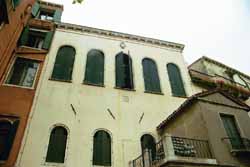
Sephardim. The Spanish Synagogue is a four-story story yellow
stone building, constructed in 1550, as the center for Spanish and
Portuguese Jewry. The building was restored in 1635. Its interior is
more ornate than the Levantine Synagogue and contains three large
chandeliers and a dozen smaller ones, as well as a huge sculpted
wooden ceiling. This synagogue may be the only in the world that has
held services continuously from 1550 until the present day. It is
open for services from Passover until the end of the High Holiday season
 Levantine Synagogue
 |
The Levantine Synagogue, which is a two-story yellow stone
building, catered to the Jews of Middle East descent. Inside the
sanctuary are two dozen hanging lamps and an ornate wooden bima.
It was built in the late 16th Century. Today it is used
for prayer services from the period after the High Holy Days until Passover.
In the alleyways facing the Levantine synagogue,
one can find the Calle del Forna, where there is an oven that
is still used today for making matzo.
One can also find, in this section of the ghetto,
the bet midrash (study house) of Leon da Modena and the Midrash Vivante, which was founded in 1853.
Ghetto Nuovissimo
There is not much left of this section of the
Venetian ghetto, besides a few mezuzah indentations found on the doorposts of some of the buildings.
The Jewish Cemetery
The land for the Jewish cemetery at the Lido di
Venezia was given to the Jews in 1386. One can find the grave of
Rabbi Leon da Modena, as well as Sarah Sullam. A new cemetery was
opened in the 1800's in the adjacent area. On the graves from this
period, one can find portraits of the deceased.
Other
sites of Jewish interest in Venice include a stone with an engraved Star
of David found in St. Mark’s Cathedral. According to legend,
the stone was brought to Venice from the Temple in Jerusalem. Above the
stone is a mosaic of Moses.
Mosaics of King Solomon, Joseph and Abraham can also be found
in the cathedral.
In the Palace of the Doges, next to Saint Mark’s, there are
statues of King Solomon and other biblical figures.
For more information about Jewish life in Venice, contact:
Chabad of Venice
Ghetto Nuovo
Cannaregio 2884
Venice, Italy
phone/fax, 39-041-715-284
[email protected]
Sources:Ancient
Ghetto of Venice
Chabad
of Venice
The Ghetto of the Lagoon: A guide to the history and art of the
Venetian Ghetto. Translated by Roberto Matteoda. 1987-2000.
The
Jewish Cemetery at Lido of Venice
Jews and Synagogues: A practical Guide. EdizioniStorti Venezia.
1999
Jewish Art and Civilization. Edited by Geoffrey Wigoder
“Venice.” Encyclopedia
Judaica. CD-ROM edition, Judaica Multimedia
“Venice.”
Tigay, Alan M. "Venice" The
Jewish Traveler
Photo credits: Lido cemetery photos copyright � PhotoArts,
photos of medieval Jews, “milah,” menorah and inside
of Canton Synagogue copyright � Jews and Synagogues.
EdizioniStorti Venezia. 1999, the remainder copyright � Mitchell
Bard.
|


