Following the defeat of the German Army in World
War II, the Judge Advocate Department of the Third U.S. Army set
up a War Crimes Branch which conducted 489 court proceedings in which
1,672 German war criminals were charged. This was apart from the proceedings
against the major German war criminals before an International
Military Tribunal at Nuremberg. Most of the secondary proceedings
conducted by the American occupation forces were held at Dachau,
on the grounds of Germany's most infamous horror camp, between November
15, 1945 and 1948. The most controversial of the Dachau proceedings,
and the one that is still discussed to this day, is the infamous Malmedy
Massacre case against the Waffen-SS soldiers who were accused of the murder of American Prisoners of War
and Belgian civilians during the intense fighting of the Battle
of the Bulge.
The Malmedy
Massacre, or the shooting of 84 American soldiers who had surrendered,
took place on December 17, 1944, the second day of the Battle of the
Bulge. After the war, during the summer of 1945, the U.S. occupation
authorities rounded up over 1,000 former soldiers in the 1st SS Panzer
Division and interrogated them. Seventy-five of them were originally
charged as war criminals in the Malmedy case. One of those who were
charged was 18-year-old Arvid Freimuth who committed suicide in his
cell before the trial started. Charges were dismissed against Marcel
Boltz after it was learned that he was a French citizen. That left 73
men who were ultimately prosecuted by the American Military.
The Malmedy case became officially known as U.S.
vs. Valentin Bersin, et al. Bersin's name was the first in the alphabetical
list of the accused, and he was the first to be sentenced to death for
killing Belgian civilians in the village of Wanne.
The proceedings in the Malmedy Massacre case started
on May 12, 1946 and the verdicts were read on July 16, 1946. All of
the 73 men on trial were convicted and 42 were sentenced to death by
hanging. The list of the names of the 73 men are on a separate page.
Although popularly known as "the Dachau trials,"
these court proceedings by the American Military Tribunal at Dachau
were not conducted like a typical trial in the American justice system.
Guilt was established beforehand by interrogators assigned to obtain
confessions from the accused who were then presumed guilty; the burden
of proof was on the defense, not the prosecution. A panel of American
military officers acted as both judges and jury and the defense attorneys
were also American military officers. The judges took judicial notice
of the crimes that were allegedly committed, which meant that the defense
was not permitted to argue that the crimes had not taken place. Hearsay
testimony was allowed and affidavits could be submitted by witnesses
who did not appear in the courtroom and thus could not be cross examined
by the defense. In some of the proceedings at Dachau, the prosecution
witnesses were paid to testify. Some of the accused were not permitted
to testify in their own defense. Thus the outcome of the Malmedy Massacre
proceedings was never in doubt.
The accused in the proceedings included General Josef
"Sepp" Dietrich, commander of the Sixth Panzer Army, who
was a long-time personal friend of Adolf Hitler, and Col. Jochen Peiper,
the commanding officer of "Kampfgrüppe Peiper," the armored
battle group which spearheaded the German attack in Hitler's Ardennes
Offensive, better known to Americans as the Battle of the Bulge. Peiper's
rank was the equivalent of an American Lt. Col. when he was assigned
on December 16, 1944 to lead the tank attack, but after the battle,
he was promoted to Colonel. Peiper preferred to be called by his nickname,
Jochen, rather than his real first name, Joaquim.
Both Peiper and Dietrich were members of the "Leibstandarte-SS
Adolf Hitler," an SS outfit which was established in 1933 under
the command of Dietrich. SS stands for Schutzstaffel which means "Protection
Squad" in English. The SS was an elite group that was separate
from the regular German army, which was called the Wehrmacht. The Schutzstaffel
had started out as a private protection squad, whose purpose it was
to personally guard Adolf Hitler. Another branch of the SS was the SS-Totenkopfverbände,
which served as the guards in the concentration camps. The SS was a
unique branch of the German armed forces; it was a volunteer army which
had many divisions made up of recruits from almost every country in
Europe. The Waffen-SS soldiers swore an oath of loyalty to Adolf
Hitler, rather than to their country, as did the Wehrmacht soldiers.
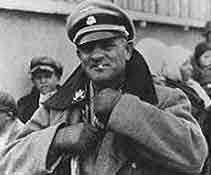
General Sepp Dietrich wearing Death's
Head emblem on cap
The SS men was more hated by the Americans than the
regular Wehrmacht soldiers. The men in all the SS Panzer (tank) divisions
wore the Totenkopf or Death's Head symbol on their visor caps, the same
symbol that was also worn by the Einsatzgruppen when they followed behind the troops, killing the Communists and Jews,
when the German Army invaded Russia on June 22, 1941, and the same symbol
that was worn by the guards in the Nazi concentration
camps.
Dachau was selected as the
site for the German war crimes proceedings
that were conducted solely by the American
military, partly because of the abundant
housing available at the former concentration
camp and the huge SS Training Camp there,
but primarily because it was the place most
associated with German atrocities in World
War II....

Courtroom at Dachau where proceedings
took place
Lt. William Perl...was
the chief interrogator of the Malmedy Massacre
accused....The chief prosecutor, called
the Trial Judge Advocate, was Lt. Col. Burton
F. Elli...The lawyer for the defense was
Lt. Col. Willis M. Everett....Everett was
ably assisted by Herbert J. Strong, a civilian
attorney who had volunteered to work on the
war crimes military tribunals....A panel
of high-ranking American army officers acted
as both judge and jury. Seven members of
the panel are shown in the photograph below.
The president of the panel was Brigadier
General Josiah T. Dalbey....

Judges
at Malmedy, Panel President Dalbey is
the fourth
man from the left
Of all the proceedings before the American military
tribunal at Dachau, the one that was the most highly publicized was
the Malmedy Massacre case. The proceedings were filmed and scenes were
shown in the newsreels in American theaters. The accused complained
that they were being blinded and cooked by the hot lights needed for
the movie cameras. This case was important because every school child
in America knew the name of the Battle of the Bulge. It was the most
decisive battle on the Western front, the battle in which the Allies
crushed the enemy army, leading to Germany's final defeat. Besides bringing
war criminals to justice, the Nuremberg and Dachau military tribunals
were designed to educate the public, both in Germany and in America,
that World War II was "the Good War," the war fought by the
American good guys against the German bad guys, who were rotten through
and through, from their evil leader right down to the teenagers who
died defending their country. The purpose of the Dachau military tribunals
was to establish once and for all that the Germans had committed unspeakable
atrocities, which were all part of an evil conspiracy masterminded by
Adolf Hitler.

Bodies of American POWs killed at Baugnez Crossroads
The incident which became known as "the Malmedy
Massacre" happened at the Baugnez Crossroads in the Ardennes Forest
in Belgium on December
17, 1944, the second day of fighting in the famous Battle of the Bulge,
where American troops suffered 81,000 casualties, including 19,000 deaths,
in one of the bloodiest battles of World War II. The German army suffered
70,000 casualties with 20,000 dead in the month-long battle, which didn't
stop even for Christmas Day. It was during this decisive battle that
a number of American soldiers were taken prisoner by Waffen-SS soldiers
who were fighting in the battle group named Kampfgrüppe Peiper,
which was spearheading the German attack.
The photograph above shows some of the 72 bodies which
were recovered after they were left lying in the snow until January
13, 1945, four weeks after they were killed. The reason given by the
U.S. Army QM unit which eventually retrieved the bodies was that there
was still heavy fighting in the area, which was not true, according
to American soldiers who participated in the fighting in the vicinity
of the Massacre. According to one veteran of the battle, an American
Infantry Captain who is now deceased, the alleged massacre was a cover-up
to explain why the U.S. Army waited four weeks to collect combat fatalities
after they had been notified about the bodies by local Belgian citizens.
Another 12 bodies were recovered four months later after all the snow
had melted, making a total of 84 victims.
On the day of the incident, Peiper's assignment had
been to capture the bridge over the Muese in the Belgian town of Huy,
and hold it to the last man until General Dietrich's 6th Panzer Army
could cross over it, then rush across the northern Belgian plain to
take the great supply port of Antwerp, which was the main objective
of Hitler's Ardennes Offensive. Hitler had personally picked the route
that Peiper was to take, but heavy artillery fire from the 2nd U.S.
Infantry Division had forced him to take an alternative route through
the tiny village of Malmedy, close to the Baugnez Crossroads.
Peiper's Battle Group never reached its objective,
which was the bridge over the Muese. Many of Peiper's tanks were destroyed
by the Allies, and after Peiper ordered his men to destroy the remaining
tanks and vehicles, the survivors escaped by wading and swimming across
the river. Peiper's men were forced to retreat on foot, at a killing
pace, on Christmas Eve 1944. Out of the 5,000 men in Peiper's unit,
only 800 survived the Battle of the Bulge. Almost one out of ten of
the survivors was indicted as a war criminal by the victorious Allies.

Defense
attorney Lt. Col. Everett (l), Trial
Judge Advocate Lt. Col. Ellis (r)
The Baugnez Crossroads was known to the Americans as
Five Points because it was the intersection of 5 roads. There is considerable
disagreement about what actually happened at Five Points on that Sunday
afternoon in 1944 when the blood of American soldiers was spilled in
the snow. The victims were members of Battery B of the 285th Field Artillery
Observation Battalion. The function of this lightly-armed technical
unit was to locate enemy artillery and then transmit their position
to other units. No two accounts of the tragedy agree, not even on the
number that were killed. The official report said 86 were shot and there
are 86 names on the Memorial Wall that has been erected at the site,
but the Malmedy Massacre trial was based on the murder of the 72 soldiers
whose bodies were autopsied after they were recovered on January 13,
1945, buried under two feet of snow.
According to the story that was pieced together by
the American survivors, Peiper's assault unit had destroyed around a
dozen American army spotter planes that day and had captured a group
of American soldiers, who had been forced to ride along as Peiper's
men continued down the road on their tanks. At the crossroads, the German
tanks caught up with the American soldiers of Battery B, 285th Battalion
which had just left the village of Malmedy and were traveling the same
road, bound for the same destination. At the crossroads, a U.S. Military
Policeman, Homer Ford, was directing traffic as a column of artillery
vehicles, led by Lt. Virgil Lary, passed through the intersection, headed
for the nearby village of St. Vith.
A five-minute battle ensued in which approximately
50 Americans were killed. Some of the Americans tried to escape by hiding
in the Cafe Bodarme at the crossroads, but Peiper's SS soldiers set
the cafe on fire and then heartlessly gunned down those who tried to
run out of the building. Survivors of the massacre said that the SS
soldiers then assembled those who had surrendered after the battle in
a field beside the Cafe. There were three eye-witnesses to the event:
the owner of the Cafe, Madame Bodarme, a 15-year-old boy and a German-born
farmer, Henri Le Joly. None of these witnesses were called to testify
at the military tribunal in Dachau.
According to Charles Whiting in his book entitled The
Traveler's Guide to The Battle for the German Frontier, "The
Americans huddled in a field to the right of the pub, some of them with
their hands on their helmets in token of surrender; others smoking and
simply watching the SS armor pull away, leaving their POWs virtually
unguarded. It was so quiet that Mme Bodarme and Le Joly came out of
hiding to watch what was going on."
Peiper's tank unit continued down the road, after leaving
behind a few SS men to guard the prisoners. Legend has it that Lt. Col.
Peiper, who had an excellent command of the English language, passed
the scene and called out to the American prisoners, "It's a long
way to Tipperary." According to Whiting's book, Peiper had heard
that an American General was in the next village and he was on his way
to capture him. General Dwight D. Eisenhower mentioned in his autobiography,
"Crusade in Europe," that there was some concern among the
American generals about being captured, although he didn't mention Peiper
by name.
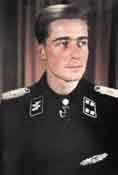
Lt. Col. Jochen Peiper
At the Dachau proceedings, Lt. Virgil Lary was able
to identify Pvt. 1st Class Georg Fleps, a Waffen-SS soldier from Rumania,
who allegedly fired the first two shots with his pistol. Some versions
of the story say that he fired a warning shot in the air when several
prisoners tried to make a run for it. Other versions say that he deliberately
took aim and shot one of the Americans. Panic ensued and the SS soldiers
then began firing upon the prisoners with their machine guns. The survivors
testified that they had heard the order given to kill all the prisoners:
"Macht alle kaputt." According to the testimony of three survivors
who played dead, the SS murderers were laughing as they walked among
the fallen American soldiers and shot those who still showed signs of
life. The autopsies showed that 41 of the Americans had been shot in
the head and 10 had head injuries consistent with being bashed with
a rifle butt. Curiously, most of the victims were not wearing their
dog tags, although all of them were identified by their personal effects,
since there were no wallets or watches taken by the Germans.

1st. Lt. Virgil Lary points out
Sturmmann Georg Fleps
Private Georg Fleps, who is shown in the photograph
above, was sentenced to death by hanging, but his sentence was commuted
to life in prison. Forty-two of the accused were sentenced to death,
but all the sentences were commuted to life after a Congressional investigation
determined that there had been misconduct by members of the prosecution
team.
(List of the accused)
The photograph below shows one of the survivors, an
American soldier named Kenneth Ahrens, on the witness stand as he demonstrates
how he held up his hands to surrender. Seated beside him is the interpreter
who was responsible for translating his words into German for the benefit
of the accused.

Kenneth Ahrens demonstrates how
he surrendered
The exact number of soldiers who surrendered to the
Germans is unknown, but according to various accounts, it was somewhere
between 85 and 125. After the captured Americans were herded into the
field at the crossroads, they were allegedly shot down by Waffen-SS
men from Peiper's Battle Group in what an American TV documentary characterized
as an orgy motivated by German "joy of killing." Forty-three
of the Americans taken prisoner that day managed to escape and lived
to tell about it. One of them was Kenneth Ahrens, pictured above, who
was shot twice in the back. Seventeen of the survivors ran across the
snow-covered field, and made their way to the village of Malmedy where
they joined the 291st Engineer Battalion.
The massacre occurred at
approximately 1 p.m. on December 17th and
the first survivors were picked up at 2:30
p.m. on the same day by a patrol of the
291st Engineer Battalion. Their story of
the unprovoked massacre was immediately
sent to General Eisenhower, the Supreme
Allied Commander of the war in Europe, who
made it a point to disseminate the story
to the reporters covering the battle. One
of the news reporters at the Battle of the
Bulge was America's most famous writer,
Ernest Hemingway, who was covering the war
for Collier's magazine. When the gory details
of the Malmedy Massacre reached the American
people, there was a great outcry for justice
to be done. To this day, the Malmedy Massacre
is spoken of as the single worst atrocity
perpetrated by the hated Waffen-SS soldiers....

SS Lt.
Heinz Tomhardt listens as his death
sentence is read. Lt.
Col. Willis M. Everett, stands on the right.
During the proceedings, the
prosecution contended that Lt. Col. Jochen Peiper had instructed his
men to fight as they had fought against the Russians, disregarding international
law about the treatment of prisoners of war. The defendants testified
that they had been instructed to take no prisoners, but they understood
this to mean that because they were fighting in a tank unit, they were
supposed to send POWs to the rear to picked up by infantry units.

Besides the killing of 72 American soldiers at the
Baugnez Crossroads, near the village of Malmedy, there were many other
charges against the 73 accused. The charge sheet specifically stated
that the 73 accused men
"did....at, or in the vicinity of Malmedy,
Honsfeld, Büllingen, Lignauville, Stoumont, La Gleize, Cheneux,
Petit Thier, Trois Ponts, Stavelot, Wanne and Lutre-Bois, all in Belgium,
at sundry times between 16 December 1944 and 13 January 1945, willfully,
deliberately, and wrongfully permit, encourage, aid, abet, and participate
in the killings, shooting, ill treatment, abuse and torture of members
of the Armed Forces of the United States of America, then at war with
the then German Reich, who were then and there surrendered and unarmed
prisoners of war in the custody of the then German Reich, the exact
names and numbers of such persons being unknown aggregating several
hundred, and of unarmed civilian nationals, the exact names and numbers
of such persons being unknown."
In all, the accused were
charged with murdering between 538 to 749
nameless Prisoners of War and more than 90
unidentified Belgian civilians in the locations
mentioned on the charge sheet, which is quoted
above. The accused SS men claimed that the
civilians, who were killed, had been actively
aiding the Americans during the fighting....
The prosecution claimed
that General Sepp Dietrich, on direct orders
from Hitler himself, had urged the SS men
to remember the German civilians killed
by the Allied bombing, and to disregard
the rules of warfare that were mandated by
the Hague Convention of 1907 and the Geneva
convention. This meant that all of the accused
were charged with participating in a conspiracy
of evil that came from the highest level,
the moral equivalent of the Nazi conspiracy
to exterminate all the Jews in Europe, which
was one of the charges against the major
German war criminals at Nuremberg.
"It's so long ago now. Even I don't know the
truth. If I had ever known it, I have long forgotten it. All I knew
is that I took the blame as a good CO should and was punished accordingly."
— Jochen Peiper, quoted in A Traveler's
Guide to the Battle for the German Frontier by Charles Whiting

Lt. Col. Joachim Peiper on the witness stand,
June 17, 1946
The Malmedy Massacre proceedings
were conducted like a U.S. Army court martial,
except that only a two-thirds majority vote
by the panel of 8 judges was needed for
conviction. Each of the accused was assigned
a number because it was hard to keep the
names of the 73 men straight. They all wore
their field uniforms, which had been stripped
of the double lighting bolt SS insignia
and all other military emblems and medals.
The proceedings lasted for only two months,
during which time both the prosecution and
the defense presented their cases. Fearful
that they might incriminate themselves on
the witness stand, their defense attorney,
Lt. Col. Everett, who believed that they
were guilty, persuaded most of the SS soldiers
not to testify on their own behalf. Col.
Joaquim Peiper, pictured above, volunteered
to take all the blame if his men could go
free, but this offer was declined by the
court....

Col. Peiper listens to closing
statement with his arms folded
After only 2 hours and 20
minutes of deliberation by the panel of
judges, all
73 of the accused SS soldiers were convicted.
Each of the accused was required to stand
before the judges with his defense attorney,
Lt. Col. Everett, by his side, as the sentence
was read aloud.

Waiting for the Malmedy Massacre
verdict outside the courtroom
Forty-two of the accused were sentenced to death by
hanging, including Col. Peiper. Peiper made a request through his defense
attorney that he and his men be shot by a firing squad, the traditional
soldier's execution. His request was denied. General Sepp Dietrich was
sentenced to life in prison along with 21 others. The rest of the accused
were sentenced to prison terms of 10, 15 or 20 years.
None of the convicted SS soldiers were ever executed
and by 1956, all of them had been released from prison. All of the death
sentences had been commuted to life in prison. As it turned out, the
Malmedy Massacre proceedings at Dachau, which were intended to show
the world that the Waffen-SS soldiers were a bunch of heartless killers,
became instead a controversial case which dragged on for over ten years
and resulted in criticism of the American Occupation, the war crimes
military tribunals, the Jewish prosecutors at Dachau and the whole American
system of justice. Before the last man convicted in the Dachau proceedings
walked out of Landsberg prison as a free man, the aftermath of the case
had involved the U.S. Supreme Court, the International Court at the
Hague, the U.S. Congress, Dr. Johann Neuhäusler who was a survivor
of the Dachau concentration camp and a Bishop in Munich, and the government
of the new Federal Republic of Germany. All of this was due to the efforts
of the defense attorney, Lt. Col. Willis M. Everett.

U.S. Army Major Harold D. McCown
testified as a witness for Col. Peiper

Peiper poses for his mug shot
at Schwabish Hall prison
Col. Jochen Peiper, the main one of the 73 accused
in the Malmedy Massacre Military Tribunal proceedings, was not a member
of the Nazi party,
although he joined the Hitler Youth as a young boy and then, at the
age of 19, applied for admission to the elite Waffen-SS in 1934. (He
was a Lt. Col. at the time of the Battle of the Bulge, but was promoted
to Colonel afterwards.) Sepp Dietrich reviewed his application and admitted
him into the "Leibstandarte-SS Adolf Hitler," one of the most
prestigious outfits in the SS. In 1943, the Leibstandarte das Reich
and Totenkopf divisions were formed into the new 1 SS Panzer Korps,
which was sent to the Eastern Front. After the Korps won a decisive
battle at Kharkow, more SS outfits were formed and the Leibstandarte
Adolf Hitler was combined with the 2nd SS Panzer Hitler Jugend division
to form a new 1 SS Panzer Korps.

Lt.
Col. Jochen Peiper, 1 SS Panzer Korps
Peiper had started his military career as an adjutant
to Reichsführer-SS Heinrich
Himmler, the head of the SS and the arch fiend who masterminded
the Holocaust. Himmler is shown in the photograph below on a visit to
inspect the troops at the Eastern front, some time after the invasion
of Russia in June 1941. He is the man who is wearing an officer's cap
in the exact center of the photo, behind the tank.

Heinrich Himmler visits a Waffen-SS
tank division on Eastern front
When the case came to the
attention of Secretary of the Army Kenneth
C. Royall, he ordered a stay of execution
for the 12 men who were scheduled to be hanged
in just a few days, and then directed General
Lucius D. Clay, the highest authority of
the American occupation in Germany to investigate
Everett's charges against the prosecution....Royall
appointed a three-man commission, headed
by Judge Gordon Simpson of the Texas Supreme
Court....The other two members of the commission
were Judge Edward L. Van Roden and Lt. Col.
Charles Lawrence, Jr.
Lt.
Col. Jochen Peiper on the Eastern front
After a six-week investigation
conducted from an office which they set
up in Munich, the Simpson Commission made
its recommendation to Royall. The Commission
had looked at 65 mass trials of German war
criminals in which 139 death sentences had
been handed down. By that time, 152 German
war criminals tried at Dachau had already
been executed. The 139 men who were still
awaiting execution were staff members of
the Dachau concentration camp, SS soldiers
accused of shooting POWs at Malmedy and
German civilians accused of killing Allied
pilots who were shot down on bombing missions
over Germany. On January 6, 1949, they recommended
that 29 of these death sentences, including
the 12 death sentences in the Malmedy Massacre
case, be commuted to life in prison....

SS 2nd Lt. Kurt Flamm testified
on May 27, 1946
In March 1949...General
Lucius D. Clay commuted 6 more of the death
sentences to life in prison, but not the
death sentence of Col. Jochen Peiper, who
was the main person in the Malmedy Massacre
case. Peiper did not personally shoot any
American Prisoners of War, but he was the
one who had allegedly ordered his armored
unit not to take prisoners....

Private Samuel Bobyns, a U.S.
Army ambulance driver, gets admiring glances
from two women as he tries to identify the accused SS man who saved
his life
The last 6 death sentences
of the men convicted in the Malmedy Massacre
proceeding were finally commuted by General
Handy in 1951, after the fledgling Federal
Republic government demanded a halt to the
execution of German war criminals as a necessary
precondition to rearmament and their cooperation
with the Allies in the Cold War against
the Communist Soviet Union. In 1955, a Mixed
Parole and Clemency Board was set up with
3 Germans and one representative each from
the U.S., Great Britain and France, and as
a result, General Sepp Dietrich was paroled
in October 1955.
But it was not that easy for General Dietrich to escape
justice, since he was one of Hitler's closest associates. Hitler thought
so highly of him that he once commented that if he ever had a son, he
would want him to be like Dietrich. After he was paroled, Dietrich was
tried again by a German court for his role in the execution of 6 SA
men in June 1934. As a result of his loyalty to Adolf Hitler, who had
ordered the executions, Dietrich rose rapidly in the ranks, although
he was a Bavarian peasant who was barely literate. He was convicted
by the German court and served 18 more months in prison before he was
released in February 1959, due to ill health. Dietrich was a swashbuckling
figure who was so esteemed by the Waffen-SS men that 6,000 of them turned
out for his funeral, after his death on April 21, 1966 at the age of
74.

Hitler's favorite general, Josef
"Sepp" Dietrich

General Sepp Dietrich, charged
with being a war criminal
Eventually all
73 of the convicted German war criminals
in the Malmedy Massacre case were released
from Landsberg prison, including Col.
Peiper who was freed on December 22,
1956, the last of the accused to finally
walk out of Landsberg....
The bodies of the Malmedy Massacre victims were buried
in temporary graves at Henri-Chappelle, 25 miles north of the village
of Malmedy. The temporary cemetery was made into a permanent military
cemetery after the war, and 21 of the murdered heroes of the Battle
of the Bulge are still buried there. A stone wall has been erected as
a memorial in honor of all the victims of the Malmedy Massacre near
the site of the tragedy.