
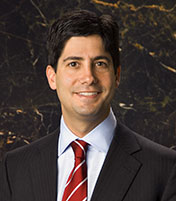
Kevin M. Warsh is a Jewish American economist, financier, and public policy official who served as a member of the Board of Governors of the U.S. Federal Reserve System from 2006 to 2011 and was nominated in 2026 by President Donald Trump to serve as chair of the Federal Reserve.
Warsh was born in Albany, New York. He studied public policy with an emphasis on economics and statistics at Stanford University, graduating with honors in 1992. He went on to Harvard Law School, where he focused on the intersection of law, economics, and regulatory policy and received his Juris Doctor degree in 1995. He also completed coursework in market economics and debt capital markets at Harvard Business School and the Massachusetts Institute of Technology’s Sloan School of Management.
From 1995 to 2002, Warsh worked at Morgan Stanley & Co. in New York in the mergers and acquisitions department, ultimately serving as vice president and executive director. In this role, he advised corporations across multiple industries and helped structure capital markets transactions, including fixed income and equity financing.
In 2002, Warsh entered government service, joining the administration of President George W. Bush as special assistant to the president for economic policy and executive secretary of the National Economic Council. He advised senior officials on capital markets, banking, securities, and financial regulation, and served as a member of the President’s Working Group on Financial Markets.
President Bush nominated Warsh to the Federal Reserve’s Board of Governors in 2006, making him the youngest member of the board at age 35. He served until 2011, a period that encompassed the global financial crisis and the Great Recession. During the crisis, Warsh acted as the Federal Reserve’s chief liaison to Wall Street and played a central role in emergency financial interventions, including helping broker the sale of Bear Stearns to JPMorgan Chase and participating in the federal government’s bailout of American International Group (AIG).
While at the Federal Reserve, Warsh also served as the institution’s representative to the Group of Twenty (G20) and as an emissary to emerging and advanced economies in Asia. He carried out the duties of administrative governor, overseeing the board’s internal operations, personnel, and financial performance. He delivered several notable speeches during this period, including “The End of History?,” “The Federal Funds Rate in Extraordinary Times,” and “Rejecting the Requiem.”
Warsh resigned from the Federal Reserve in 2011. In subsequent years, he became an increasingly vocal critic of post-crisis monetary policy, arguing that the central bank’s expanded role and prolonged bond-buying programs had led to systematic policy errors and undermined institutional credibility.
Following his departure from public office, Warsh became a Shepard Family Distinguished Visiting Fellow in Economics at Stanford University’s Hoover Institution and a lecturer at the Stanford Graduate School of Business. He also joined the Duquesne Family Office, the investment firm of hedge fund manager Stanley Druckenmiller, as an advisor and partner. In addition, Warsh has served on several corporate boards, including United Parcel Service (UPS) and Coupang, a South Korean e-commerce company. He is a member of the Group of Thirty and the Congressional Budget Office’s Panel of Economic Advisers.
Warsh also authored an independent report to the Bank of England proposing reforms to the conduct of monetary policy in the United Kingdom; Parliament later adopted the report’s recommendations.
In the years after leaving the Fed, Warsh gained a reputation as an “inflation hawk,” frequently warning that easy monetary policy would contribute to rising prices. At the same time, he later argued that the Federal Reserve should cut interest rates while sharply reducing its balance sheet. This position drew both support and criticism from economists.
On January 30, 2026, President Donald Trump announced his intention to nominate Warsh as chair of the Federal Reserve, positioning him to succeed Jerome Powell upon Powell’s term expiring. Warsh had been a leading candidate for the position in 2017 but was not selected. Warsh was officially sworn into office on May 22, 2026, at the White House, in the presence of President Trump.
Warsh is married to Jane Lauder, daughter of Ronald Lauder, chairman of the World Jewish Congress and heir to the Estée Lauder cosmetics fortune.
Source: Kevin Warsh, AAE Speakers.
“Kevin M. Warsh,” Federal Reserve History.
“Kevin M. Warsh,” MarketsWiki.
“Kevin M. Warsh,” UPS.
Sydney Ember, Ben Casselman, “What to Know About Kevin Warsh, Trump’s Pick to Lead the Fed,” New York Times, (January 30, 2026).
“Ronald Lauder’s son-in-law Kevin Warsh emerges as the next Fed chair,” Jerusalem Post, (February 1, 2026).
Federal Reserve, Public domain, via Wikimedia Commons.