
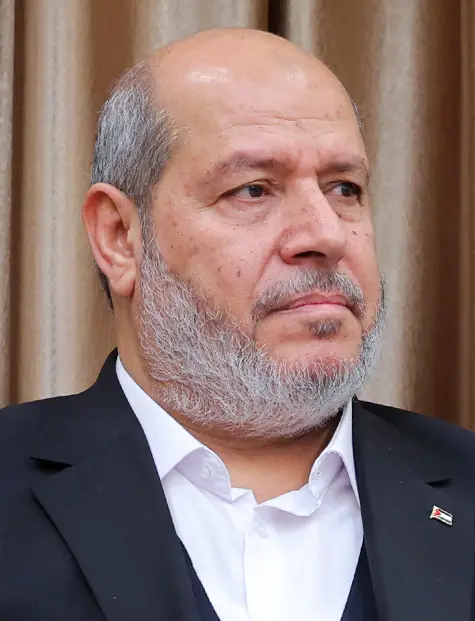
Khalil Ismail al-Hayya (born November 5, 1960) is a Palestinian Islamist politician and senior Hamas official who was elected chairman of the organization’s political bureau in July 2026. Hamas is designated a terrorist organization by the United States and the European Union.
Al-Hayya was born in Gaza City and earned a bachelor’s degree in Islamic studies from the Islamic University of Gaza, a master’s degree in Sunnah and Hadith studies from the University of Jordan, and a doctorate in the same field from the University of the Holy Quran and Islamic Sciences in Sudan. He joined the Muslim Brotherhood in the early 1980s and became a member of Hamas after its founding in 1987. Israel detained him several times, including for approximately three years in the early 1990s.
In 2006, al-Hayya was elected to the Palestinian Legislative Council on Hamas’s Change and Reform list and later led its parliamentary bloc. Israel repeatedly targeted him and his residences. A 2007 strike on his home in Gaza City’s Shejaia neighborhood killed several relatives while he was absent. His son Hamza was killed in a 2008 strike, and his eldest son, Osama, was killed with his wife and three children in 2014. Al-Hayya continued to endorse armed “resistance.” In 2015, he described attack tunnels as Hamas’s “most powerful weapon” and said the al-Qassam Brigades would continue digging them. He became deputy head of Hamas’s Gaza political bureau in 2017. His home was struck again in 2021.
Al-Hayya also emerged as a foreign-relations official and negotiator. He helped mediate the end of the 2014 Gaza war, maintained close relations with Iran, and in 2022 led a Hamas delegation that restored relations with Syrian President Bashar al-Assad. Minutes seized by Israel and reviewed by The New York Times indicated that in July 2023 he discussed Hamas’s planned large-scale attack with Iranian commander Mohammed Said Izadi and sought Iranian and Hezbollah participation. Iran denied advance knowledge or involvement.
After Hamas-led attackers killed approximately 1,200 people and abducted 251 others on October 7, 2023, al-Hayya defended the attack. He said it was necessary to “change the entire equation,” adding, “We succeeded in putting the Palestinian issue back on the table.” He acknowledged that Hamas expected a major Israeli response and said the attack had not sought to improve daily life in Gaza but “to completely overthrow the situation.” He later claimed the operation was initially intended to capture Israeli soldiers for a prisoner exchange, denied that civilians had been deliberately targeted, and said Hamas did not regret it. In April 2024, however, he told the Associated Press that Hamas could accept a prolonged truce and disarm if an independent Palestinian state were established on the pre-1967 lines.
Based in Qatar, al-Hayya led Hamas delegations in indirect ceasefire and hostage-release negotiations mediated by Qatar, Egypt, and the United States. After Israel killed Ismail Haniyeh and Yahya Sinwar in 2024, he joined a five-member interim leadership council. On September 9, 2025, he survived an Israeli strike against Hamas leaders in Doha; his son Himam, his office director, three Hamas bodyguards, and a Qatari security officer were killed. He subsequently helped conclude the October 2025 ceasefire and continued talks over its implementation. Another son, Azzam, was killed in an Israeli strike in Gaza in May 2026.
On July 20, 2026, Hamas appointed al-Hayya as head of its political bureau, making him the first person to hold the position since Yahya Sinwar’s death in October 2024. Al-Hayya has become increasingly influential following the deaths of Sinwar, Ismail Haniyeh and other senior Hamas officials.
Sources: “Khalil al-Hayya (Chairman),” European Council on Foreign Relations.
“What’s the Worst Way to Spend $3 Million? Ask Hamas,” IDF, (July 2, 2015).
Ben Hubbard, Maria Abi-Habib, “Behind Hamas’s Bloody Gambit to Create a ‘Permanent’ State of War,” New York Times, (November 8, 2023).
Abby Sewell, “Hamas Official Says Group Would Lay Down Its Arms if an Independent Palestinian State Is Established,” AP, (April 25, 2024).
Ronen Bergman, Adam Rasgon, Patrick Kingsley, “Secret Documents Show Hamas Tried to Persuade Iran to Join Its Oct. 7 Attack,” New York Times, (October 12, 2024).
Nidal Al-Mughrabi, “Who Is Khalil Al-Hayya, the Top Hamas Figure Targeted by Israel?,” Reuters, (September 9, 2025).
“Hamas’ Gaza Chief: Group Received Guarantees from Mediators, U.S. Confirming War Ended,” Reuters, (October 9, 2025).
Nidal Al-Mughrabi, Dawoud Abu Alkas, “Israeli Attack Kills Son of Hamas Leader Negotiating with Trump-Led Board,” Reuters, (May 7, 2026).
Nidal Al-Mughrabi, Eman Abouhassira, “Hamas Names Khalil Al-Hayya as New Overall Leader,” Reuters, (July 20, 2026).
Photo: Khamenei.ir, CC BY 4.0, via Wikimedia Commons.