
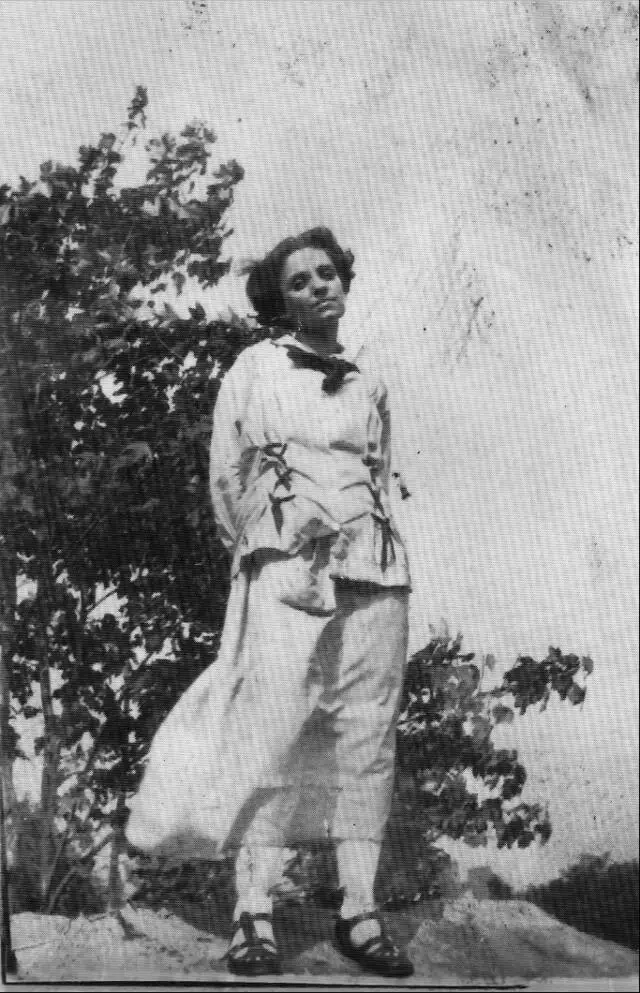
 Matilda Robbins circa 1912
Jewish immigrant, labor organizer, journalist, poet, and advocate of women’s independence.
Early life and immigration
Matilda Rabinowitz Robbins (1887–1963) was a Jewish immigrant from the Russian Empire who became an organizer for the Industrial Workers of the World (IWW), a journalist, a poet, and a single mother. Born in territory that is now Ukraine, she immigrated to the United States in 1900. Her experience working in New York garment shops helped shape her understanding of immigrant women’s precarious lives. She entered a political world in which socialism, anarchism, and labor unionism circulated through immigrant neighborhoods and radical publications. [1, 2]
Rabinowitz belonged to a generation of Jewish immigrants whose political identities developed in dialogue with American industrialization and with the secular, multilingual cultures of Eastern European Jewish radicalism. Although her subsequent commitments were not organized around religious observance, her trajectory forms part of the history of Jewish participation in American labor movements. Her writing offers an unusually personal record of how a woman moved between immigrant employment, public activism, and the demands of family life. [1, 3]
Industrial Workers of the World
By the early 1910s, Rabinowitz was working with the Industrial Workers of the World, often known as the Wobblies. The IWW sought to organize workers across divisions of trade, skill, nationality, race, and gender. Rabinowitz was among the women who undertook visible organizing work in a movement whose best-known leaders were predominantly men. She helped organize textile workers in Little Falls, New York; workers in Bridgeport and Shelton, Connecticut; and workers in other industrial communities. [1, 4]
In 1913, she helped organize workers in Bridgeport, Connecticut, during a strike affecting the brass, electrical, and sewing trades. Her activities demonstrated both the possibilities and the limitations of solidarity among workers divided by occupation, ethnicity, and gender. Even when industrial campaigns ended in defeat, they contributed to the development of her conviction that working people needed to act collectively and retain control over their organizations. [1, 4]
Journalism and political thought
Rabinowitz’s political activity continued through journalism and commentary. Her essay “A Near Industrial Union,” published in The One Big Union Monthly in August 1920, criticized the increasing bureaucratization of industrial unionism. She argued that an organization could keep the language of workers’ solidarity while letting decision-making drift toward professional leadership. For Rabinowitz, ordinary workers’ democratic participation mattered more than institutional prestige. [1, 5]
Her essay “What Does Russia Need?” (1923) addressed the economic and political difficulties confronting postrevolutionary Russia and called for international workers’ solidarity. Her writings reveal an activist attentive to the relationship between labor democracy, the dangers of hierarchy, and the practical consequences of political ideology. They also show that her intellectual life extended beyond the better-documented years of strike organizing. [1, 6]
Poetry and the radical press
Rabinowitz also wrote poems of mourning, protest, and solidarity. “To Fannie Sellins,” published in 1919, commemorated a labor organizer killed during a labor conflict in Pennsylvania. “To All Imprisoned Industrial Workers of the World” expressed identification with imprisoned fellow activists. “The Castaway,” published in The Industrial Pioneer in 1922, depicted the vulnerability and social abandonment of a marginalized woman. “The Buried Gold Diggers,” included in a 1929 anthology of revolutionary poetry, condemned the human cost of the pursuit of wealth. [1, 7–10]
Her verse generally used direct language rather than elaborate formal experimentation. Her experiences of exploitation, poverty, and collective resistance also shaped her journalism. Irina Rabinovich’s recent study argues that readers should read these poems not as minor by-products of activism but as a significant part of Rabinowitz’s political and literary legacy. [1]
Motherhood, relationships, and independence
In 1919, Rabinowitz gave birth to her daughter, Vita, whom she raised as a single mother. Her relationship with Ben Légère, Vita’s father, was troubled and eventually ended. The demands of earning a wage, childcare, domestic work, and continued political engagement made her daily life difficult. She wrote candidly about the strain of arranging childcare and the emotional cost of being separated from her daughter. Yet her decision to raise Vita independently also affirmed her personal autonomy. [1, 2]
Her experiences complicate a familiar division between public political activism and private domestic life. The burdens of care did not simply interrupt her radical commitments; they gave her another vantage point from which to understand economic inequality and women’s dependence. A 1927 piece, “From the Life of a Wage-Earning Mother,” described the conflict between paid employment and raising a child. As her granddaughter’s editorial materials note, Rabinowitz submitted it to The Nation under the byline “Anonymous.” [1, 2]
Her story is therefore relevant to histories of Jewish immigrant family life and American labor activism. It illustrates how women’s independence could entail both freedom from restrictive marital expectations and exposure to severe financial and emotional pressures. [1]
Memoir and historical recovery
Rabinowitz’s memoir was published posthumously in 2017 as Immigrant Girl, Radical Woman, edited and illustrated by her granddaughter Robbin Légère Henderson. The autobiographical narrative ends in 1923, while Henderson’s editorial additions draw on family materials and surviving papers to illuminate the later decades of her life. The volume combines Rabinowitz’s own prose with images and contextual material produced by a subsequent generation. [1, 2]
The published memoir has helped restore attention to a woman whose achievements were not always prominent in conventional histories of the IWW. In “Radical Memory and Maternal Autonomy” (2026), Irina Rabinovich reads the memoir, along with unpublished poetry and radical journalism, as a form of “radical memory”: the preservation and interpretation of experiences often excluded from accounts centered on male leaders, strikes, and institutions. The study also describes Rabinowitz’s writings as a form of autotheory, in which personal experience becomes a means of analyzing power, gender, and work. These are scholarly interpretations rather than labels Rabinowitz herself necessarily used. [1]
Legacy and archival sources
Rabinowitz’s importance lies in the breadth of her activity. She was an immigrant worker who helped organize strikes, a journalist who scrutinized the politics of union leadership, a poet who commemorated working-class struggles, and a mother who recorded the costs of independence. Together, these roles illuminate the often-overlooked contributions of Jewish women to American radicalism. [1, 2]
Her surviving papers, including poems, journalism, and translations, are held in the Matilda Rabinowitz Papers, 1909–1963, at the Walter P. Reuther Library of Labor and Urban Affairs, Wayne State University (accession LR002787, Boxes 1–3). The collection complements her published memoir and studies of immigrant labor and women’s political writing. [1, 11]
About the author: Dr. Irina Rabinovich, Senior Lecturer, English Department, Holon Institute of Technology, Israel. Research interests include Jewish women’s history, American literature, gender studies, and cultural memory.
Sources: 1. Rabinovich, Irina. “Radical Memory and Maternal Autonomy: Re-reading Matilda Rabinowitz Robbins (1887–1963).” Feminist Modernist Studies (published online September 17, 2026). DOI: https://doi.org/10.1080/24692921.2026.2726103
2. Rabinowitz Robbins, Matilda. Immigrant Girl, Radical Woman. Edited and illustrated by Robbin Légère Henderson. Ithaca, NY: Cornell University Press, 2017. Publisher search: https://www.cornellpress.cornell.edu/
3. Michels, Tony. A Fire in Their Hearts: Yiddish Socialists in New York. Cambridge, MA: Harvard University Press, 2005. Publisher: https://www.hup.harvard.edu/
4. Dubofsky, Melvyn. We Shall Be All: A History of the Industrial Workers of the World. Edited by Joseph A. McCartin. Urbana: University of Illinois Press, 2000. Publisher: https://www.press.uillinois.edu/
5. Rabinowitz Robbins, Matilda. “A Near Industrial Union.” The One Big Union Monthly 2, no. 8 (August 1920): 44–45. Bibliographic discussion in [1]: https://doi.org/10.1080/24692921.2026.2726103
6. Rabinowitz Robbins, Matilda. “What Does Russia Need?” Soviet Russia Pictorial 8 (February 1923): 27. Bibliographic discussion in [1]: https://doi.org/10.1080/24692921.2026.2726103
7. Rabinowitz Robbins, Matilda. “To Fannie Sellins.” The Workers’ World (November 28, 1919): 4. Bibliographic discussion in [1]: https://doi.org/10.1080/24692921.2026.2726103
8. Rabinowitz Robbins, Matilda. “To All Imprisoned Industrial Workers of the World.” The One Big Union Monthly (October 1919): 37. Bibliographic discussion in [1]: https://doi.org/10.1080/24692921.2026.2726103
9. Rabinowitz Robbins, Matilda. “The Castaway.” The Industrial Pioneer 1, no. 12 (January 1922): 26. Bibliographic discussion in [1]: https://doi.org/10.1080/24692921.2026.2726103
10. Rabinowitz Robbins, Matilda. “The Buried Gold Diggers.” In An Anthology of Revolutionary Poetry, edited by Marcus Graham. New York: Active Press, 1929. Bibliographic discussion in [1]: https://doi.org/10.1080/24692921.2026.2726103
11. Matilda Rabinowitz Papers, 1909–1963. Walter P. Reuther Library, Wayne State University, accession LP000143, Boxes 1–2. Repository:
Photo: Robbin Henderson, Public domain, via Wikimedia Commons.